


7075 vs. 6061 Aluminum: Engineering the Optimal Joint Housing Design
Yield Strength Difference: The yield strength of 7075-T6 is almost twice that of 6061-T6, allowing for significant reductions in wall thickness for weight-sensitive robotic or aerospace joints.
Corrosion Risk: 7075 is prone to stress corrosion cracking (SCC) in high-load joint environments; 6061 offers superior environmental stability and weldability.
Machinability: While 7075 offers high machinability, its higher raw material cost and sensitivity to tool pressure can increase the total cost of ownership (TCO) by 20% to 40%.
Conclusion: For housings with high torque, limited space, and where mass is the primary limiting factor, use 7075; for static components or high-vibration environments requiring fracture toughness, 6061 is the default choice.
Material Physics and the Weight-to-Strength Delta
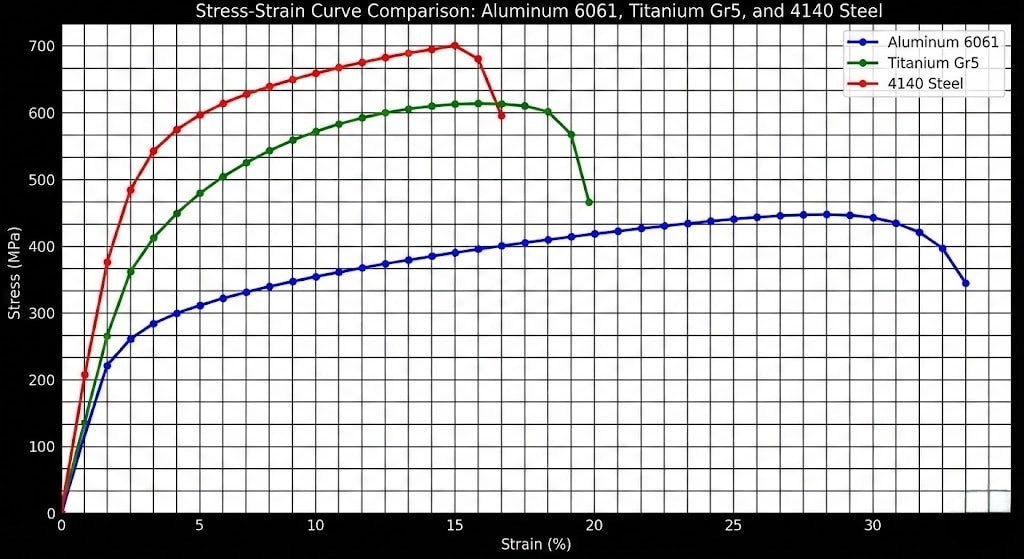
When we talk about shifting from 6061-T6 aluminum to Grade 5 Titanium (Ti-6Al-4V) or high-modulus carbon fiber composites, we aren’t just swapping materials; we are managing a fundamental shift in Specific Strength (Strength-to-Weight ratio). In high-cycle environments, the delta between these materials dictates our fatigue life calculations and resonant frequency management.
For instance, while 6061-T6 is the workhorse of the shop, its fatigue limit is roughly 95 MPa at $10^7$ cycles. Compare that to Ti-6Al-4V, which offers nearly double the tensile strength ($\approx$ 895 MPa) at roughly 60% of the weight of steel. However, the physics of machining these materials introduces a “tax” on our cycle times. The low thermal conductivity of Titanium ($\approx$ 6.7 W/m-K) means the heat doesn’t exit through the chip; it stays at the tool-workpiece interface.
Elastic Modulus Considerations: We must account for the lower Young’s Modulus of Titanium ($E \approx 1138$ GPa) compared to steel ($E \approx 200$ GPa). This leads to increased tool deflection during aggressive milling, necessitating specialized tool geometries to prevent chatter.
Thermal Expansion Alpha ($\alpha$): When overmolding or mating dissimilar materials, the Coefficient of Thermal Expansion (CTE) mismatch can induce parasitic stresses.
Weight Reduction: By optimizing the geometry via FEA (Finite Element Analysis) and leveraging the material’s higher yield strength, we can reduce wall thicknesses to 1.2mm without compromising the structural safety factor.
Structural Integrity and Failure Mode Mitigation

Ensuring structural integrity goes beyond checking the Yield Strength; we have to look at Failure Mode and Effects Analysis (FMEA) through a manufacturing lens. Our primary enemies are stress concentrations (radii) and hydrogen embrittlement in plated parts.
In the design phase, we adhere to ISO 2768-m for general tolerances, but for critical load-bearing interfaces, we tighten the GD&T requirements. Specifically, we focus on Cylindricity and Position tolerances to ensure even load distribution across fasteners. If a bore is out of round by even 0.015mm, the localized hoop stress can lead to premature crack initiation.
Surface Integrity: A “rough” finish isn’t just an aesthetic failure; it’s a structural one. We target a Ra surface finish of 0.8 μm or better on load-bearing shoulders. Anything coarser creates micro-notches that act as stress risers.
Fastener Preload: We define torque specs based on the Nut Factor (K) to ensure we stay within the elastic region of the bolt. For M8 Grade 12.9 fasteners, we typically target 75% of proof load.
Anodic Protection: For aluminum components, Type III Hardcoat Anodizing per MIL-A-8625 is mandatory to prevent galvanic corrosion when in contact with stainless steel hardware.
[Comparison Table] Technical Specifications & Sourcing Metrics
To streamline our sourcing and DFM (Design for Manufacturability) reviews, I’ve compiled the core metrics for our three primary candidates. Note the Buy-to-Fly ratio—this is where our cost overruns usually hide.
We need to be cautious with the Titanium sourcing. While the raw material cost has stabilized, the tooling consumption rate is 4x higher than aluminum. If we aren’t seeing a 30% performance gain in the weight-to-strength delta, I’d suggest sticking with the 7075-T6 alloy as a middle ground before jumping to Ti.
DFM (Design for Manufacturing) and Machining Logistics
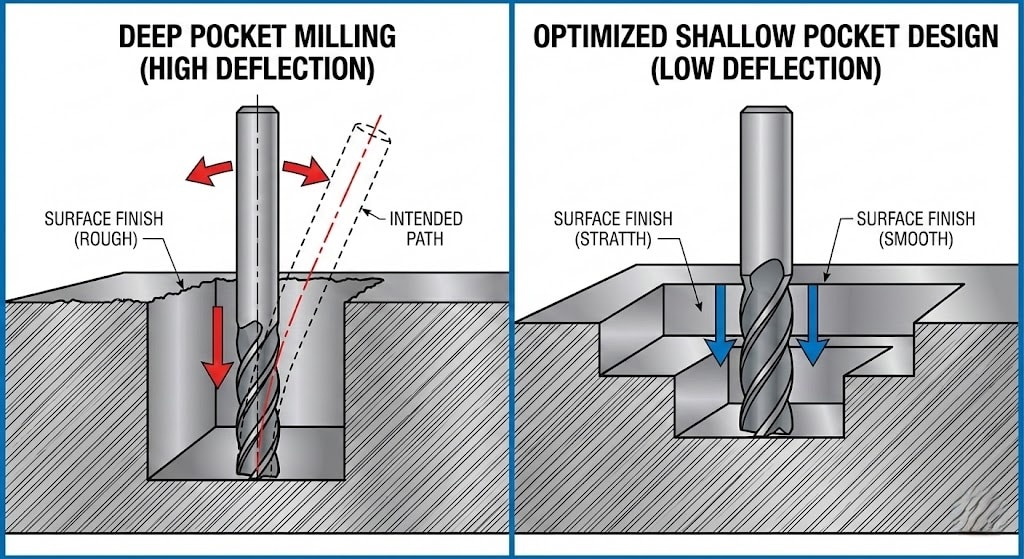
In the transition from CAD to the shop floor, the most common bottleneck I see is a lack of consideration for tool reach and deflection. When we are milling deep pockets or complex geometries, the $L:D$ ratio (length-to-diameter) of the end mill becomes the primary constraint. Once you exceed a 3:1 ratio, deflection increases exponentially, forcing us to throttle feed rates and sacrifice Ra surface finish to maintain GD&T requirements like profile of a surface or parallelism.
To optimize the machining logistics, we should prioritize standardization of corner radii. I frequently see designs with sharp internal corners that require EDM (Electrical Discharge Machining) or specialized small-diameter tooling. By defaulting to a minimum internal radius of 3.2mm (or 1/8″), we can utilize high-feed cutters and significantly reduce cycle times.
Fixture Design: We need to account for “Part Zero” stability. If the geometry is too thin, the part will vibrate or “sing” during machining, leading to chatter marks. I recommend a minimum wall thickness of 1.2mm for aluminum and 1.5mm for stainless alloys to ensure structural rigidity during the roughing passes.
Hole Features: Stick to ISO 286 standard fits for bores. If you’re calling for a press-fit, ensure the tolerance is explicitly defined (e.g., H7/p6) rather than just a ±0.005″ block tolerance.
Chip Evacuation: In deep hole drilling (exceeding 5x diameter), we must specify peck cycles or through-spindle coolant (TSC) to prevent chip packing and subsequent tool breakage.
Economic Impact: TCO and Strategic Sourcing
When we talk about cost, we need to look past the “sticker price” of the raw material and analyze the Total Cost of Ownership (TCO). A cheaper alloy that requires five separate setups on a 3-axis mill is often more expensive than a premium alloy that can be completed in a single “Done-in-One” operation on a 5-axis mill.
For the dakingsrapid projects, we should evaluate the Buy-to-Fly ratio. If we are starting with a 50kg billet to produce a 5kg finished part, our material utilization is only 10%. In the case of Grade 5 Titanium, that’s an enormous amount of high-value scrap. In these scenarios, we should pivot the sourcing strategy toward near-net-shape forgings or investment casting with secondary CNC finishing to minimize waste.
Strategic Sourcing: For recurring production runs, we should leverage ASTM B209 (Aluminum) or ASTM B348 (Titanium) mill certs to ensure chemical consistency. Inconsistent hardness in “bargain” batches leads to unpredictable tool wear and dimensional drift.
Inventory Buffers: Given the current volatility in the nickel and titanium markets, I suggest we lock in pricing for a 6-month blanket order to mitigate the risk of sudden surcharges.
Application-Specific Selection Logic

The logic for material selection must be driven by the operational environment, not just the peak load. We have to consider the “Is” and “Oughts” of the design requirements. If we are designing a mounting bracket for a humanoid robot arm, the Stiffness-to-Weight ratio is the king of metrics. However, if that same part is for a subsea enclosure, Pitting Resistance Equivalent Number (PREN) and galvanic compatibility take precedence.
We utilize a weighted matrix to grade material suitability based on the specific application:
High-Cycle Fatigue: If the part undergoes $10^6$ cycles, we avoid 6061 aluminum in favor of 7075-T6 or a Maraging steel, as aluminum lacks a defined fatigue limit.
Thermal Stability: For sensor housings where thermal drift affects accuracy, we look at Invar or specific ceramics with low CTE (Coefficient of Thermal Expansion).
Conductivity vs. Insulation: We use the #009FB2 primary brand color not just for aesthetics but as a visual indicator for non-conductive hardcoat anodizing on electrical interface plates.
Precision Interfaces: For parts requiring ISO 2768-f (fine) tolerances, we prefer materials with high dimensional stability after machining (e.g., MIC-6 cast plate) to prevent the part from “walking” or warping after it’s released from the fixtures.
Wear Resistance: For sliding contacts, we specify a surface hardness (HRC) rather than just a material type. If we can’t get the base metal hard enough, we look at Nitriding or DLC (Diamond-Like Carbon) coatings.
FAQ:
Does 7075 aluminum require specific inserts or threads in joint housings?
Typically, yes. While 7075-T6 has higher shear strength than 6061, both alloys benefit from stainless steel thread inserts (like Helicoils) in high-cycle joint applications. However, in 7075, you can often achieve equivalent pull-out strength with shorter thread engagement lengths, allowing for shallower tapped holes in compact housing designs.
How much weight can be saved by switching from 6061 to 7075 in a housing?
Expect a 15% to 30% reduction in mass. Because 7075-T6’s yield strength is significantly higher (approx. 503 MPa vs 276 MPa), you can thin out wall sections and ribs without compromising structural integrity. This is the primary driver for 7075’s dominance in weight-sensitive robotics and aerospace joint assemblies.
Is 7075-T6 weldable for complex joint assemblies?
No, 7075 is generally considered non-weldable by conventional methods like TIG or MIG. The high zinc content leads to extreme “hot cracking” and severe reduction in strength at the heat-affected zone (HAZ). If your joint housing requires welded attachments, 6061-T6 is the industry standard, provided you perform post-weld heat treatment.
What is the price-per-pound difference between 6061 and 7075 currently?
7075-T6 typically carries a 2x to 3x price premium over 6061-T6. Beyond the raw material cost, the total cost of ownership (TCO) increases due to slower machining speeds to manage heat and tool wear. For large-scale production, 7075 is only financially viable when the performance gains justify the significant material surcharge.
Which alloy is better for hard-anodized wear surfaces?
6061-T6 is superior for Type III hard-coating. It produces a more uniform, denser oxide layer due to its lower alloying content. While 7075 can be hard-anodized, the high copper and zinc content can result in a more porous coating and less consistent color, which may impact long-term wear resistance in sliding joints.