




Navbar Flip Text Optimized

Strategic Sourcing Guide: Domestic vs. Offshore CNC Manufacturing

Subscription Form
Table of Contents
    Add a header to begin generating the table of contents
    Scroll to Top

    Sourcing decisions between domestic (USA) and offshore (China) CNC manufacturing rely on a calculated trade-off between total landed cost, supply chain velocity, and regulatory compliance. Offshore production in China typically supports high-volume scalability with reduced tooling and labor expenditures, making it the preferred vector for cost-sensitive commercial hardware where extended logistics timelines are permissible. In contrast, US-based facilities offer critical advantages in intellectual property (IP) security, ITAR/DFARS regulatory adherence, and rapid prototyping cycles, justifying higher hourly burden rates through superior responsiveness and risk mitigation. Consequently, procurement strategies often bifurcate based on the product lifecycle: utilizing domestic capacity for iterative, high-liability development and transitioning to offshore partners for stabilized, mass-market production.

    CNC Machining: Process Fundamentals and Capabilities

    CNC Technology Component

    Precision Engineering Through Computer-Controlled Manufacturing
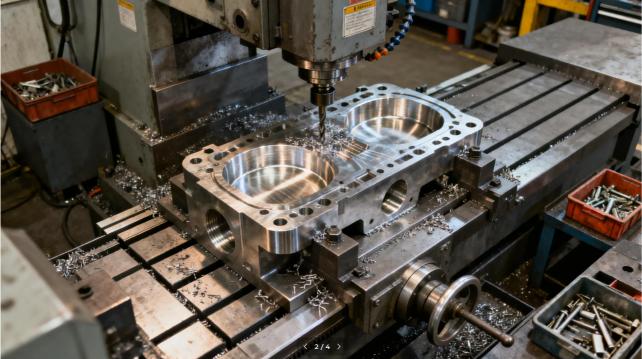
    CNC Machining Process

    Computer Numerical Control (CNC) machining is a subtractive manufacturing process that utilizes pre-programmed software (G-code) to dictate the movement of factory tools and machinery. Originating from CAD (Computer-Aided Design) and CAM (Computer-Aided Manufacturing) data, this technology automates the precise removal of material from a solid block—the workpiece—to create complex geometries with tight tolerances typically unattainable by manual control.

    ⚙️

    CNC Mills

    Employ rotating multi-point cutting tools for prismatic parts with exceptional precision and surface finish quality.

    🔄

    CNC Lathes

    Rotate the workpiece against stationary tools for cylindrical components like shafts and bushings.

    🔧

    Specialized Equipment

    Routers, plasma cutters, and grinders address unique material or surface finish requirements.

    Industry Applications

    ✈️

    Aerospace

    🚗

    Automotive

    ⚕️

    Medical Devices

    🔬

    R&D Prototyping

    China vs USA: Cost Comparison

    Global Quality Assurance in CNC Manufacturing - DakingsRapid
    Global quality assurance in CNC manufacturing is grounded in a hierarchy of international and regional standards designed to validate dimensional conformity and material integrity. Regardless of geography, technical verification relies on identical metrology practices, utilizing advanced measurement technologies to ensure precision across all production volumes and applications.

    China Standards

    Production protocols in China are strictly regulated by the Standardization Administration of China (SAC) through Guobiao (GB) standards, which harmonize with ISO 9001 frameworks to mandate process validation.

    • GB Standards: National quality benchmarks aligned with ISO
    • FAI Protocols: First Article Inspection verification
    • In-Process Monitoring: Continuous quality control systems

    US Standards

    The US manufacturing sector is characterized by specialized, high-liability certifications necessitated by aerospace and defense applications with stringent regulatory compliance requirements.

    • AS9100: Aviation & aerospace quality management
    • ITAR Compliance: Defense article export controls
    • ASTM Standards: Material property verification

    Universal Metrology Practices

    📐

    CMM Technology

    Coordinate Measuring Machines audit Geometric Dimensioning and Tolerancing (GD&T) profiles with micron-level precision

    📊

    Statistical Process Control

    SPC methodologies maintain process capability (Cpk) across production volumes for consistent quality

    🔬

    Material Verification

    Rigorous material testing ensures conformity to specifications and industry-specific requirements

    Global Quality Assurance Standards in CNC Manufacturing

    图片6 1
    Global Quality Assurance Standards in CNC Manufacturing

    Global quality assurance in CNC manufacturing is grounded in a hierarchy of international and regional standards designed to validate dimensional conformity and material integrity. In China, production protocols are strictly regulated by the Standardization Administration of China (SAC) through Guobiao (GB) standards, which harmonize with ISO 9001 frameworks to mandate process validation via First Article Inspections (FAI) and rigorous in-process monitoring. Conversely, the US manufacturing sector is characterized by specialized, high-liability certifications necessitated by aerospace and defense applications; facilities frequently maintain AS9100 accreditation for aviation safety and adhere to ITAR regulations for controlled defense articles, while verifying material properties against ASTM International specifications. Regardless of geography, technical verification relies on identical metrology practices, utilizing Coordinate Measuring Machines (CMM) to audit Geometric Dimensioning and Tolerancing (GD&T) profiles and Statistical Process Control (SPC) to maintain process capability (Cpk) across production volumes.

    Strategic CNC Manufacturing Sourcing

    Strategic CNC Manufacturing Sourcing

    Strategic sourcing for CNC manufacturing is fundamentally a trade-off between unit economics and risk mitigation. Offshore production in China is the optimal channel for high-volume, mature product lines, allowing manufacturers to leverage vast industrial infrastructure and raw material proximity to drive down unit costs through economies of scale.

    CNC Manufacturing Facility

    Offshore Production Benefits

    • High-volume manufacturing capabilities
    • Economies of scale advantages
    • Vast industrial infrastructure access
    • Raw material proximity
    • Reduced unit costs for mature products

    Domestic Sourcing Advantages

    • Time-sensitive project execution
    • High-mix/low-volume flexibility
    • Strict IP sovereignty protection
    • Reduced logistics latency
    • Simplified engineering collaboration

    Key Strategic Consideration

    Conversely, domestic US sourcing is essential for time-sensitive, high-mix/low-volume projects and applications requiring strict Intellectual Property (IP) sovereignty; limiting the supply chain to domestic borders eliminates transoceanic logistics latency, simplifies iterative engineering collaboration, and ensures compliance with rigorous regulatory frameworks typically absent in cross-border data transfers.

    CNC Production Lead Times Analysis

    Understanding Manufacturing Timelines by Region

    CNC Production Lead Times Analysis

    US Domestic

    Rapid Prototypes

    3-5 Days

    As-machined rapid prototypes benchmark for standard parts without secondary processing.

    Complex Workflows

    2-3 Weeks

    Extended timeline for complex workflows requiring secondary processing: heat treatment, anodizing, or NADCAP-certified finishing.

    China Offshore

    Standard Cycle

    2-4 Weeks

    Standard production cycle dictated primarily by logistics, customs clearance, and raw material procurement rather than machine cycle time.

    Key Factors

    Logistics

    Schedule influenced by international shipping, customs processing, and supply chain coordination rather than manufacturing time.

    Supply Chain & Delivery Performance

    Production lead times for CNC manufacturing are structurally bifurcated by sourcing origin. Regardless of manufacturing location, schedule adherence is contingent on supply chain visibility. Unbuffered raw material shortages or sub-tier vendor delays are the primary drivers of On-Time Delivery (OTD) failure, necessitating the use of ERP-integrated forecasting to synchronize stock availability with production slots.

    Supply Chain Visibility

    Real-time tracking and monitoring of material flow throughout the entire production pipeline.

    Raw Material Management

    Buffered inventory strategies to prevent production delays from material shortages.

    ERP Integration

    Synchronized forecasting systems to align stock availability with scheduled production slots.

    Vendor Coordination

    Sub-tier supplier management to minimize delays in the production chain.

    References

    1. Comparative study of international marketing strategy of Japanese and Taiwanese CNC machine tool industry in the ASEAN region
      University of Strathclyde Repository
      While focusing on Japan and Taiwan, this study includes comparisons with the US and China, offering valuable context on CNC machining strategies and industry dynamics.
    2. China’s manufacturing locus in 2025: With a comparison of “Made-in-China 2025” and “Industry 4.0”
      ScienceDirect
      This paper compares China’s manufacturing strategies with those of the US and other industrialized nations, shedding light on advancements and challenges in CNC machining.
    3. CNC Machining Service
      Additional resources and information about CNC machining services.
    Related Posts Component
    Full Width Author Profile
    Ryan

    Written By

    Ryan

    Conscientious sales engineer at DakingsRapid with demonstrated experience working in the machine and parts manufacturing industry. Ability to independently manage sales operations for commodities and proficiency in quality customer service.

    评论表现