



CNC Machining or Die Casting? A 500-Unit Strategic Analysis for Robotics
The “No Man’s Land” Dilemma: 500 units represents a critical volume threshold where CNC per-unit costs plateau, yet die casting amortization remains a significant CAPEX risk.
Material Integrity vs. Surface Finish: Aluminum die casting offers high-volume efficiency but may require secondary CNC operations for critical tolerances and surface finish requirements in humanoid or industrial joints.
DFM Flexibility: CNC allows for mid-production design iterations—a crucial factor if your robot’s BOM is still evolving—whereas die casting locks you into a $50k+ “frozen” design.
Risk Mitigation: The decision hinges on the complexity of the assembly and whether the components are structural (load-bearing) or cosmetic (housing).
The Economic Inflection Point: Amortizing Tooling at 500 Units
Let’s cut through the sales noise and look at the unit economics. The “500-unit valley” is notoriously difficult to navigate. You are effectively in a grey zone where the Non-Recurring Engineering (NRE) costs for injection molding—even with rapid aluminum tooling—often fail to amortize favorably against the per-part cost of CNC machining.
When we quote a run of 500 housings or linkages, we aren’t just looking at the cycle time; we are looking at the total landed cost. For injection molding, an aluminum mold (P20 or similar) might run you $6,000 to $12,000 upfront. Spread over 500 units, that’s a $12 to $24 “tax” per part before you even shoot the first gram of resin. Conversely, the NRE for CNC is primarily programming (CAM) and fixture design. If I can hold the part with standard vices or soft jaws—costing maybe $400 in setup time—the amortization is negligible (under $1/part).

At this volume, CNC also offers a liquidity advantage. You aren’t locking capital into a fixed asset (the mold) that can’t handle revision controls. In robotics and hardware startups, revision B is inevitable. Modifying a hardened steel mold for an Engineering Change Order (ECO) is a nightmare of EDM work and welding. Modifying a CNC program is a matter of updating the G-code and maybe cutting a new set of soft jaws.
However, the tipping point is heavily geometry-dependent. If your part requires 5-axis simultaneous machining with 90% material removal rates (MRR), the machine time bill will eat you alive. But for standard 3-axis prismatic parts, sticking with CNC up to 500–700 units often yields a better ROI and keeps your cash flow fluid for iteration.
Material Properties and Structural Integrity in Robotics
In robotics applications—specifically end-effectors and drive trains—anisotropy is the enemy. This is where the argument for CNC machining over additive manufacturing (even high-end SLS or DMLS) becomes about physics, not just finish.
When we machine a component from billet 6061-T6 or 7075-T6 aluminum, we are banking on isotropic structural integrity. The grain structure of the rolled billet provides consistent yield strength and tensile modulus across the X, Y, and Z axes. Compare this to FDM or even SLS printing, where the Z-axis (layer adhesion) is a perpetual weak point. For a robotic arm subjected to high torque and cyclic loading, a printed part’s fatigue limit is a gamble I’m not willing to take.
We also need to talk about stiffness-to-weight ratios. In dynamic applications, deflection is a killer. A robotic joint housing needs to hold bearing bores to ISO 286 H7 tolerances while resisting the radial loads of the gear train.
Aluminum 7075-T6: With a yield strength around 503 MPa, it rivals many low-alloy steels but at a third of the weight. It’s the standard for high-stress linkages.
Stainless Steel 303/304: While excellent for corrosion resistance, we generally avoid it for moving mass unless inertia isn’t a constraint.
Titanium Gr5 (Ti-6Al-4V): The holy grail for strength-to-weight, but the machining costs (due to heat generation and tool wear) restrict this to critical failure points only.
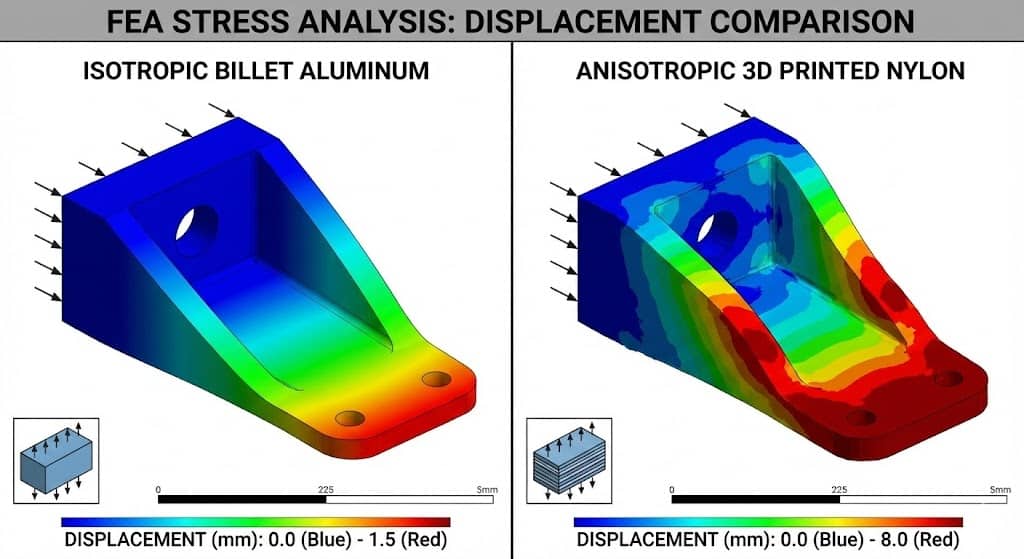
Furthermore, thermal conductivity plays a massive role in actuator lifespan. A CNC-machined aluminum housing acts as a passive heatsink for servo motors. Polymers (like PEEK or Nylon) act as insulators, potentially trapping heat and degrading motor performance over long duty cycles. When you are speccing materials for a 500-unit build, you need material certs (DFARS compliant if applicable) that guarantee the chemical composition matches the ASTM B209 standards. You simply don’t get that level of assurance with vacuum casting resins.
[Comparison Table] Technical & Financial Performance Matrix
When deciding between processes for that 100–1,000 unit bridge production, we need to balance the “Iron Triangle”: Cost, Quality (Tolerance/Finish), and Speed. The following matrix assumes a standard “breadbox” sized enclosure (approx. 150mm x 100mm x 50mm) with moderate complexity.
| Metric | CNC Machining (High Speed) | 3D Printing (SLS Nylon) | Urethane Casting (RTV) | Rapid Injection Molding |
| Typical Tolerance | +/- 0.05mm (ISO 2768-m) | +/- 0.30mm | +/- 0.20mm | +/- 0.10mm |
| Material Isotropy | Excellent (100%) | Poor (Z-axis weakness) | Moderate | Excellent |
| Surface Finish (Ra) | 0.8 – 1.6 µm (As Machined) | 6.3 – 10 µm (Rough) | Varies (Copies Master) | SPI-B1 to SPI-A2 |
| NRE (Setup Cost) | Low ($200 – $800 CAM/Fixtures) | Zero | Low ($500 – $1,500 Pattern) | High ($5k – $15k Tooling) |
| Unit Cost (50 Units) | High | Moderate | High | Very High (Amortization) |
| Unit Cost (500 Units) | Moderate (Optimized Toolpaths) | High (Linear Scaling) | Moderate | Low (Break-even point) |
| Lead Time | 10 – 15 Days | 2 – 5 Days | 15 – 20 Days | 25 – 45 Days (T1 Samples) |
| Scalability | Linear (Machine constrained) | Linear (Printer constrained) | Poor (Mold degradation) | Exponential |

Engineer’s Note on the Data: The standout metric here is the NRE. For a 500-unit run, if your design is still “fluid” (i.e., Marketing might change the IO port locations next week), CNC is the only safe harbor. You can modify the CAM program instantly. With injection molding, even a “steel-safe” mold modification requires pulling the tool, welding, and EDM work, costing you weeks of lead time.
Also, pay attention to the Surface Finish (Ra). If this is a visible component, 3D printed parts will require labor-intensive sanding and painting to look consumer-ready, which drives the real unit cost up significantly. CNC parts can come off the machine with a bead-blasted and anodized finish that is retail-ready immediately.
FAQ
At what exact volume does die casting become cheaper than CNC for aluminum parts?
Typically between 300 and 800 units. The “crossover point” depends on the complexity of the geometry. If the part requires significant secondary CNC finishing after casting to meet robotic tolerances, the break-even point often pushes beyond 1,000 units due to the combined cost of tooling amortization and double-handling.
Can I use a hybrid approach for a 500-unit robot run?
Yes. Many engineers employ “Bridge Machining,” utilizing CNC for the first 100 units to allow for real-world field testing and design tweaks. Simultaneously, you kick off die cast tooling. This mitigates the risk of “locking in” a flawed design while ensuring you hit TTM (Time-to-Market) targets.
How does the strength of cast aluminum compare to machined billet?
Billet 6061-T6 offers superior structural integrity. Cast alloys like A380 have lower tensile strength and inherent porosity, which can lead to fatigue failure in high-torque robotic joints. For load-bearing chassis or actuator housings, the grain structure of machined wrought aluminum is significantly more reliable.
What are the typical lead times for production-grade die casting molds?
Standard lead times range from 10 to 14 weeks for hardened steel molds. In contrast, a 500-unit CNC run can often be completed in 3 to 5 weeks. If your robotics project is under a tight VC or stakeholder deadline, the lead time for casting usually represents a critical path risk.
Does die casting require a design overhaul from a CNC prototype?
Almost always. CNC designs often feature deep pockets, sharp internal corners, and zero draft, which are impossible to cast. You must redesign for draft angles (typically 1°–3°), uniform wall thickness to prevent sink marks, and gate locations, often requiring a complete DFM revision of the assembly.
Are there alternatives for the 500-unit gap besides die casting?
Yes, semi-permanent mold casting or investment casting can bridge the gap. However, for precision robotics, “High-Speed CNC” is the primary alternative. Modern 5-axis horizontal machining centers with pallet changers have significantly lowered the labor-cost-per-part, making CNC competitive even up to 1,000 units.