




Carbon Fiber vs Aluminum: A Strategic Engineering Comparison for US Manufacturing
Key Takeaways
Specific Stiffness: Carbon fiber (CFRP) offers up to 5x the strength-to-weight ratio of 6061-T6 aluminum, yet remains anisotropic, requiring precise fiber orientation to avoid mid-plane delamination.
Cost Delta: Raw material for CFRP ranges from $25–$120/lb compared to $1.50–$5.00/lb for aluminum; however, CNC machining time for aluminum often offsets the specialized tooling costs of composite layups at low volumes.
Thermal Stability: CFRP exhibits a near-zero Coefficient of Thermal Expansion (CTE), whereas aluminum expands at $\approx 23 \times 10^{-6} / \text{°C}$, making CFRP the default for high-precision optical or sensor mounting.
Comparative Specific Stiffness and Yield Strength
Carbon fiber outperforms aluminum in specific stiffness by a factor of 5:1, provided the loading vector aligns with the primary fiber axis. Aluminum is isotropic. You get 69 GPa of modulus whether you pull it longitudinally or transverse to the grain. It’s predictable. It’s safe for multi-axial loading where FEA might miss a localized stress riser.
Carbon fiber is a different beast entirely. It is anisotropic. If your layup is 0°/90°/45°/45°, you achieve high quasi-isotropic performance, but you sacrifice the peak stiffness found in unidirectional (UD) tapes.
7075-T6 Yield Strength: ~503 MPa.
Standard Modulus CFRP Tensile Strength: ~3500 MPa (Fiber level).
Density Gap: Aluminum sits at 2.7 g/cm³; CFRP averages 1.55 g/cm³.
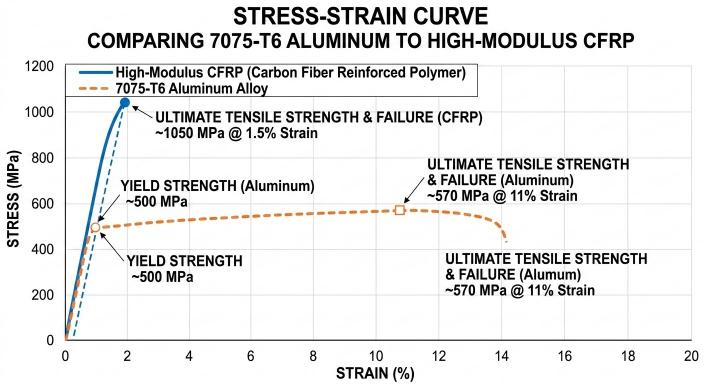
When designing for deflection-limited assemblies, CFRP allows for thinner wall sections. However, the moment you introduce a bearing mount or a threaded insert, the “stiffness” conversation shifts to bearing strength and pull-out resistance. Aluminum wins on bearing stress every time. It doesn’t delaminate under the compressive load of a bolt head.
Total Cost of Ownership: Carbon Fiber vs Aluminum Per Pound
Raw material is a trap.
Buying 6061-T6 plate at $4.00/lb is a standard procurement task. Buying aerospace-grade prepreg at $65/lb is a capital expenditure. But the real TCO (Total Cost of Ownership) is buried in the “Buy-to-Fly” ratio and the secondary operations.
If you are hogging out a 100lb block of aluminum to get a 5lb part, your scrap rate is 95%. You are paying to recycle chips. With CFRP, you have high “Near-Net-Shape” potential, but your “scrap” is cured resin and trimmings that have zero recovery value.
| Metric | 6061-T6 Aluminum | 7075-T6 Aluminum | Standard CFRP | High Modulus CFRP |
|---|---|---|---|---|
| Raw Cost/lb | $1.20 - $2.50 | $3.50 - $6.00 | $30 - $55 | $100 - $250+ |
| Machinability | Excellent (Ra 32) | Good | Poor (Abrasive) | Extreme Wear |
| Tooling Cost | Low (Standard Carbide) | Medium | High (PCD/Diamond) | Ultra-High |
| Lead Time | 2-4 Weeks | 4-8 Weeks | 8-16 Weeks | 20+ Weeks |
| Waste Value | High (Scrap Credit) | High (Scrap Credit) | Zero (Landfill) | Zero (Landfill) |
Don’t forget the Autoclave. A 3-axis VMC running at 15,000 RPM can churn out aluminum housings 24/7. CFRP requires cleanroom kitting, bagging, and an 8-hour cure cycle. Your bottleneck isn’t the machine; it’s the oven.
Fatigue Resistance and Long-Term Structural Integrity
Carbon fiber exhibits no traditional fatigue limit and can withstand infinite cycles at 60% of ultimate tensile strength, whereas aluminum initiates cracks at any stress level over time.
Aluminum has a memory. Every vibration, every thermal expansion cycle, and every gust of wind counts against its finite life. In aerospace applications, we track “landings” because 7075-T6 will eventually fail via crack propagation. You need NDT (Non-Destructive Testing)—Eddy Current or Liquid Penetrant—to find those cracks before they hit critical length.
CFRP is different. It fails from the inside out.
Matrix Cracking: Micro-fractures in the resin that don’t immediately compromise the fibers.
Delamination: The silent killer. Layers separate due to impact or poor interlaminar shear strength.
Impact Sensitivity: Drop a wrench on an aluminum wing, and you get a dent. Drop it on a CFRP wing, and you might have internal delamination that is invisible to the naked eye.
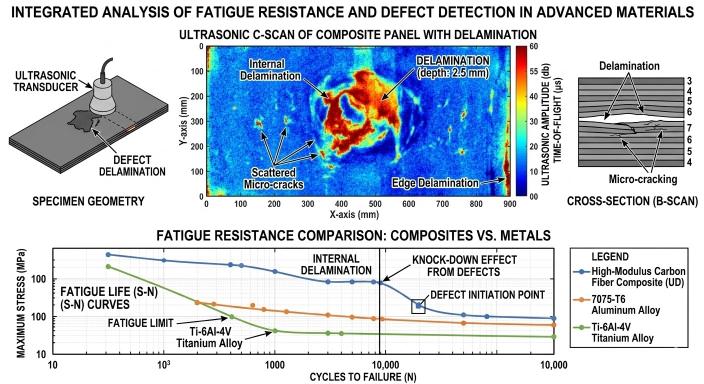
In a high-vibration environment, like a robotic end-effector cycling 60 times per minute, CFRP is the superior choice for longevity. It won’t work-harden. It won’t snap after 10 million cycles. Just ensure your fastener interfaces are isolated to prevent the carbon from eating your aluminum mounting brackets via galvanic corrosion.
Thermal Expansion and Heat Dissipation Challenges
Carbon fiber provides near-zero dimensional change under thermal load, while aluminum expands at a rate of 23 micrometers per meter for every degree Celsius of temperature rise. This makes CFRP the only viable substrate for high-precision optical benches or satellite sensor housings where a ±0.0001″ tolerance must be maintained across a 100°C delta.
Aluminum is a heat sink. It features a thermal conductivity of roughly 167 W/m·K for 6061-T6. It sheds BTUs rapidly. Carbon fiber acts as an insulator, with transverse conductivity often dipping below 1.0 W/m·K.
CTE (Coefficient of Thermal Expansion): Aluminum 6061 is 23.6 µm/m°C; CFRP (Pitch-based) can be -0.1 µm/m°C.
Thermal Shock: Aluminum handles rapid cycling without delamination.
Operating Limit: Standard epoxy-matrix CFRP loses structural integrity above 150°C as the resin hits its glass transition temperature ($T_g$).
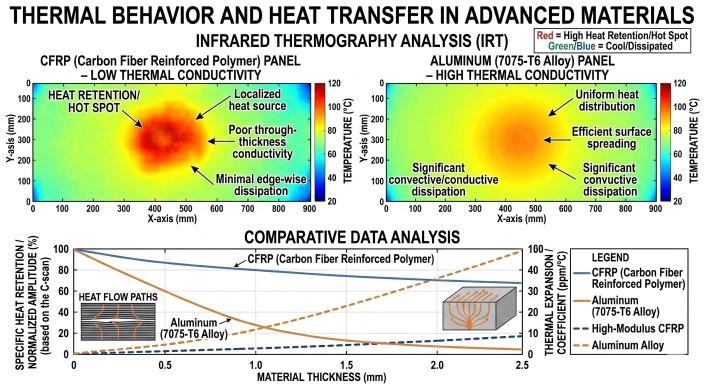
Heat kills composites. If your assembly houses high-wattage electronics or sits near an exhaust manifold, your CFRP will soften and creep. You must design in copper thermal paths or stick with 7075-T6 to avoid catastrophic loss of Young’s Modulus at elevated temperatures.
Manufacturing Throughput: Lead Times and Scalability
Speed is a variable.
Machining an aluminum prototype is a 48-hour turn if you have an open 3-axis mill and a piece of plate. You hit the “Cycle Start” button and walk away. Scaling to 10,000 units involves a horizontal machining center and a tombstone fixture. It is predictable.
CFRP scaling is a nightmare of “touch time.”
Kitting: Cutting prepreg plies on a CNC plotter.
Layup: Manual or robotic placement of plies into a mold.
Debulking: Removing air pockets every 3–5 layers to prevent voids.
Curing: 4 to 12 hours in an autoclave at 100 psi.
If you need 5,000 brackets by next Tuesday, aluminum is usually the practical choice. At DakingsRapid, we can quickly scale CNC machining capacity to meet tight production schedules and deliver consistent parts on time.
Composite production, on the other hand, is often constrained by tooling availability. Typically, only one part can be produced from a mold during each cycle. Increasing output generally requires duplicating molds—often made from costly INVAR or aluminum—significantly raising the tooling investment.
Risk Mitigation in Aerospace and Defense Applications
Supply chains break.
Aluminum sourcing is a commodity game. You can find DFARS-compliant 7075-T6 from multiple domestic mills. The risk is low. If a supplier fails, you pivot to a local service center.
CFRP risk is concentrated in the resin chemistry and fiber precursor. Most high-modulus PAN (polyacrylonitrile) fiber originates from a handful of global manufacturers. If a specific “prepreg” spec goes on backorder, your AS9100 certification might prevent you from swapping to an equivalent material without a full re-qualification battery.
[Author’s Field Note]: We managed a project for a UAV wing spar where the specified Toray fiber went on a 26-week lead time due to a defense surge. We were forced to redesign for 7075-T6 aluminum mid-stream to meet the delivery window. The weight penalty was 12%, but the project survived. Always have a “Plan B” metallic design for critical-path composite components.
Non-Destructive Inspection (NDI): Aluminum requires X-ray or Dye Pen. CFRP requires Ultrasonic C-Scan.
Quality Cpk: Aluminum machining easily holds Cpk > 1.33. Composite thickness varies by ±10% based on vacuum bag pressure.
Foreign Object Debris (FOD): Carbon dust is conductive. It shorts out PCBs. You need dedicated HEPA filtration for CFRP trimming areas to protect your shop’s electronics.
Final Engineering & Sourcing Verdict
Weight vs. Complexity: Use CFRP only when the weight-to-stiffness requirement exceeds the 503 MPa yield strength of 7075-T6; otherwise, the 4x-10x cost multiplier of composites rarely justifies the engineering overhead.
Thermal Management: Default to aluminum for active heat dissipation (167 W/m·K) or high-vibration environments where field-detectable crack propagation is a safety requirement.
Procurement Lead Times: Budget 12–20 weeks for aerospace-grade CFRP due to autoclave scheduling and ply-book validation, compared to 2–4 weeks for standard CNC-machined 6061-T6 plate.
FAQ
At what production volume does aluminum become more cost-effective than carbon fiber?
Typically under 5,000 units. Aluminum’s high-speed CNC cycle times and low raw material costs ($5/lb) beat CFRP’s manual layup and 8-hour autoclave cycles. Unless the assembly requires extreme weight reduction, aluminum remains the default for most US industrial scales.
How does the CTE of aerospace-grade aluminum affect sensor calibration compared to CFRP?
Aluminum expands at 23.6 µm/m°C, causing micron-level boresight shift in optical assemblies. CFRP offers near-zero or negative CTE. For sensors requiring ±0.0001” stability across a 50°C delta, CFRP is the only substrate that prevents recalibration drift.
What are the specific tooling costs for machining CFRP vs. 7075 aluminum?
CFRP tooling is 3x-5x more expensive. You must use PCD (Polycrystalline Diamond) or CVD-coated bits to resist the abrasive carbon fibers. Aluminum 7075-T6 runs efficiently with standard uncoated or ZrN-coated carbide at 12,000+ RPM with minimal tool wear.
Can carbon fiber components be repaired in the field as reliably as aluminum weldments?
No. CFRP repairs require controlled cleanrooms, vacuum bagging, and specific cure cycles to restore structural B-basis design values. Aluminum can be TIG welded or patched with mechanical fasteners (rivets) by any certified technician, making it superior for field-deployed military hardware.
Which material performs better under high-impact loading: 6061-T6 or quasi-isotropic CFRP?
6061-T6 Aluminum. It is ductile and absorbs energy through plastic deformation (denting). CFRP is brittle; high-velocity impacts cause internal delamination or catastrophic shattering. If your component faces “tool drop” or debris impact risks, stick with metallic alloys.
What is the environmental degradation rate of epoxy resins in CFRP versus oxidized aluminum?
CFRP resins degrade under UV exposure and moisture (hygroscopic swelling), potentially losing 10-15% of interlaminar shear strength over 10 years. Aluminum 6061-T6 forms a protective Al2O3 oxide layer that halts deep corrosion, provided you avoid galvanic contact with the carbon itself.
Related popular articles

Written By
Ryan
Conscientious sales engineer at DakingsRapid with demonstrated experience working in the machine and parts manufacturing industry. Ability to independently manage sales operations for commodities and proficiency in quality customer service.