




Key Takeaways
Adaptive control algorithms reduce cycle times by 12-18% by modifying feed rates in real-time based on spindle load feedback.
Digital twin simulation predicts thermal expansion in 5-axis milling, maintaining +/- 0.0005 inch tolerances without manual operator offsets.
Predictive maintenance logic extends end mill life by up to 22% in hardened steel (HRC 50+) by detecting micro-vibrations before catastrophic tool failure.
The Shift from Reactive to AI-Native Manufacturing
Traditional G-code is blind.
Once you hit cycle start, the machine executes lines of code regardless of what is actually happening at the cutting edge. If a billet of 6061-T651 aluminum has a slightly harder localized grain structure, the spindle does not care. It pushes the tool through at the programmed feed rate.
This is where most cost models fall apart.
US job shop rates hover between $120–$180/hr. Every minute spent overriding feeds manually to save an end mill, or scrapping a part due to unpredicted thermal expansion, destroys margins. AI-native manufacturing fundamentally changes this dynamic by closing the data loop. Instead of executing static code, the CNC controller constantly monitors spindle load, acoustic emissions, and vibration data.
If chatter begins during a deep pocketing routine, the edge computing system adjusts the RPM and feed in milliseconds.

Getting to this level of predictability starts long before the machine warms up. Engineering teams often lose weeks going back and forth on manufacturability. By routing DFM data through AI-assisted quoting platforms, frontend delays vanish. When US engineers submit models to DakingsRapid, the Shenzhen time zone advantage allows for an overnight RFQ turnaround. By the time the US team logs in the next morning, they have a fully parsed manufacturability report highlighting exact corner radii limits and tool reach issues.
How Does Adaptive Control Reduce Tool Wear in CNC Machining?
Adaptive control reduces tool wear by continuously monitoring spindle load and automatically decreasing feed rates during heavy material engagement to prevent catastrophic cutter deflection.
Here is the reality on the floor.
You program a dynamic milling toolpath for a titanium aerospace bracket. The CAM software assumes a perfectly uniform block of material. The physical block of ASTM B209 aluminum or grade 5 titanium is never perfect. Tool wear is not linear. It spikes the moment the cutter hits a work-hardened zone or experiences chip packing in a tight corner.
Adaptive control intercepts this failure mechanism.
Monitors spindle torque and axis servo loads at 1000 Hz or higher.
Detects micro-fluctuations in cutting force before acoustic chatter becomes audible to the operator.
Instantly overrides the programmed G-code to maintain a constant chip load.
Keeping the chip load perfectly stable prevents the micro-chipping of carbide flutes. This prevents thermal degradation when holding tight geometric tolerances across a long production run. When you need to maintain a 0.02 mm true position on a hole pattern per ASME Y14.5-2018 GD&T standards, you cannot afford tool deflection.
Once the batch is complete, the data loop must be closed. At DakingsRapid, CMM measurement systems pull the final inspection reports directly into the production database. If a specific toolpath consistently yields dimensions near the upper control limit, the system correlates that with the adaptive control logs, adjusting offsets to ensure the process capability remains at a Cpk > 1.33.

Digital Twin Simulation for First-Pass Yield
Simulating toolpaths in CAM only checks for geometric collisions.
A true digital twin simulates the physics of the cut. It models cutting forces, material removal rates, and thermal deformation of the workpiece before a single chip is thrown.
This is why your first article inspection failed.
That deep pocket with a tight corner radius looked perfectly fine on the screen. During actual machining, the sustained engagement angle caused the end mill to pull into the material, gouging the wall and ruining a surface finish that required a strict Ra 0.8. Digital twin software identifies these high-force spikes in the virtual environment.
We use this data to aggressively refine the machining strategy. When a US client sends a complex 5-axis manifold, the DFM feedback from DakingsRapid often leverages digital twin analysis to suggest minor geometry tweaks—like standardizing internal radii. This directly reduces unnecessary tool changes and standardizes the roughing parameters, stripping hours out of the machining cycle.
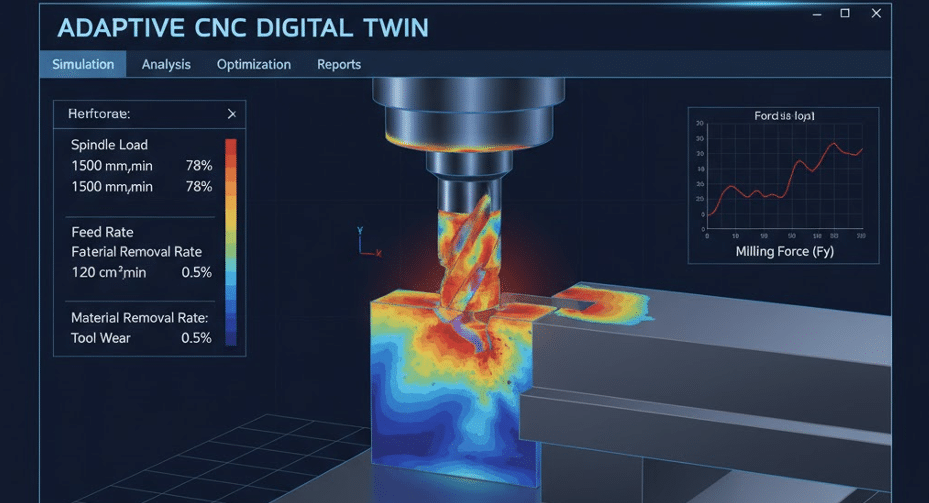
Machining Variables Influenced by Digital Twin Analysis
| Variable | Traditional CAM Verification | Digital Twin Simulation |
|---|---|---|
| Collision Detection | Kinematic only (holder hits jaw) | Kinematic + dynamic tool deflection |
| Thermal Expansion | Ignored | Modeled based on verified material MTRs |
| Feed Rate Control | Static (set by programmer) | Dynamically adjusted for constant volume |
| Tolerance Prediction | Assumes perfect machine state | Predicts deviations at $\pm 0.005\text{mm}$ |
AI Predictive Maintenance vs. Scheduled CNC Maintenance
Preventative maintenance schedules are mostly guesswork.
Spindle bearings do not fail cleanly on a 500-hour schedule. They fail because a specific batch of 6061-T651 aluminum had material inclusions that spiked radial loads during a heavy roughing pass. When you rely on a static calendar to replace machine components, you are either throwing away perfectly good parts or waiting for a catastrophic failure mid-cycle.
At typical US job shop rates of $120–$180/hr, unexpected spindle downtime destroys project margins instantly.
AI predictive maintenance eliminates this calendar-based guessing game. High-frequency acoustic emission sensors continuously monitor the harmonic frequencies of the spindle and ball screws. When a bearing race develops a microscopic pit, the vibration signature changes. The edge computing system detects this anomaly weeks before the vibration becomes audible to a human operator or registers as chatter on a finished part.

AI Predictive Maintenance vs. 500-Hour Scheduled Maintenance
| Maintenance Strategy | Sensor Feedback Type | Spindle Bearing MTBF | Tolerance Hold Capability |
|---|---|---|---|
| AI Predictive | Acoustic emission & thermal | > 8,500 hours | ±0.005mm active compensation |
| 500-Hour Scheduled | Visual & manual indicator | ~ 6,000 hours | ±0.025mm mechanical wear |
What is the Tolerance Limit for AI-Compensated Machining?
AI-compensated machining can hold tolerances down to ±0.005mm by using real-time thermal sensors on the machine casting to dynamically offset axis drift during operation.
That tolerance looks harmless on the drawing.
Then you try to hit it on a Friday afternoon when the shop floor is 15 degrees hotter than in the morning. Thermal expansion is the enemy of volumetric accuracy. A 40-inch cast-iron X-axis can grow by several thousandths of an inch over an eight-hour shift. In a traditional open-loop setup, the operator must constantly pause the machine, measure the part, and adjust work offsets manually.
AI thermal compensation calculates this growth dynamically.
Reads data from thermocouples placed on the spindle nose, ball nut, and main casting.
Correlates temperature spikes with specific G-code feed rates and material removal parameters.
Injects micro-offsets directly into the axis servo drives every few milliseconds.
When you specify a strict 0.02 mm true position on a dowel pin hole pattern, this compensation is mandatory. The controller actively fights thermal drift, ensuring the tool center point remains exactly where the CAM software intended.
Integrating CMM Data into Machine Learning Loops
Inspection data usually dies in a filing cabinet.
You run a batch, probe the parts, print a report, and file it away to satisfy compliance. This is a massive waste of manufacturing intelligence. In an AI-native environment, inspection data is the primary feedback mechanism that trains the machine tool how to behave on the next run.
Optical comparators are dead for complex 3D profiles.
To hold strict ASME Y14.5-2018 GD&T standards on 5-axis aerospace components, you need tactile and laser-scanned data. When DakingsRapid processes high-volume production batches, CMM measurement systems inspect the parts and push that dimensional data directly back into the central manufacturing execution system (MES).
The machine learning algorithm looks for trends. If hole diameters are slowly shrinking by 0.001mm per part, the system knows the carbide drill is wearing. It automatically updates the tool wear offset in the CNC controller before the next billet is loaded.
This closed-loop system is the only reliable way to maintain a Cpk > 1.33 across thousands of cycles.

[Author's Field Note]Supply Chain Agility Through Smart Factory Data
Waiting six weeks for a first article inspection report kills project momentum.
Most supply chain delays happen before a single chip is cut. Engineering teams send an RFQ, wait days for a response, and then spend another week arguing over corner radii or non-standard thread pitches. Data-driven manufacturing accelerates this entire front-end process.
We require verified material traceability (MTRs) to ASTM specifications, like ASTM B209 for aluminum plate, not just for compliance, but because the AI simulation models need exact yield strengths to predict cutting forces. Once that data is locked, the actual machining parameters are generated almost instantly.
By pairing this digital integration with the Shenzhen time zone advantage, DakingsRapid routinely reviews US engineering models overnight. US teams wake up to an actionable DFM report that flags deep pockets requiring a surface finish of Ra 0.8, providing specific design tweaks that reduce tool changes and drop cycle times. Getting the physics right in the virtual environment means physical parts ship faster, with no surprises in the quality lab.
Final Engineering & Sourcing Verdict
Specifying sub-Ra 0.8 surface finishes artificially inflates $120–$180/hr US shop rates by forcing multiple spring passes and specialized wiper inserts; reserve these callouts strictly for mating sealing surfaces to control procurement costs.
Mandating ASTM-verified MTRs is non-negotiable for AI-native production, as generic material yield strengths will corrupt the physics-based digital twin simulations and cause unexpected tool deflection.
Integrating CMM inspection data directly into the CNC controller loop eliminates manual offset errors, ensuring a Cpk > 1.33 and preventing the cascading delays typical of failed first-article inspections.
FAQ
How does real-time thermal compensation manage volumetric accuracy in large-envelope titanium milling?
By injecting micro-offsets directly into the axis servo drives. Thermocouples on the machine casting track temperature spikes and calculate structural growth. The controller instantly shifts the tool center point to maintain ±0.005mm positional accuracy without manual operator intervention.
What are the specific machine-hour cost variables when specifying surface finishes below Ra 0.8?
Up to a 300% increase in active spindle time. Tight finishes require significantly lower step-overs, specialized wiper inserts, and multiple zero-load spring passes. This drastically inflates standard $120–$180/hr shop rates for purely aesthetic requirements.
Why are MTRs to ASTM standards strictly required to calibrate AI-assisted machining parameters?
To prevent catastrophic tool deflection. Predictive models calculate cutting forces based on exact yield strengths and hardness values. Generic material assumptions corrupt the physics simulation, while verified traceability provides the precise mechanical data needed for safe adaptive control.
How do automated CMM probing routines integrated with CAD models compare to manual inspection for complex contoured profiles?
They eliminate subjective operator error. Manual optical comparators cannot reliably verify 3D surfaces. Tactile and laser probes import the native step file, measuring hundreds of points to evaluate profile deviations against strict ASME Y14.5-2018 GD&T standards with extreme repeatability.
How does dynamic factory floor scheduling mitigate bottlenecks in high-mix, low-volume production?
By automatically re-routing active jobs. The system monitors real-time spindle uptime and predictive tool life data. If a machine goes down for maintenance, the software immediately shifts the G-code to an available cell, preventing cascading delays across the entire batch.

Written By
Ryan
Conscientious sales engineer at DakingsRapid with demonstrated experience working in the machine and parts manufacturing industry. Ability to independently manage sales operations for commodities and proficiency in quality customer service.