


Hard Anodizing Gearbox Housings: Navigating EU Environmental Regulations and Manufacturing Risks
Regulatory Bottlenecks: Traditional MIL-A-8625 Type III hard coat processes often utilize Hexavalent Chromium (Cr6+) in sealing, violating EU REACH Annex XIV.
Performance Parity: New Trivalent (Cr3+) and non-chromate sealants achieve near-identical wear resistance (60-70 HRC equivalent) but require stricter bath control.
Cost vs. Compliance: Switching to compliant Plasma Electrolytic Oxidation (PEO) increases unit cost by 20-30% but eliminates long-term environmental liability.
Supply Chain Risk: Sourcing form non-compliant regions (e.g., unchecked APAC suppliers) risks import blockages under current EU directives.
The Regulatory Landscape: Why Traditional Type III is a Liability
If you are still specifying generic “MIL-A-8625 Type III” on your prints without exploring the sealing method, you are exposing your supply chain to significant risk under EU REACH Annex XIV.
While the primary hard coat bath (sulfuric acid) is generally compliant, the standard dichromate seal—historically favored for its ability to pass the 336-hour salt spray test—relies on Hexavalent Chromium ($Cr^{6+}$). This substance effectively sunsetted in the EU in September 2017. While some upstream suppliers operate under consortium authorizations (like CTACSub), these are narrowing in scope and face continual legal challenges.
The “Article” vs. “Substance” Trap:
As a buyer or engineer importing gearboxes into Europe, you might assume you are safe because you are importing a finished “article,” not a chemical. However, under REACH Article 33, if your sub-assembly contains $>0.1\%$ w/w of an SVHC (Substance of Very High Concern), you incur notification obligations. Worse, if the coating is not fully stable and leachable $Cr^{6+}$ is detected during customs XRF screening, your shipment can be flagged as non-compliant waste.
Actionable Advice:
Update Prints: Explicitly call out “Sealing: Nickel Acetate” or “Hydrothermal Seal (DI Water >98°C)” on your technical drawings.
Audit the CoC: Do not accept a generic “RoHS Compliant” stamp. Require a specific declaration stating the absence of Hexavalent Chromium in the conversion coating and seal.
Technical Feasibility of Eco-Compliant Hard Coats
Moving to trivalent ($Cr^{3+}$) or hot-water sealed hard coats is not just a regulatory box-ticking exercise; it fundamentally alters the tribology of the gearbox housing.
Hardness and Abrasion (Taber Test):
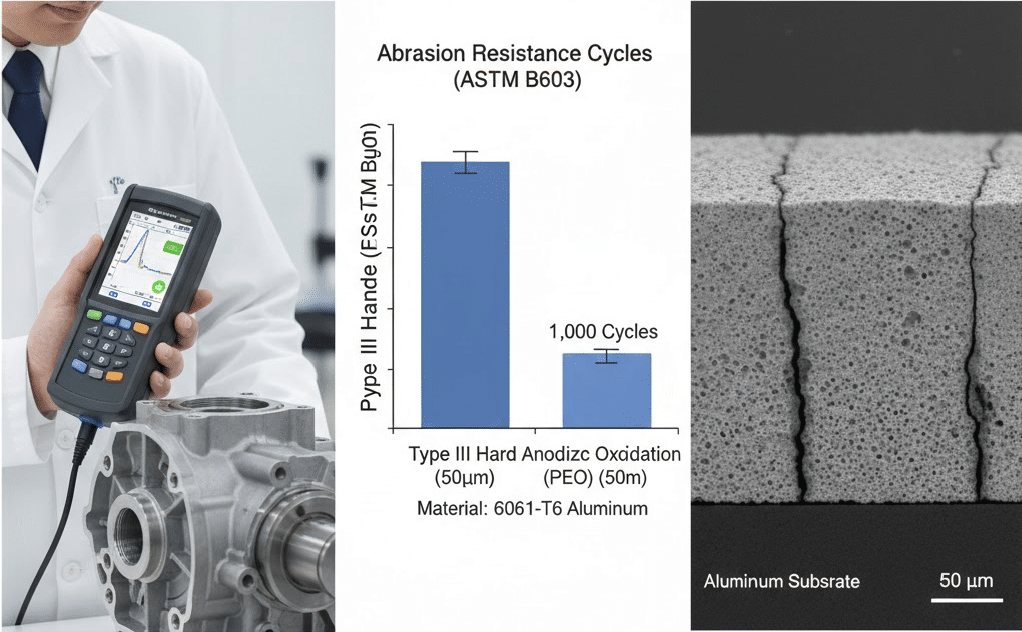
The good news is that the aluminum oxide layer ($Al_2O_3$) formed by sulfuric-oxalic blends achieves comparable micro-hardness to legacy processes—typically 450–550 HV (Vickers) on 6061-T6 aluminum. In standard Taber abrasion tests (CS-17 wheel, 1000g load), we see wear indices effectively identical to chromate-sealed parts.
The Fatigue Debit Challenge:
For high-torque gearboxes, the real concern is the fatigue debit. A standard Type III hard coat (30–50µm) reduces the fatigue strength of the base alloy by 30–50%. This is due to the brittle nature of the oxide layer and the micro-cracks that form during the sealing process, which act as stress risers.
Note: Hex-free hydrothermal sealing requires high temperatures (~96°C) which can induce different residual stress profiles than lower-temp chemical seals.
Thermal Considerations:
Thicker eco-coatings can act as a thermal barrier. If your gearbox relies on the housing for passive dissipation, be aware that a 50µm hard coat has a thermal conductivity roughly 1/10th that of bare aluminum.
Advanced Alternatives: PEO and Electroless Nickel
When standard hard anodizing limits your geometric tolerances or fatigue life, we must consider plasma electrolytic oxidation (PEO) and high-phosphorus electroless nickel plating (EN).
Plasma Electrolytic Oxidation (PEO)
PEO (or micro-arc oxidation) is essentially “spark discharge anodizing.” It transforms the aluminum surface into a ceramic layer (primarily composed of α-alumina and γ-alumina).
Advantages: Hardness reaches 1200–1500 HV, comparable to ceramic. The coating is chemically stable and complies with REACH regulations by default.
Risks: The surface is highly porous (sponge-like structure) before sealing. Corrosion resistance is poor without secondary impregnation (e.g., PTFE or epoxy).
Fatigue: PEO generally has lower fatigue performance than Type III anodizing because its coating is more cohesive and lacks the through-thickness vertical cracks typical of standard hard coatings.
High-phosphorus electroless nickel plating (P content > 10%)
For precision planetary gearboxes with complex internal geometries, electroless nickel plating is often a superior choice due to their strong throwing power.
Comparison: GD&T and uniformity
| Feature | Hard Anodizing (Type III) | Electroless Nickel (High Phos) |
|---|---|---|
| Growth Mode | 50% Penetration / 50% Growth | 100% Surface Addition |
| Edge Effect | "Dog-bone" (Thicker at corners) | Perfectly Uniform (1:1) |
| Blind Holes | Poor coverage (Air pockets) | Excellent coverage |
| As-Plated Hardness | ~60-65 HRC | ~48-52 HRC |
| Heat Treated Hardness | N/A (Degrades >120°C) | ~68 HRC (Bake @ 400°C/1hr) |
Engineering Insight: If you choose Electroless Nickel, be wary of the “Skipping” phenomenon on leaded aluminum alloys (like 2000 series). The lead segregates at the surface and can prevent the nickel from bonding, leading to blistering. Always specify a “double zincate” pretreatment for these alloys.
Comparative Analysis: Cost, Speed, and Performance
When evaluating surface treatments for precision gearbox housings, we cannot simply look at the price per square decimeter ($/dm^2$). We must analyze the Total Cost of Ownership (TCO), which includes machining offsets, rectification of out-of-tolerance parts, and supply chain risk.
Below is a comparative matrix normalized against standard Type III Hard Anodizing (Mil-Spec 8625).
Table 1: Surface Treatment Matrix for Aluminum Gearbox Housings
| Feature | Standard Type III (Cr6+ Sealed) | Type III (RoHS Compliant / Cr3+) | Plasma Electrolytic Oxidation (PEO) | Electroless Nickel (High Phos) |
|---|---|---|---|---|
| Regulatory Risk (EU) | Critical (Annex XIV Auth Required) | Low (Standard Compliance) | Zero (Green Process) | Moderate (Waste intensive) |
| Unit Cost Index | 1.0 (Baseline) | 1.15 - 1.25x | 1.5 - 1.8x | 1.3 - 1.4x |
| Micro-Hardness | ~450–500 HV | ~400–480 HV | ~1000–1200 HV | ~500 HV (As plated) |
| Dimensional Growth | ~50% of thickness | ~50% of thickness | Variable (60/40 to 70/30) | 100% of thickness |
| Surface Finish (Ra) | Increases slightly (~2x baseline) | Increases (~2-3x baseline) | Increases significantly (Porous) | Duplicates baseline (1:1) |
The “Hidden” Dimensional Costs:
Standard Type III anodizing converts the aluminum substrate, meaning a 50µm coating results in ~25µm of penetration and ~25µm of outward growth.
The Trap: If you switch from Type III to Electroless Nickel (EN) to chase RoHS compliance without updating the CNC program, your bearing bores will be undersized. EN is a deposition process; a 50µm plate adds 50µm per side (100µm on the diameter).
The Finish Penalty: PEO and Hex-Free Type III electrolytes are more aggressive. A pre-machined surface of $R_a$ 0.4µm can degrade to $R_a$ 1.2µm after coating. For lip seals or O-ring grooves, this often necessitates a post-anodize honing operation, driving up OPEX.

Sourcing and Vendor Qualification Strategies
In the current regulatory climate, a “Certificate of Conformance” (CoC) is just paper unless backed by an audit. Sourcing gearbox housings from unchecked APAC suppliers or low-tier local shops presents a distinct liability: The “Cheap Quote” Red Flag.
If a vendor quotes hard anodizing at 30% below market rate, they are likely bypassing waste treatment. Anodizing generates significant acidic wastewater and aluminum hydroxide sludge. Proper neutralization and Zero Liquid Discharge (ZLD) systems are capital intensive.
The Engineering Audit Checklist:
Waste Treatment Protocol: Do not ask if they treat waste; ask to see the filter press and the discharge permit. Illegal dumping can lead to your inventory being seized under environmental liability laws.
Bath Chemistry Control:
Ask for their titration logs. Trivalent Chromium ($Cr^{3+}$) baths are far more sensitive to metallic impurities (Copper, Zinc) than Hexavalent baths.
If they cannot show daily titration records for pH and concentration, they cannot guarantee the +/- 5µm thickness tolerance required for H7 bearing fits.
Incoming Quality Control (IQC) at Your Dock:
XRF Screening: Use a handheld X-Ray Fluorescence analyzer to screen for Lead (Pb) in the alloy and Chromium (Cr) on the surface.
Eddy Current Testing: Verify thickness using ISO 2360 standards. Be aware that the magnetic permeability of Electroless Nickel can interfere with standard eddy current gauges; ensure your QC team uses phase-sensitive probes for EN.
GD&T Communication:
You must provide the finishing house with a drawing that specifies “Dimensions Apply After Coating” or “Dimensions Apply Before Coating.” Ambiguity here is the leading cause of scrap in precision gearbox manufacturing.

The Verdict: Balancing Opex with Compliance
As senior engineers, our job is to balance technical feasibility with commercial viability. Here is the decision matrix for the next generation of gearbox housings entering the EU market.
1. General Automation (Conveyors, Actuators)
Recommendation: Stick with Type III Hard Anodizing, but strictly specify “Seal: Hex-Free (Nickel Acetate or Hot Water).”
Rationale: The cost premium (15%) is negligible compared to the risk of a REACH violation. The wear resistance is sufficient for standard industrial environments.
Caveat: Ensure your CNC offsets account for the potentially higher surface roughness ($R_a$) of the hex-free etch.
2. High-Precision / High-Load (Robotics, Aerospace)
Recommendation: Upgrade to Plasma Electrolytic Oxidation (PEO) or Electroless Nickel (High Phos).
Rationale: The fatigue debit of standard anodizing is too high for cyclic loading in robotics. PEO provides the necessary fatigue strength and thermal stability.
Caveat: You must budget for the 50% cost increase and longer lead times.
3. The “Legacy” Trap
Recommendation: Stop issuing prints with “MIL-A-8625 Type III” without qualifiers.
Rationale: This legacy spec allows the finisher to use whatever process meets the salt spray test—usually the cheapest, non-compliant Hex-Chrome seal. You must take control of the print specifications to protect your company from liability.
FAQ
Is standard Type III hard anodizing RoHS/REACH compliant?
It depends on the sealing method. The sulfuric acid anodizing bath is generally compliant. However, legacy specifications often require sealing with hexavalent chromium (dichromate seal) for maximum corrosion resistance, which violates RoHS and REACH Annex XIV. You must explicitly specify “Class 1” (unsealed) or “hex-free sealing” (e.g., nickel acetate or hot water) to ensure compliance.
How does materiaDoes switching to REACH-compliant anodizing affect gearbox tolerances?
Yes, pre-machining offsets may need adjustment. While the “50% penetration / 50% growth” rule generally holds, compliant seals (like hydrothermal sealing) can result in slightly different final dimensional stack-ups compared to chromate seals. Furthermore, newer eco-friendly electrolytes often produce higher surface roughness ($R_a$), potentially requiring post-process honing for bearing bores.
Can Plasma Electrolytic Oxidation (PEO) replace hard anodizing for gear housings?
Yes, particularly for high-stress applications. PEO creates a ceramic-like conversion coating that offers superior fatigue strength and thermal stability compared to Type III anodizing. However, PEO coatings are porous and require specialized impregnation (sealing) to prevent corrosion, and the process is typically 30-50% more expensive than standard hard coat.
How do I verify if my anodizing supplier is using hexavalent chromium?
Request a Certificate of Compliance (CoC) and perform spot testing. The CoC must explicitly state compliance with EU Directive 2011/65/EU (RoHS 2). For physical verification, use a diphenylcarbazide spot test kit on the part surface; a red/violet reaction indicates the presence of restricted hexavalent chromium ($Cr^{6+}$). XRF analysis can also screen for total chromium levels.
What is the cost difference between hex-free and traditional hard anodizing?
Hex-free is typically 10–20% more expensive. This cost uplift is driven by tighter bath chemistry controls, higher energy consumption for alternative sealing methods (e.g., maintaining hot water tanks at >95°C), and the higher cost of trivalent chromium ($Cr^{3+}$) or non-nickel sealing salts compared to the cheap, legacy chromic acid solutions.
Related popular articles

Written By
Ryan
Conscientious sales engineer at DakingsRapid with demonstrated experience working in the machine and parts manufacturing industry. Ability to independently manage sales operations for commodities and proficiency in quality customer service.