




Humanoid Robot CNC Prototype Lead Time: Scheduling & Risk Mitigation
Key Takeaways
Base machining times for standard aluminum or steel structural components average 10-14 days; complex 5-axis multijoint linkages require 3-4 weeks.
Executing a concurrent DFM review reduces overall rapid prototyping cycles by up to 25% by eliminating secondary fixturing delays and tooling revisions.
Material sourcing for specialized aerospace-grade alloys (e.g., Titanium Grade 5, 7075-T6 Aluminum) routinely adds 5-10 days to low-volume production schedules.
Baseline Timelines for Rapid Prototyping Humanoid Components
The standard CNC prototyping cycle for humanoid robots is 10 to 14 days (aluminum chassis components), while complex five-axis multi-joint titanium alloy linkages can take up to 4 weeks. At DakingsRapid, this takes only 5-10 days, thanks to their own factory and AI system, resulting in a 50% increase in efficiency.
Machining time dictates your production schedule. Machining the structural frame consumes significant spindle time. A standard three-axis milling machine can quickly machine 6061-T6 aluminum alloy supports. You simply remove the blank, perform end face machining and cavity machining, and then ship.
However, machining complex multi-joint components completely changes the machining process.
Comparison of Machining Speeds for Aluminum and Titanium
Aluminum has a fast chip removal rate. You can increase the feed rate and reach spindle speeds of 12,000 rpm or higher. Tool wear is negligible.
Titanium (Ti-6Al-4V titanium alloy), if thermal management is neglected, can severely damage end mills. Surface speeds can drop to 150 SFM. Increasing the feed rate can cause tool deflection, severely impacting dimensional accuracy. The total machining time is expected to increase threefold compared to standard aluminum alloy machining.
Standard 3-axis Machining Center vs. Complex 5-axis Machining Center
Setup time is a fatal flaw in rapid prototyping. 3-axis machines require manual flipping of parts with multiple geometric features. Each setup introduces mechanical errors.
Continuous 5-axis machining eliminates this problem. This machine can machine all five faces of the workpiece in a single setup. You can easily maintain accuracy of ±0.0005 inches on intersecting planes. While the initial cost is higher, it can save a full week in the long run.
How DFM Review Compresses Quick Turnaround Schedules
Design for Manufacturability (DFM) is not a suggestion. It is the schedule. Sending raw CAD directly to the shop floor guarantees delays. A concurrent DFM review slashes turnaround schedules by up to 25%.
Identifying Undercuts and Non-Standard Radii Early
Engineers love sharp internal corners. Machinists hate them. An end mill is round. It leaves a radius. Calling out a 0.010″ internal radius in a deep pocket forces EDM work. Sinker EDM adds 5 days to your lead time.
Relax that radius to 0.125″ where clearance allows. We drop in a standard 1/4″ end mill and clear the pocket in minutes. Reviewing these details before issuing the PO prevents mid-production tooling revisions.
Minimizing Setup Changes and Fixturing Constraints
Odd-shaped blanks require custom soft jaws. Designing clamping tabs into the initial raw material profile solves this.
The tabs hold the part during aggressive roughing operations. We machine the tight-tolerance geometries, then slice the tabs off in a secondary op. You bypass the need for custom workholding design. Production starts 48 hours faster.

Component Complexity and GD&T Tolerance Constraints
Geometric Dimensioning and Tolerancing (GD&T) dictates your yield rate. Tight callouts slow down everything.
Actuator Housings and Precision Bearing Bores
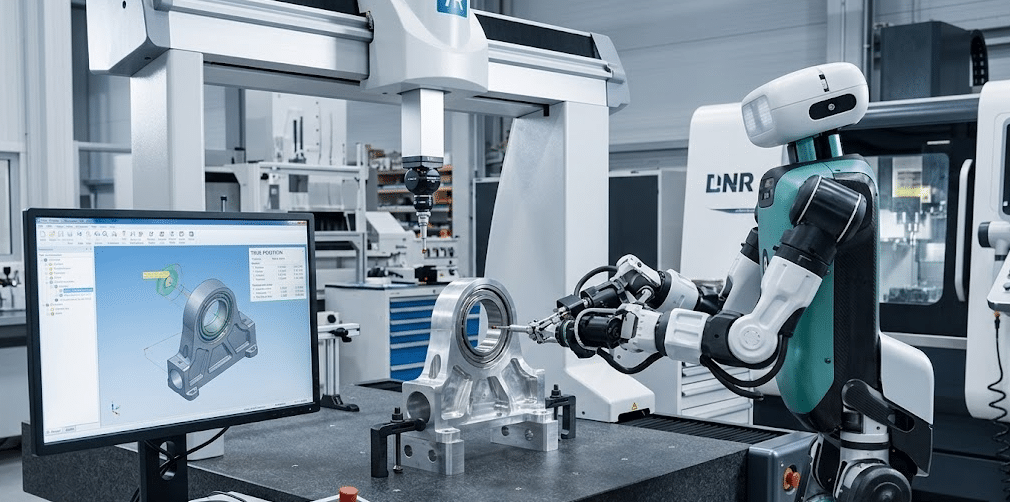
Humanoid joints rely on harmonic drives and absolute encoders. Bearing bores require extreme cylindricity. Calling out a true position of 0.001″ at Maximum Material Condition (MMC) forces us to slow feed rates to a crawl. We must bore, measure, and bore again. Thermal expansion during machining becomes a primary variable.
Structural Frame Linkages and Articulation Points
Long linkages warp. Asymmetrical material removal releases internal stresses. We rough machine 7075-T6 aluminum linkages oversize, send them out for thermal stress relief, and finish machine them to final dimensions. This breaks the standard quick turnaround promise. You trade speed for strict flatness requirements.
| Tolerance Class (ISO 2768) | Typical Humanoid Feature | Effect on Machining Speed | Scrap Rate Risk |
|---|---|---|---|
| Fine (f) / ± 0.0005" | Actuator Bearing Bores | Reduces feed rates by 60% | High |
| Medium (m) / ± 0.005" | Linkage Mounting Faces | Standard speeds | Low |
| Coarse (c) / ± 0.015" | Non-mating bracket edges | Maximum material removal | Minimal |
Material Sourcing Delays in Low-Volume Production
Material dictates the calendar. You want standard 6061-T6 aluminum? We pull it off the rack today. You spec specialized aerospace alloys for humanoid joints, and the clock stops.
Billet Availability vs. Custom Forgings
Off-the-shelf billet works for most rapid prototyping. We order standard rectangular bar stock. It arrives in 48 hours.
Humanoid femur linkages often require custom geometries to maintain grain structure. Forging those blanks requires custom dies. You just added 6 weeks to your timeline before a single chip flies. High-stress dynamic load paths demand continuous grain flow, making billet machining structurally inferior for flight-weight or high-agility bipedal robots.

Managing Aerospace-Grade Alloy Lead Times
Procuring certified Titanium Grade 5 (Ti-6Al-4V) routinely adds 5-10 days to low-volume production schedules. Mill test reports (MTRs) are non-negotiable for AS9100 compliance.
We reject raw material if the paperwork drops a single decimal point on the yield strength (120,000 psi minimum). Plan your supply chain around the metal, not the spindle. If your purchasing team relies on spot-market alloys to save pennies, they will burn weeks of engineering time fighting material impurities during the roughing passes.
Secondary Operations and Surface Finishing Timelines
Machining is only half the battle. Surface treatments wreck delivery schedules.
Hard Coat Anodizing and Heat Treatment Cycles
[Author’s Field Note] Last year, a client expedited a 7075-T6 pelvic block, demanding a 5-day turnaround. We nailed the machining in 3 days holding ± 0.0002″ on the bearing bores. Then it hit the anodize line. The MIL-A-8625 Type III hard coat added 0.002″ of dimensional buildup. The bearings wouldn’t press fit. We had to strip it, re-machine, and re-anodize. Know your plating thickness allowances before you cut metal.
Heat treating custom 4340 steel shafts to 45 HRC takes a dedicated 72-hour cycle. Vacuum heat treating prevents surface scaling but guarantees an additional 3 days added to your lead time. You cannot rush metallurgy.
Masking Requirements for Conductive Surfaces and Grounding Points
Humanoids require uninterrupted electrical continuity. Anodizing is a literal insulator. You must mask grounding points.
Masking placement tolerance: ± 0.015″ manual hand-masking capability.
Liquid masking cure time: 24 hours minimum.
Plugging tapped holes: Mandatory to maintain a strict 2B thread class.
Custom masking requires human hands. It scales poorly and directly impacts rapid turnaround metrics. Specify grounding pads precisely on the print.

Expediting Strategies for Late-Stage Design Iterations
Expediting a humanoid robot CNC prototype requires purchasing dedicated spindle time, which typically commands a 50% to 100% financial premium over standard queued production.
Money buys priority. You are paying to disrupt an optimized manufacturing floor.
Dedicated Spindle Time vs. Queued Production Runs
Standard lead times assume your part enters a first-in, first-out queue. High-mix, low-volume (HMLV) shops schedule machine capacity weeks in advance.
Buying dedicated spindle time means we hold a 5-axis Hermle mill open purely for your iterations. You send the STEP file on Tuesday. We cut chips on Wednesday. This strategy is reserved exclusively for critical path failure resolutions.
The Financial Premium of Breaking In on Existing Setups
Breaking into an active production run is brutal. We tear down a dialed-in fixture. We lose the statistical process control baseline.
Setup teardown: 2-4 hours lost.
New fixture tramming: 1-3 hours lost.
First Article Inspection (FAI): 4-6 hours holding Cpk > 1.33.
You absorb these downtime costs completely.
| Expediting Tier | Average Lead Time | Typical Cost Multiplier | Ideal Engineering Use Case |
|---|---|---|---|
| Standard Queue | 10-14 Days | 1.0x | Initial chassis clearance proving |
| Priority Routing | 5-7 Days | 1.5x | Mating part interference fixes |
| Dedicated Spindle | 24-72 Hours | 2.0x+ | Critical path actuator failure resolution |
Final Engineering and Procurement Decisions
- Complete a Design for Manufacturability (DFM) review before issuing a Purchase Order (PO). Eliminating secondary electrical discharge machining (EDM) and custom fixtures can reduce the baseline rapid prototyping cycle time (10-14 days) by 25%. At DakingsRapid, this can be improved by 50%, with a cycle time of [5-10] days.
- Strictly limit the tolerances of actuator bearing bores and mating surfaces (±0.0005 inches). Excessive tolerances in structural connectors lead to high scrap rates and significantly increase spindle machining time and costs.
- Incorporate surface finish and material sourcing into the critical path. Waiting for the aerospace-grade titanium alloy Ti-6Al-4V material test report (MTR) or hard anodizing to MIL-A-8625 Type III standards typically extends the standard machining cycle time by 1-2 weeks.
FAQ
How does a +/- 0.0005" tolerance requirement affect the CNC lead time for robot joint actuators?
It doubles your machining time. We drop feed rates, introduce mid-cycle thermal stabilization pauses, and mandate 100% CMM inspection. Reserve this strictly for harmonic drive interfaces.
Can utilizing continuous 5-axis machining reduce the setup time for complex humanoid pelvis structures?
Yes. It eliminates manual part flipping. We access five planes in a single fixturing operation holding true position across the entire billet. You save 3-5 days of setup delays.
What is the typical standard delay for hard coat anodizing on 7075-T6 aluminum prototypes?
Five to seven days. MIL-A-8625 Type III processing requires precise racking, dedicated masking of your 2B threaded holes, and controlled acid bath times to hit the 0.002″ buildup spec.
How much faster is rapid prototyping in engineering plastics (Delrin/PEEK) versus aluminum for initial kinematic testing?
About 30% faster. Plastics machine at maximum spindle RPMs with zero coolant thermal shock. Delrin holds ± 0.005″ easily for early-stage interference checks before you commit to 6061-T6.
Do tight geometric dimensioning and tolerancing (GD&T) callouts require extended CMM inspection time?
Absolutely. A complex profile of a surface callout requires hundreds of CMM probe touch points. A standard First Article Inspection (FAI) jumps from 2 hours to 8 hours.
How does concurrent engineering with a contract machine shop shorten the overall low-volume production cycle?
It stops unmanufacturable CAD at the gate. Engineering teams at DakingsRapid catch non-standard radii and impossible undercuts before raw material is ordered. You avoid mid-production tooling revisions entirely.
Reference Sources
- Titanium (Ti-6Al-4V Titanium Alloy)
- Titanium Grade 5 (Ti-6Al-4V)
- DakingsRapid robotics technology
Related popular articles

Written By
Ryan
Conscientious sales engineer at DakingsRapid with demonstrated experience working in the machine and parts manufacturing industry. Ability to independently manage sales operations for commodities and proficiency in quality customer service.