


Strategic Lightweighting for Skeletal Structures: Balancing Mass Reduction with Structural Integrity in CNC Manufacturing
Topology Optimization is Mandatory, Not Optional: Moving beyond standard pocketing to generative design strategies significantly improves specific stiffness but introduces complex workholding challenges.
Material Selection Drives ROI: The trade-off between 7075-T6 Aluminum, Titanium Grade 5, and Magnesium AZ31B must be evaluated against machining cycle time, not just raw material cost.
Thin-Wall Machining Risk Management: Aggressive weight reduction dramatically increases the risk of harmonic chatter and part distortion; mitigation strategies are critical for maintaining tight tolerances.
The Economics of Stiffness: Material Selection Beyond Density
Engineering Insight: If the design allows, 7075-T6 remains the ROI leader. Titanium should only be specified if the volume constraints prevent the thicker wall sections required by Aluminum, or if operating temperatures exceed 150°C.
We cannot evaluate skeletal lightweighting solely on density ($\rho$). For structural integrity in high-performance chassis or aerospace brackets, the critical metric is Specific Stiffness (Young’s Modulus $E$ / Density $\rho$). While a lower density material reduces mass, it often requires increased wall thickness to match the rigidity of denser alternatives, potentially negating weight savings and inflating the machining envelope.
For most CNC-machined structural components, the decision matrix usually narrows to Aluminum 7075-T6, Titanium Ti-6Al-4V (Grade 5), and Magnesium AZ31B.
Aluminum 7075-T6 (ASTM B209): The baseline. It offers a high strength-to-weight ratio comparable to some mild steels but with significantly better machinability. It is prone to stress corrosion cracking if not anodized properly (MIL-A-8625 Type II or III).
Titanium Ti-6Al-4V (ASTM B265): Essential when thermal stability or galvanic corrosion resistance is required alongside high fatigue strength. However, the low thermal conductivity means heat concentrates at the cutting edge, necessitating lower surface footage (SFM) and higher tool consumption.
Magnesium AZ31B: Roughly 33% lighter than aluminum with excellent damping capacity. The trade-off is flammability risk during machining (requires Class D fire protocols) and poor corrosion resistance in untreated states.
Cost-Benefit Analysis: Material vs. Machinability
The raw material cost is often a fraction of the total part cost (typically <30% for complex skeletal parts). The primary cost driver is Material Removal Rate (MRR).
Material Density (g/cm³) Specific Stiffness (106 m) Machinability Rating (Al 6061 = 100%) Coolant Strategy Manufacturing Risk Al 7075-T6 2.81 ~25 70-80% Flood / High Pressure Moderate (Warpage) Ti-6Al-4V 4.43 ~26 15-20% High Pressure (1000 psi+) High (Tool Wear, Heat) Mg AZ31B 1.77 ~25 150%+ Air Blast / Mineral Oil High (Fire Hazard)

Advanced Geometry: Implementing Isogrid and Orthogrid Patterns
sogrid (triangular) and Orthogrid (square/rectangular) patterns utilize stiffening ribs to mitigate buckling in thin-walled structures. This places material strictly along the principal stress vectors. From a machining standpoint, however, these patterns are often where cost and lead time balloon unnecessarily due to corner radius constraints.
The Corner Radius Trap
The most common DFM error in skeletal structures is specifying a grid corner radius ($R$) that requires a tool diameter ($D$) too small for the pocket depth ($L$).
Ideally: $L/D \le 3:1$.
Manageable: $L/D = 5:1$ (Requires reduced feed rates).
High Risk: $L/D > 8:1$ (Requires tapered tools, high chatter risk, poor surface finish).
If you design a 2.0″ deep isogrid pocket with a 0.125″ corner radius, we are forced to use a $\frac{1}{4}$” diameter end mill hanging out 8x its diameter. This guarantees tool deflection, chatter marks that exceed Ra 63 surface finish requirements, and potentially undersized ribs due to cutter push-off.
Machining Strategy: High Efficiency Milling (HEM)
To achieve these geometries without inducing residual stress:
Trochoidal Toolpaths: We utilize dynamic milling strategies (constant tool engagement angle) to maintain high feed rates with low radial depth of cut (RDOC). This reduces heat generation—critical for minimizing distortion in the thin floor (often <0.040″).
Floor Finishing: We leave 0.005″–0.010″ on the floor and walls during roughing, remove the part from the fixture to allow stress relaxation (if necessary), and then finish.
Fillet Radii: A “bull nose” or corner radius on the floor of the pocket is mandatory. A sharp corner creates a stress concentration factor ($K_t$) that can lead to fatigue failure.
](https://www.dakingsrapid.com/wp-content/uploads/2026/02/26e28a50987e0da13bf70b4e2c877aba.png "26E28A50987E0Da13Bf70B4E2C877Aba")
Topology Optimization and Generative Design Manufacturability
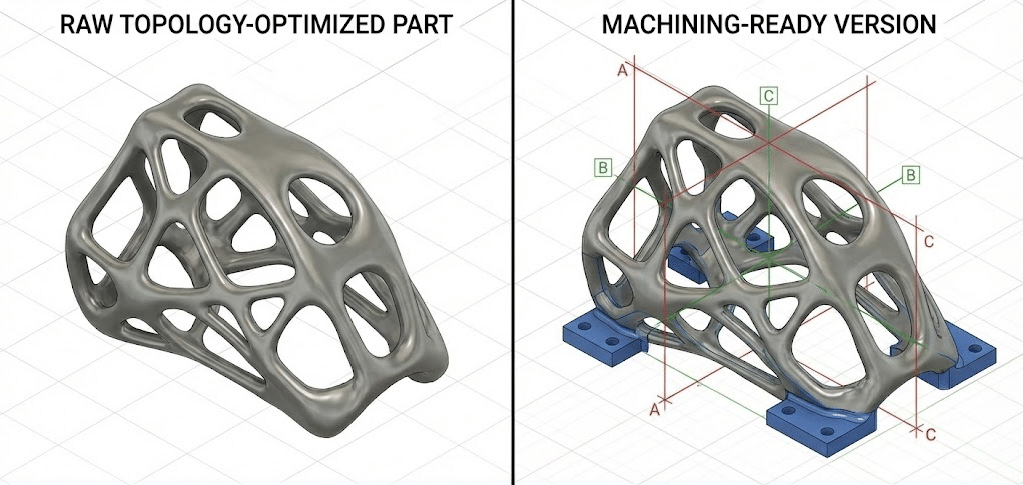
Topology optimization (TO) and Generative Design (GD) yield mathematically optimal mass-to-stiffness ratios, often resembling organic, bone-like structures. While FEA validates these shapes, CNC machines do not naturally move in organic splines efficiently.
The 3-Axis vs. 5-Axis Dilemma
Generative algorithms frequently produce undercuts and negative draft angles.
3-Axis Constraint: Requires the part to be re-fixtured multiple times (Op10, Op20, Op30…) to reach all features. Every setup introduces specific stack-up error (typically +/- 0.0005″ to 0.001″).
5-Axis Solution: Allows access to complex geometries in a single setup (Done-in-One). However, 5-axis machine time is typically billed at 1.5x to 2.0x the hourly rate of 3-axis centers.
Guideline: Apply a “manufacturing constraint” within your topology solver (e.g., Fusion 360, Ansys, nTopology) specifically for 3-axis milling or 5-axis continuous to preventing the software from generating un-machinable voids.
Tolerancing Organic Shapes
Applying GD&T to a generative design is challenging because there are few planar datums.
Datums: You must integrate “sacrificial” or functional datum blocks into the design that remain accessible for probing during the machining process.
Profile Tolerances: Rely heavily on Profile of a Surface tolerances (ISO 1101) rather than linear dimensions.
Surface Finish Cost: “Stair-stepping” (scallop height) is inherent when machining 3D curvatures with ball-nose end mills. Achieving a smooth Ra 32 finish on a generative curve requires extremely tight step-overs, increasing cycle time exponentially compared to a planar face.
Managing Manufacturing Risk in Thin-Wall Components
The primary failure mode in aggressive lightweighting isn’t structural yield under load; it’s manufacturing-induced distortion. When we machine skeletal structures with wall thicknesses approaching 0.020″–0.040″ (0.5mm–1.0mm), we release bulk residual stresses inherent in the billet rolling process. This is the “potato chip effect”—you machine a flat, accurate part, release the clamps, and it springs into a pretzel, instantly violating Flatness and Profile tolerances.
Controlling Residual Stress: The Rough-Relax-Finish Protocol
We cannot machine thin-wall structural frames in a single continuous operation. To hold a True Position of 0.005″ (0.127mm) or a Flatness of 0.002″ (0.05mm) on a part with >80% material removal, the process must be broken down:
Aggressive Roughing: Remove bulk material (leaving ~0.020″ stock) to expose the core.
Stress Relief: For 7075-T6 or Ti-6Al-4V, the part naturally bows as “skin” stresses are removed. We must release workholding pressure to allow the material to find its new equilibrium state.
Note: For critical aerospace components, an intermediate thermal stress relief cycle (e.g., AMS 2770) may be required between roughing and finishing.
Shimless Finishing: Re-clamping a bowed part forces it flat only while clamped. Once machined and released, it springs back. We must use free-state workholding (e.g., potting in low-melt alloy, vacuum chucks with custom gasketing, or floating hydraulic clamps) to machine the part in its relaxed state.
Vibration and Harmonic Chatter
Thin walls act as diaphragms. Standard end mill helix angles often induce harmonic chatter in walls with height-to-width ratios exceeding 10:1.
Variable Helix End Mills: Use tools with unequal flute spacing to break harmonic resonance.
Sacrificial Support Tabs: Leave integral tabs connecting tall walls to create temporary rigidity, then machine them away in the final pass.
Damping: We often apply localized damping mass (e.g., modeling clay or tunable mass dampers) to the non-machined side of the wall during the cut.

Cost Drivers and Strategic Sourcing Implications
The economics of skeletal lightweighting are dominated by the Buy-to-Fly Ratio (weight of raw stock vs. finished part weight). In optimized skeletal structures, this ratio often exceeds 10:1 or even 20:1. You are effectively paying to turn 90% of a high-grade alloy into chips, which then hold only scrap value.
The “90% Removal” Rule: Billet vs. Near-Net Shape
Sourcing Managers must identify the volume inflection point where machining from solid billet becomes fiscally irresponsible.
Low Volume (<50/yr): Machining from billet (Plate/Block) is cost-effective due to zero tooling investment (NRE).
Mid-to-High Volume (>500/yr): Transition to Investment Casting or Precision Forging. While the NRE for molds/dies is significant ($15k–$50k), the reduction in machining cycle time (only finishing critical features) and raw material waste yields an ROI typically within 12-18 months.
Comparison: Manufacturing Strategy for 1.5 lb Skeletal Node (Al 7075)
| Metric | CNC from Billet (Solid) | Near-Net Shape (Forging + Finish CNC) | Strategic Impact |
| Buy-to-Fly Ratio | 15:1 (22.5 lbs stock) | 1.5:1 (2.25 lbs forging) | Massive material savings in Forging. |
| Machining Time | 4.5 Hours | 0.75 Hours | Capacity utilization increases 6x with Forging. |
| NRE (Tooling) | $1,500 (Fixtures) | $35,000 (Die + Trim Tool) | High upfront risk for Forging. |
| Lead Time | 3-4 Weeks | 12-16 Weeks | Billet offers agility; Forging requires forecasting. |
| Unit Cost @ 100 qty | $450.00 | $620.00 | Billet Wins |
| Unit Cost @ 1000 qty | $380.00 | $185.00 | Forging Wins |
Quality Control and NDT Overhead
Don’t underestimate the cost of validating a skeletonized part.
CMM Programming: Inspecting a generic block takes minutes. Verifying a complex isogrid with hundreds of pockets and thin walls requires automated CMM routines (PC-DMIS/Calypso) that can take days to program and hours to run per part.
NDT (Non-Destructive Testing): Aggressive lightweighting reduces the safety factor. Sourcing must budget for Fluorescent Penetrant Inspection (FPI) per ASTM E1417 to detect surface-breaking cracks induced by machining stress, particularly in radiused corners.

FAQ
What is the most efficient pattern for CNC lightweighting?
Isogrid (triangular stiffening) is typically the most efficient balance of strength and manufacturability. While honeycomb structures offer marginally better weight reduction, they are prohibitively difficult to machine from billet. Isogrid provides excellent isotropic strength and is accessible via standard 3-axis CNC, whereas random pocketing saves machining cost but sacrifices torsional rigidity.
How does material removal affect the fatigue life of skeletal structures?
Material removal can degrade fatigue life if tool marks or sharp corners remain. Aggressive lightweighting exposes internal grain structures and creates potential stress concentrators. To mitigate this, engineers must enforce strict surface finish requirements ($Ra < 32 \mu in$) and generous fillet radii to prevent crack initiation under cyclic loading.
Can 5-axis machining reduce costs for lightweight structural parts?
Yes, primarily by reducing fixture setups and improving positional accuracy. While 5-axis machines have a higher hourly rate, they allow for cutting complex organic geometries and undercuts in a single operation. This eliminates manual repositioning errors and total queue time, often lowering the total cost per part for complex generative designs.
What is the minimum wall thickness for CNC machined aluminum frames?
A wall thickness of 0.040” (1 mm) is a safe standard, though 0.020” (0.5 mm) is achievable with specialized high-speed machining. The limiting factor is the height-to-width ratio; exceeding a 10:1 ratio dramatically increases the risk of harmonic chatter and deflection, requiring slower feed rates or damping strategies.
How do you prevent warping when machining large skeletal parts?
Prevent warping by utilizing balanced material removal and intermediate stress relief. Flip the part frequently to remove stock evenly from both sides (“skin passes”). For critical tolerances, introduce a thermal stress relief cycle between roughing and finishing, and use free-state workholding (like vacuum chucks) to avoid inducing stress during clamping.
Is Magnesium lighter than Aluminum for structural components?
Yes, Magnesium (AZ31B) is approximately 33% lighter than Aluminum 6061. However, it requires strict safety protocols due to flammability risks during machining (chip ignition). Additionally, magnesium is highly reactive, necessitating immediate surface passivation or coating (anodizing/chromate conversion) to prevent rapid corrosion in service.