




- Material Integrity: Critical joint components requiring Al 7075-T6 must verify tensile strength ($\ge 570$ MPa) via Mill Test Reports (MTR) to prevent fatigue under high-frequency cyclic loading.
Dimensional Precision: Harmonic drive housings and actuator interfaces typically demand bores held to $\pm 0.005$ mm to ensure zero-backlash assembly and concentricity.
Validation Cost: Implementing full heat-lot traceability and hardness testing adds roughly 15–20% to part cost but eliminates the risk of catastrophic field failure in multi-axis cobots.
The Role of MTRs in High-Torque Actuation
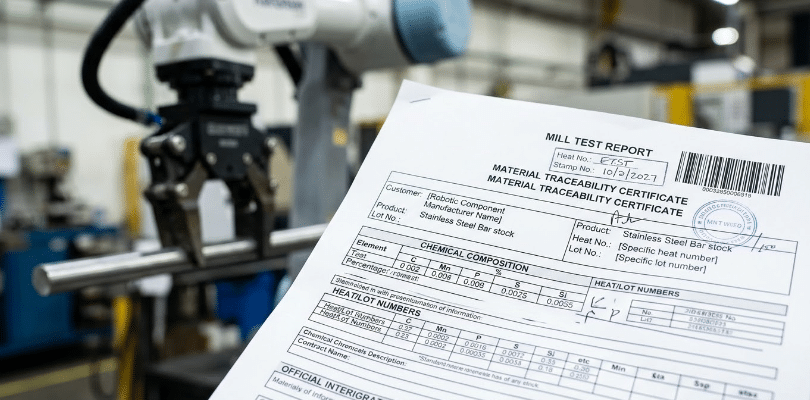
Material traceability for robotic joints starts with the Mill Test Report (MTR). For high-precision aluminum certification, the MTR must confirm chemical composition and mechanical properties—such as yield strength and hardness—matching ASTM B209 or B221 standards to ensure the alloy handles specified torque loads without deformation.
An MTR is not a generic “Certificate of Conformance.” It is the DNA of the heat lot. When an actuator experiences peak torque—often 300% of its rated continuous duty—any deviation from the specified magnesium or silicon content in 6061-T651 can lead to catastrophic grain boundary shearing.
Yield Strength ($\sigma_y$): Must meet or exceed 240 MPa (35 ksi) for 6061-T6.
Elongation: Minimum 8–10% to ensure the housing doesn’t crack under shock loading.
Chemical Analysis: Verification of Cr, Cu, and Zn percentages to prevent stress corrosion cracking (SCC).
Failure to verify these metrics during the RFQ stage is where most US-based projects face delays. At DakingsRapid, our engineering team reviews MTRs against the physical stock before the first chip is pulled to ensure the material matches the digital twin’s FEA assumptions. If the MTR doesn’t match the ASTM B209 standard, the batch is rejected before it ever hits the 5-axis table.
Material Selection and Torque Load Validation
Selecting the correct alloy for actuator housings requires balancing weight and stiffness. While 6061 is the industry baseline, robotic joints subjected to high-frequency oscillation often require 7075-T6 due to its fatigue strength ($160$ MPa at $5 \times 10^8$ cycles).
The physics are simple: stiffness ($E$) is relatively constant across aluminum alloys, but yield strength varies wildly.
“Over-designing the wall thickness is a common trap.”
Increasing wall thickness to compensate for inferior material increases the moment of inertia, requiring a larger motor and more power. It is more economical to use 7075-T6 with a thinner profile, provided the $GD&T$ maintains a 0.02 mm true position on the bearing bores.
Material Performance Comparison Table

| Property | 6061-T651 | 7075-T651 | Engineering Impact |
|---|---|---|---|
| Yield Strength | 276 MPa | 503 MPa | Determines the maximum torque allowable before permanent deformation. |
| Machinability | Excellent | Good | 7075 produces shorter chips, making it easier to achieve superior Ra surface finishes. |
| Fatigue Strength | 97 MPa | 159 MPa | Critical for components subjected to high-frequency cyclic loading. |
| Material Cost | Base (1.0x) | ~1.6x | Directly impacts the BOM; a strategic trade-off for high-performance requirements. |
This is a shop-floor reality: 7075 machines more “crisply” than 6061. You can achieve an Ra 0.4 to 0.8 surface finish more consistently on gear-interfacing surfaces because the material is less prone to “gumming” the flutes of the end mill.
Hardness Testing and Heat Treat Verification
Hardness test certification (typically Webster or Rockwell B/C) provides a non-destructive method to verify that the machining stock reached the specified T6 temper. This step is mandatory for robotic components to ensure the material provides the necessary wear resistance and thread strength for high-speed robotic assembly fasteners.
Surface hardness is the primary indicator of successful precipitation hardening. If a batch of 6061 is “soft” (below 95 Brinell), the tapped holes for the actuator mounting bolts will eventually pull out under cyclic vibration.
Verification Method: Rockwell B (HRB) is standard for aluminum; 6061-T6 should sit between 60-65 HRB.
The “Skin” Effect: Hardness must be checked after the outer 1.0 mm of “mill scale” is removed to ensure the core temper is consistent.
Process capability is non-negotiable here. For critical joint interfaces, we look for a Cpk > 1.33 on both dimensional tolerances and hardness uniformity. During the inspection phase at DakingsRapid, we utilize calibrated digital hardness testers as part of our standard quality gate. This data is cross-referenced with CMM measurement systems to ensure that the part hasn’t warped during the stress-relief process.

“That 0.005mm tolerance looks harmless on the drawing.”
In reality, if the material hardness isn’t uniform, the tool pressure will deflect the part differently across its geometry. You end up with a tapered bore that ruins the zero-backlash requirement of a harmonic drive. Proper heat treat verification prevents this “moving target” during the finishing pass.
Cost vs. Precision: Traceability Tiers
Traceability is a cost driver, not just a paperwork exercise. In a US job shop setting with rates between $120–$180/hr, every layer of documentation represents a measurable increase in non-machining labor and machine downtime. If you demand full heat-lot segregation, the shop cannot mix plates to optimize nesting; they must machine each heat lot as a discrete setup.
Traceability Impact on Manufacturing Economics
| Comparison | FOB | DDP |
|---|---|---|
| Customs Clearance | Buyer | Seller/Factory |
| Import Duties | Paid by Buyer | Included |
| Logistics Risk | Higher | Very Low |
| Documentation | Complex | Minimal |
“The documentation often costs more than the aluminum.”
It sounds like a joke until you factor in the labor of an inspector manually cross-referencing heat lot stamps against material certifications for a 500-piece run. For robotic joints, Tier 3 is usually the “sweet spot” where you ensure the actuator housing won’t crack without paying for aerospace-level serialization.
Bridging the Gap Between Design and Shop Floor
Designers frequently default to ±0.005 mm because they aren’t sure of the thermal expansion coefficients of the mating bearing. On the shop floor, that extra zero doubles the scrap rate. If the part is an Al 6061-T651 actuator housing, a 5°C temperature swing in the shop will move the part more than the tolerance allows.
Field Note: I recently worked on a US-led project where the team requested a 0.01 mm true position for 12 peripheral holes on a 300 mm diameter ring. The machining consequence was severe: it required a specialized jig and three separate finishing passes to manage stress relief. After providing DFM feedback through DakingsRapid, we relaxed the position to 0.03 mm while tightening the bore concentricity. This simple shift reduced tool changes by 40% and brought the unit price down by $22 without affecting assembly performance.
CMM and Tolerance Verification for Robotic Assemblies
Robotic assembly verification requires Coordinate Measuring Machine (CMM) data to validate GD&T callouts like perpendicularity and true position that manual gauges cannot accurately capture. For a multi-axis cobot, a deviation of 0.02 mm in a primary joint bore propagates through the arm, resulting in several millimeters of error at the end effector.
Precision is measured, not assumed. Using ASME Y14.5-2018 standards, the CMM must establish a primary datum from the mounting face and a secondary datum from the central bore.
Process Capability: We target a Cpk > 1.33 for robotic interfaces to ensure the statistical distribution of parts stays well within the “green zone.”
Surface Finish: A bore held to Ra 0.8 is critical for bearing press-fits; anything rougher results in “peak” shearing during assembly, leading to eventual looseness.

At DakingsRapid, the inspection reliability is anchored by our CMM measurement systems, which provide a digital heat map of the part’s geometry. This data is the only way to prove a part meets the 0.02 mm true position requirement before it ships across the Pacific.
Logistics and Supply Chain Transparency for US Markets
“Offshore manufacturing fails when the documentation stays behind.”
For US-based mechanical engineers, the risk isn’t just the machining—it’s the customs audit and the material validation. If your parts arrive without MTRs or a clear hardness test certification, they are technically scrap until they can be post-validated.
RFQ Speed: Utilizing the 12-hour time difference allows for overnight RFQ review. A US engineer can send a STEP file at 4:00 PM EST and receive a DFM-optimized quote by 8:00 AM the next morning.
DDP Shipping: Using Delivered Duty Paid (DDP) terms shifts the logistics burden. The manufacturer handles the HTS coding and entry, ensuring the parts and their “paper trail” arrive at your dock simultaneously.
This transparency reduces the “hidden cost” of procurement. When you factor in the $150/hr an American engineer spends chasing down missing paperwork, the value of a pre-bundled documentation package becomes clear.
Final Engineering & Sourcing Verdict
- Audit Trail Priority: Procurement must mandate Mill Test Reports (MTR) and hardness certifications for all load-bearing joint interfaces; a standard Certificate of Conformance is insufficient to mitigate the risk of fatigue-induced grain boundary shearing.
Precision Economics: Relaxing non-critical tolerances from $\pm 0.005$ mm to $\pm 0.02$ mm reduces the “precision tax” by 20–30% by minimizing specialized workholding requirements and decreasing CMM cycle time per unit.
Validation Redundancy: Establishing a Cpk > 1.33 for critical bores ensures that the robotic assembly remains within its zero-backlash performance envelope, effectively eliminating the high cost of manual shimming or part-matching during final integration.
FAQ
Is a Certificate of Conformance (CoC) sufficient for robotic joint materials?
No. A CoC is a generalized statement that provides zero data on the specific heat lot. High-torque actuators require an MTR to verify that yield strength and chemical composition meet ASTM B209 standards for predictable mechanical performance.
How does material hardness affect the lifespan of a robotic actuator housing?
Significantly. If the aluminum is under-tempered, bearing seats will deform under cyclic loading. This leads to bore ovalization and “spinning” of the outer race, which eventually destroys the concentricity of the entire gear train.
What is the typical tolerance feasibility for 5-axis machined joint components?
Typically $\pm 0.01$ mm for production runs. While $\pm 0.005$ mm is achievable on high-end 5-axis centers, it necessitates a temperature-controlled environment and slower feed rates, which can double the machining cost per hour.
Can CMM reports be customized for specific robotic assembly datums?
Yes. Engineers must define primary and secondary datums per ASME Y14.5-2018. This ensures the technician probes the specific interface points that dictate the stack-up tolerance of the final robotic arm assembly.
How do lead times change when adding full material traceability?
Minimally. The actual machining time is unaffected. However, the initial procurement phase may extend by 48 hours to secure raw stock with verified MTRs and to conduct pre-production hardness checks.
What are the common material cost drivers in robotic component manufacturing?
Alloy selection and documentation. 7075-T6 costs roughly 1.6x more than 6061-T6. Additionally, the labor required for 100% CMM inspection and serialized heat lot tracking adds substantial non-machining overhead to the final invoice.
Reference Sources
- ASTM B209/B209M: Standard Specification for Aluminum and Aluminum-Alloy Sheet and Plate. This serves as the primary reference for verifying the chemical composition and mechanical properties of 6061-T6 or 7075-T6 materials.
- SAE AMS-H-6088: Standard for Heat Treatment of Aluminum Alloys. This standard explains why hardness testing is critical for verifying the T6 temper condition, thereby preventing parts from undergoing creep deformation under the high-torque loads generated by robotic systems.
- NIST IR 8219: The National Institute of Standards and Technology (NIST) report on “Digital Traceability in Smart Manufacturing.” It serves as a theoretical foundation for exploring future digital MTR and real-time quality feedback.
- International Federation of Robotics (IFR): An analytical report on global industrial robot supply chain transparency, suitable as a macro-level reference for the “Supply Chain Transparency” section.
- Robot Reference
Related popular articles

Written By
Ryan
Conscientious sales engineer at DakingsRapid with demonstrated experience working in the machine and parts manufacturing industry. Ability to independently manage sales operations for commodities and proficiency in quality customer service.