


CNC turning parts are precision components manufactured by rotating metal or plastic stock while computer-controlled cutting tools remove material to create the required shape. This process is especially effective for shafts, pins, bushings, fittings, threaded components, and other rotationally symmetrical parts.
In this guide, we cover the main types of CNC turning parts, how they are manufactured, and the design features that affect machinability and quality. If you have technical questions or need custom CNC turned parts for your project, contact us for professional engineering and manufacturing support.
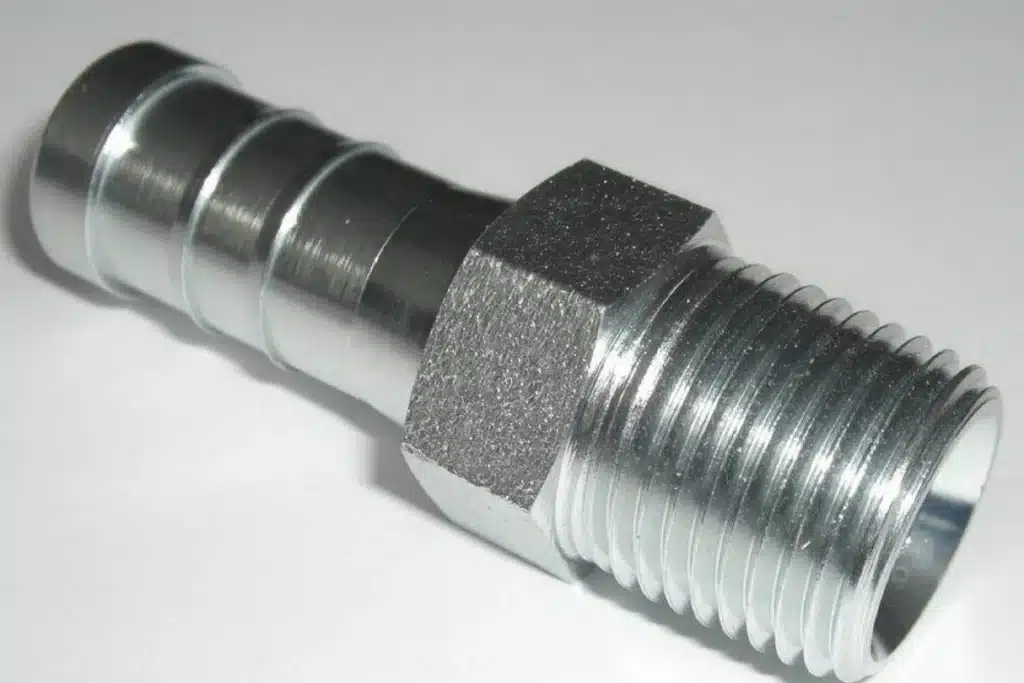
What Are CNC Turning Parts?
CNC turning parts are components produced on CNC lathes or turning centers from round bar stock, tubes, or other cylindrical workpieces. The workpiece rotates while cutting tools remove material to produce precise external and internal features.
They can range from simple pins and spacers to complex components with multiple diameters, internal bores, threads, grooves, tapers, and cross-drilled features. CNC turning is particularly efficient when a part has a predominantly round or rotationally symmetrical geometry.
Definition of CNC Turned Parts
CNC turned parts are custom-machined components made by controlling a turning machine with programmed toolpaths. Instead of manually operating the machine, CNC equipment automatically controls spindle rotation, tool movement, cutting parameters, and machining sequences.
Common CNC turned parts include:
- Shafts and pins
- Bushings and spacers
- Sleeves and rollers
- Fittings and connectors
- Threaded components
- Valve components
- Precision mechanical components
Depending on the machine and part design, turning can also be combined with drilling, boring, tapping, grooving, milling, and other secondary operations.
How CNC Turned Parts Are Manufactured
CNC turned parts typically move through several manufacturing stages:
- Design review: The CAD model and engineering drawing are reviewed for dimensions, tolerances, material, threads, surface finish, and other requirements.
- Material preparation: Round bar, tube, or other suitable stock is selected and cut or loaded into the machine.
- Programming: CAM software generates the toolpaths and machining program based on the part geometry.
- Setup: The workpiece is secured with a chuck, collet, or other workholding system, and the required cutting tools are installed.
- Turning: The machine performs operations such as facing, external turning, boring, grooving, drilling, and threading.
- Inspection: Critical dimensions and features are inspected to verify that the finished part meets the drawing requirements.
For complex parts, live tooling, sub-spindles, or mill-turn machines can complete additional features without transferring the part to another machine. This can reduce setup time and improve positional accuracy.
CNC Turned Parts vs. CNC Milled Parts
The main difference is how the workpiece and cutting tool move.
In CNC turning, the workpiece rotates on the spindle while the cutting tool moves along the part. This makes turning ideal for cylindrical, conical, and rotationally symmetrical components.
In CNC milling, the workpiece is generally stationary while a rotating cutting tool moves across multiple axes. Milling is better suited to flat surfaces, pockets, slots, irregular profiles, and complex 3D geometries.
| Feature | CNC Turning | CNC Milling |
|---|---|---|
| Workpiece | Rotates | Usually stationary |
| Cutting tool | Usually fixed relative to spindle rotation | Rotates |
| Best suited for | Round and cylindrical parts | Prismatic and complex parts |
| Typical parts | Shafts, pins, bushings, fittings | Housings, brackets, plates |
| Common features | Diameters, bores, threads, grooves | Pockets, slots, holes, contours |
Some components require both processes. Mill-turn machining can combine turning and milling in one setup, making it suitable for complex parts with both rotational and non-rotational features.

Types of CNC Turning Parts
CNC turning is used to manufacture a wide range of components, but some part categories are particularly well suited to the process.
Shafts and Pins
Shafts are cylindrical components commonly used to transmit rotation, support bearings, or connect mechanical assemblies. They may include multiple diameters, shoulders, keyways, threads, grooves, or other features.
Pins are generally smaller components used for alignment, positioning, fastening, or pivoting. Examples include dowel pins, clevis pins, locating pins, and hinge pins.
CNC turning provides the dimensional consistency needed for these components to fit accurately with mating parts.
Bushings and Spacers
Bushings are cylindrical components used to reduce friction, guide movement, or provide separation between mating components. They are commonly manufactured from metals or engineering plastics depending on the application.
Spacers maintain a defined distance between components and are often simple cylindrical parts with a central bore.
Because both parts typically have rotationally symmetrical geometry, CNC turning can produce them efficiently and consistently, including different outer diameters, inner bores, lengths, and tolerances.
Sleeves and Rollers
Sleeves are hollow cylindrical components used for shafts, bearings, insulation, alignment, or mechanical protection. Their performance often depends on accurate inner and outer diameters and consistent wall thickness.
Rollers are cylindrical components designed to rotate or guide materials and mechanisms. They may require precise diameters, concentricity, surface finishes, and bearing interfaces.
For long or slender sleeves and rollers, workholding, tool support, and vibration control become especially important to maintain dimensional accuracy.
Fittings and Connectors
CNC turning is widely used for manufacturing fluid, pneumatic, hydraulic, and electrical fittings and connectors.
Typical features include:
- External or internal threads
- Hexagonal or other wrenching sections
- Precision bores
- Sealing surfaces
- Multiple diameters
Brass, stainless steel, aluminum, copper, and engineering plastics are commonly selected depending on the required strength, corrosion resistance, conductivity, and operating environment.
Threaded Components
CNC turning can produce both external and internal threads for screws, studs, threaded adapters, couplings, fittings, and other mechanical components.
Threaded turned parts may require close control of:
- Thread diameter
- Pitch
- Thread depth
- Thread form
- Runout
- Surface finish
For critical threaded components, the machining process should be matched to the required thread specification and verified with appropriate gauges or inspection equipment.
Valves and Fluid Components
CNC turning is well suited to many valve bodies, valve stems, plugs, seats, nozzles, adapters, and other fluid-handling components.
These parts often combine cylindrical surfaces with precise bores, threads, sealing surfaces, and grooves. Dimensional accuracy is particularly important where the component must control fluid flow or interface with seals and mating components.
Material selection also depends heavily on the application. Stainless steel, brass, aluminum, titanium, and engineering plastics may be used according to pressure, temperature, corrosion, and chemical-resistance requirements.
Custom OEM Turned Parts
Custom OEM turned parts are manufactured according to a customer's specific drawings, CAD files, specifications, and production requirements rather than from standard off-the-shelf designs.
OEM CNC turning can support everything from a small prototype run to high-volume production. Depending on the part, a manufacturer may also provide:
- DFM and design feedback
- Material sourcing
- Precision turning
- Live-tool machining
- Secondary milling and drilling
- Surface finishing
- Quality inspection
- Material and inspection documentation
For OEM projects, the goal is not simply to produce a part that matches the drawing once, but to establish a stable and repeatable process that delivers consistent parts throughout production.

Common Features of CNC Turned Parts
CNC turned parts can range from simple cylindrical components to complex parts with multiple machined features. Understanding the most common features helps designers create parts that are easier to machine, inspect, and produce consistently.
External Diameters
External diameters are among the most basic features of a turned part. CNC turning can produce single or multiple diameters, shoulders, steps, and tapered surfaces along the length of a component.
When multiple diameters must work with bearings, seals, bushings, or mating components, their dimensional and geometric tolerances should be clearly specified on the drawing.
Internal Bores
Internal bores are machined into the part using drilling and boring tools. They are common in bushings, sleeves, fittings, shafts, and valve components.
For precision bores, designers should consider the required diameter, depth, tolerance, concentricity, and surface finish. Very deep or narrow bores may require additional tooling or machining strategies.
Threads
CNC turning can produce both external threads and internal threads for fasteners, fittings, connectors, adapters, and mechanical assemblies.
Thread specifications should identify the standard, nominal diameter, pitch, class or tolerance, and required thread depth. Avoid specifying unnecessarily tight thread tolerances unless the application requires them.
Grooves and Undercuts
Grooves are commonly used for retaining rings, seals, O-rings, thread reliefs, and functional clearances.
Undercuts allow certain features to be machined without interference between the cutting tool and the workpiece. However, very narrow or deep grooves can require specialized tooling and increase machining time.
Tapers
Tapered surfaces gradually change in diameter along the length of the part. They are often used in shafts, fittings, connectors, tool holders, and mating components.
The taper angle or relevant dimensional requirements should be clearly defined so the manufacturer can select an appropriate toolpath and inspection method.
Cross Holes and Off-Center Features
Some turned parts require holes or slots that are perpendicular to the main axis or positioned away from the centerline.
These features typically require live tooling or additional milling and drilling operations. If several cross features can be machined in the same setup, the manufacturing process can often be simplified and positional accuracy improved.
Tight-Tolerance Features
Certain turned components require tighter tolerances on critical diameters, bores, threads, or mating surfaces.
Not every dimension needs the same precision. A better approach is to identify functional dimensions that directly affect assembly or performance and apply tighter tolerances only where necessary. This helps control both manufacturing complexity and cost.

CNC Turning Part Design Considerations
A CNC turning design should balance functional requirements, machining capability, inspection requirements, and production cost. A part that looks simple in CAD may become expensive if its geometry requires excessive tool changes, multiple setups, or difficult workholding.
Diameter and Length
The overall diameter and length of a turned part affect machine selection, workholding, tooling, and machining stability.
Extremely large diameters may require a vertical turning machine, while very long and slender components can be more difficult to machine because of deflection and vibration.
Where possible, avoid unnecessarily long unsupported sections and use appropriate support features when the application allows.
Wall Thickness
Thin walls are more susceptible to deformation, vibration, and dimensional variation during machining.
If the design allows, use sufficient wall thickness to maintain rigidity. When thin walls are necessary, the manufacturer may need lighter cutting passes, specialized workholding, or additional support to protect the geometry.
Hole and Bore Design
Hole diameter, depth, and aspect ratio affect tool selection and machining stability.
Deep, small-diameter holes are generally more difficult than short, larger holes because they increase the risk of tool deflection, chip evacuation problems, and dimensional variation.
Designers should also consider whether a hole needs to be drilled, bored, reamed, or otherwise finished to achieve the required accuracy.
Thread Design
Threads should follow an appropriate standard and provide enough thread engagement and tool access for reliable machining.
Avoid placing threads too close to shoulders or bottoms of blind holes unless the design includes suitable thread relief. For critical applications, clearly specify the thread standard and tolerance rather than relying on a generic thread callout.
Grooves and Undercuts
Grooves should provide enough width and depth for the selected cutting tool.
Very narrow grooves, deep undercuts, or unusual profiles can require special tooling and additional machining time. Adding tool clearance and appropriate relief to the design can make these features easier and more economical to manufacture.
Corner Radii and Chamfers
Small corner radii and chamfers can improve part functionality and reduce sharp edges, but their dimensions should be appropriate for the machining process.
Avoid extremely small internal radii when they are not functionally necessary. A larger radius that can be produced with a standard tool is usually easier and faster to machine.
Tolerance Requirements
Tolerances should be based on the actual functional requirements of the component.
Applying tight tolerances to every dimension can significantly increase machining time, inspection requirements, and production cost without improving part performance. Instead, identify critical features such as bearing fits, sealing surfaces, mating diameters, and precision bores and specify tighter tolerances where they matter.
Surface Finish Requirements
Surface finish affects friction, sealing, wear, appearance, and the performance of mating surfaces.
Specify a surface roughness requirement when it is functionally important. Otherwise, a standard machined finish may be sufficient. The required finish can be achieved through tool selection, cutting parameters, finishing passes, polishing, grinding, or other secondary processes, depending on the application.
Workholding Considerations
The way a part is held during machining directly affects accuracy and stability.
Chucks, collets, soft jaws, and other workholding methods may be selected based on the part's diameter, shape, material, and production volume. Designs should provide enough gripping area and avoid features that make secure clamping difficult.
For parts requiring machining on multiple sides, consider whether they can be completed using sub-spindles, live tooling, or mill-turn machining to reduce the number of setups.
Design for CNC Turning Manufacturability
Good CNC turning design is not simply about making the geometry possible. It is about making the part stable to machine, straightforward to inspect, and economical to produce.
A practical DFM review should ask:
- Can standard turning tools access the required features?
- Is the part rigid enough during machining?
- Are tolerances limited to critical features?
- Can multiple operations be completed in one setup?
- Are threads, grooves, and bores designed for reliable tooling access?
- Can the selected material be machined efficiently?
- Are the inspection requirements appropriate for the part's function?
Addressing these questions before production can reduce unnecessary machining steps, improve consistency, and prevent costly design changes later.

CNC Turned Part Materials
The material used for a CNC turned part affects machinability, cutting parameters, tool wear, surface finish, dimensional stability, and final performance. The right choice depends on the part's mechanical, thermal, electrical, and environmental requirements.
Aluminum
Aluminum is one of the most commonly CNC turned materials because it is lightweight, corrosion-resistant, and highly machinable. Alloys such as 6061 and 7075 are widely used for shafts, housings, fittings, and other precision components.
Its good machinability also makes aluminum suitable for both prototypes and high-volume production.
Stainless Steel
Stainless steel provides high strength, corrosion resistance, and durability, making it suitable for demanding mechanical and industrial applications.
Common grades such as 303, 304, and 316 are used for fittings, shafts, connectors, medical components, and fluid-handling parts. More difficult grades require careful control of cutting speed, feed rate, tooling, and heat.
Brass
Brass is highly machinable and produces clean chips, good surface finishes, and fast cycle times. It is widely used for fittings, connectors, valves, fasteners, and electrical components.
Grades such as C360 are particularly well suited to high-speed CNC turning.
Copper
Copper offers excellent electrical and thermal conductivity, making it useful for electrical connectors, terminals, heat-transfer components, and specialized industrial parts.
However, its softness and tendency to generate burrs or adhere to cutting tools require appropriate tooling and cutting parameters.
Titanium
Titanium combines high strength-to-weight ratio, corrosion resistance, and excellent performance at elevated temperatures. It is commonly used for aerospace, medical, robotics, and high-performance mechanical components.
Titanium is more difficult to turn than aluminum or brass because of its low thermal conductivity and high cutting forces, so rigid setups and carefully controlled machining parameters are important.
Plastics
CNC turning can produce precision parts from a wide range of engineering plastics, including POM (Delrin), Nylon, PTFE, PEEK, ABS, and UHMW-PE.
Plastic turned parts are commonly used for bushings, spacers, seals, rollers, insulators, and lightweight mechanical components. Material selection should consider wear, friction, temperature, chemical resistance, dimensional stability, and load requirements.

CNC Turning Secondary Operations
Many CNC turned parts require additional machining or finishing after the primary turning operation. Secondary operations can add functional features, improve appearance, or achieve the required dimensional and surface requirements.
Milling
Milling adds non-rotational features such as flats, slots, pockets, keyways, and cross holes to turned parts.
Live tooling on CNC turning centers or mill-turn machines can often perform these features without moving the part to a separate machine.
Drilling
Drilling creates axial or cross holes in turned components. It is commonly used for shafts, fittings, connectors, valve components, and housings.
For precision holes, drilling may be followed by boring, reaming, or other finishing operations.
Tapping
Tapping produces internal threads in drilled holes for screws, fasteners, fittings, and assembly features.
The tap size, thread specification, hole diameter, depth, and material all need to be considered to achieve reliable threads without damaging the part.
Deburring
Machining can leave small sharp edges or burrs around holes, grooves, threads, and parting features. Deburring removes these unwanted edges to improve safety, assembly, appearance, and functional performance.
Depending on the part, deburring may be performed manually or through controlled mechanical processes.
Surface Finishing
Surface finishing can improve corrosion resistance, wear resistance, appearance, or surface properties.
Depending on the material and application, CNC turned parts may receive anodizing, passivation, plating, polishing, bead blasting, painting, or other finishing processes.
Heat Treatment
Heat treatment changes the material's hardness, strength, wear resistance, or internal stresses after or during the manufacturing process.
Processes such as annealing, hardening, tempering, and stress relieving may be used depending on the material and application. For precision turned parts, post-machining dimensional changes caused by heat treatment should be considered during manufacturing.

CNC Turning Parts for Different Production Volumes
CNC turning can support everything from a single prototype to high-volume production. The most suitable production approach depends on part complexity, quantity, tolerance requirements, tooling, and target cost.
CNC Turning Prototypes
CNC turning is well suited for prototypes because parts can be produced directly from CAD files and engineering drawings without expensive dedicated tooling.
Prototype turning allows engineers to verify dimensions, fit, function, and manufacturability before committing to larger production quantities. It is commonly used for new product development and design validation.
Low-Volume Production
Low-volume production typically involves producing a limited number of parts while maintaining production-level quality and consistency.
CNC turning is economical for these projects because the same machines and programs used for prototypes can often be adapted for production. Flexible setups and minimal tooling requirements make it practical for small batches and custom components.
Batch Production
Batch production is suitable when the same CNC turned part is required in repeated production runs.
Manufacturers can optimize toolpaths, workholding, cutting parameters, and inspection procedures to improve cycle time and maintain consistent quality across each batch. Automated bar feeding can further improve production efficiency.
Mass Production
Mass production requires high repeatability, stable processes, and efficient machine utilization.
For high-volume CNC turning, manufacturers may use bar feeders, automated material handling, multi-spindle or multi-axis turning centers, and optimized cycle times. The goal is to maintain consistent part quality while reducing machining and handling costs per part.

CNC Turning Part Quality Control
Quality control ensures that CNC turned parts meet the required dimensions, tolerances, material specifications, and surface requirements.
Dimensional Inspection
Critical dimensions such as outer diameters, lengths, shoulders, and hole diameters are checked using precision measuring equipment.
Depending on the tolerance requirements, manufacturers may use calipers, micrometers, height gauges, optical equipment, or CMMs to verify part dimensions.
Thread and Bore Inspection
Threads and bores require dedicated inspection because they directly affect assembly, sealing, and component fit.
Internal and external threads can be checked with thread gauges, while bore diameters and depths can be verified using bore gauges, plug gauges, micrometers, or CMM inspection.
Surface Finish Inspection
Surface finish is inspected when it affects friction, sealing, wear, appearance, or component performance.
A surface roughness tester can be used to verify specified Ra or other surface finish requirements, particularly on precision sealing and mating surfaces.
Material Certification
Material certification confirms that the supplied material matches the specified grade and applicable material requirements.
For critical applications, documentation may include material certificates, heat numbers, and other traceability information to verify the material used in production.
Inspection Reports
Inspection reports document measured results and provide evidence that the finished parts meet the required specifications.
Depending on the project, documentation may include dimensional inspection reports, first article inspection reports, material certificates, and other quality records.

CNC Turning Parts Applications
CNC turned parts are used across industries because the process can produce precise components with consistent dimensions and repeatable quality.
Automotive Components
Automotive applications include shafts, pins, bushings, spacers, fittings, connectors, valve components, and fasteners.
These parts often require reliable dimensional accuracy and consistent production quality for use in engines, transmissions, braking systems, fuel systems, and vehicle assemblies.
Robotics Components
CNC turned parts are commonly used in robot joints, shafts, pins, bushings, spacers, bearings interfaces, and precision connectors.
Tight tolerances and repeatability are particularly important where components must maintain accurate alignment and smooth mechanical movement.
Medical Components
Medical CNC turned parts include surgical instrument components, orthopedic components, precision shafts, connectors, fittings, and other small rotational parts.
Depending on the application, materials such as stainless steel, titanium, and medical-grade engineering plastics may be selected, with strict requirements for dimensional accuracy and surface quality.
Aerospace Components
Aerospace applications demand lightweight, strong, and highly reliable components. CNC turning is used for shafts, pins, fittings, connectors, bushings, fasteners, and other precision components.
Materials such as aluminum, titanium, stainless steel, and nickel-based alloys may be used depending on the application requirements.
Industrial Components
Industrial equipment uses CNC turned parts for valves, fittings, shafts, rollers, bushings, couplings, hydraulic components, and mechanical hardware.
The required material and tolerances vary widely depending on factors such as load, pressure, temperature, wear, and corrosion exposure.
Electronics Components
CNC turning is used to manufacture small connectors, terminals, pins, housings, spacers, threaded components, and precision hardware for electronic equipment.
Brass, copper, aluminum, stainless steel, and engineering plastics are commonly used according to the required electrical, mechanical, and dimensional properties.

Custom CNC Turning Parts from Prototype to Production
Custom CNC turning provides a complete manufacturing path from initial design and prototyping to repeat production. A well-managed process helps identify manufacturing issues early and maintain consistent quality as production volume increases.
CAD and Drawing Review
The process starts with reviewing the customer's 3D CAD files and 2D engineering drawings.
Key requirements such as material, dimensions, tolerances, threads, surface finish, quantity, and inspection requirements are checked before machining begins. This helps identify unclear or conflicting specifications before they affect production.
DFM Feedback
Design for Manufacturability (DFM) feedback helps determine whether a part can be machined efficiently and consistently.
Manufacturers may recommend changes to tolerances, wall thickness, grooves, threads, tool access, or other features when they could improve machinability, reduce machining time, or lower production cost without affecting part function.
Prototype Manufacturing
A prototype provides a physical part for fit, function, dimensional verification, and design validation before full production.
CNC turning is particularly useful for prototypes because the same manufacturing process can often be used later for production, reducing the transition from prototype to production.
Production Scaling
Once the design has been validated, production can be scaled from small batches to larger quantities.
Production efficiency can be improved through optimized programs, dedicated workholding, bar feeding, automated inspection, and stable process parameters. The objective is to maintain consistent dimensions and quality as order quantities increase.
Secondary Processing and Finishing
Some turned parts require additional operations after turning to achieve their final functionality or appearance.
Depending on the design, these may include milling, drilling, tapping, deburring, polishing, anodizing, plating, passivation, or heat treatment. Combining these services through one manufacturing partner can simplify production and reduce additional handling.

CNC Turning Parts FAQs
What are CNC turning parts?
CNC turning parts are components manufactured by rotating metal or plastic stock while computer-controlled cutting tools remove material to create the required geometry. They are commonly used for shafts, pins, bushings, fittings, sleeves, and threaded components.
What materials can be used for CNC turned parts?
Common materials include aluminum, stainless steel, brass, copper, titanium, steel, and engineering plastics such as POM, Nylon, PTFE, and PEEK. The best material depends on the part's strength, wear, temperature, corrosion, electrical, and dimensional requirements.
How accurate are CNC turned parts?
The achievable accuracy depends on the machine, material, geometry, tooling, tolerance requirements, and production process. Standard CNC turning can achieve tight dimensional tolerances, while precision turning and controlled inspection processes can be used for more demanding applications.
Can CNC turning produce complex parts?
Yes. Advanced CNC turning centers can produce parts with multiple diameters, bores, threads, grooves, tapers, cross holes, and other features. Mill-turn machines can also combine turning with milling operations for more complex components.
Can CNC turning be used for prototypes?
Yes. CNC turning is suitable for single prototypes and small quantities because parts can be produced directly from CAD files and drawings without dedicated production tooling.
What is the minimum order quantity for CNC turned parts?
There is no universal MOQ. CNC turning can support one-off prototypes, small batches, and high-volume production. The most economical quantity depends on setup time, material, part complexity, and production requirements.
How long does it take to manufacture CNC turned parts?
Lead time depends on part complexity, material availability, quantity, tolerance requirements, finishing, and current production capacity. Simple prototypes can often be produced much faster than complex, high-volume orders requiring multiple secondary processes.
Can CNC turned parts receive surface finishing?
Yes. Depending on the material and application, turned parts can receive anodizing, plating, passivation, polishing, bead blasting, painting, and other surface treatments after machining.
How are CNC turned parts inspected?
Inspection may include micrometers, calipers, bore gauges, thread gauges, optical inspection, CMM measurement, and surface roughness testing. The inspection method is selected according to the part's critical dimensions and quality requirements.
How do I get a quote for custom CNC turning parts?
Provide the manufacturer with your 3D CAD file or 2D drawing, material, required quantity, tolerances, surface finish, and delivery requirements. For complex or critical parts, inspection and certification requirements should also be included so the quotation reflects the complete manufacturing scope.
