





Key Takeaways
Standard press brake bending tolerances hold to ±0.010″ to ±0.015″, while precision laser cutting of the flat pattern maintains ±0.005″ positional accuracy.
Inside bend radii must equal at least 1x the material thickness (1T) to prevent outer radius micro-cracking in materials like 5052-H32 aluminum and 304 stainless steel.
Replacing initial progressive dies with CNC laser cutting and simple air bending reduces initial prototyping setup costs by up to 80% for low-volume verification runs.
Selecting the Right Sheet Metal Forming Process
Laser cutting combined with CNC press brake air bending is the fastest and most cost-effective custom sheet metal fabrication method for rapid prototyping. This approach eliminates the need for hard tooling, allowing engineers to program flat patterns directly from CAD and form geometries within hours.
Process selection dictates process capability. A standard US job shop charging $120–$180/hr will default to the equipment they have open, not necessarily the equipment your tolerance requires. Air bending on a CNC press brake is standard, but it leaves the final angle highly dependent on material thickness variation. Bottom bending forces the material into the die, yielding tighter angular tolerances but requiring significantly higher tonnage and tooling investment.
This is where most RFQs break down. You will see an engineer drop a ±0.005″ true position tolerance on a hole pattern spanning across three bent flanges. You cannot hold that level of precision across multiple air bends without post-machining. If true position must be maintained across bends to ASME Y14.5-2018 standards, the process must shift from sheer forming to post-bend CNC milling.
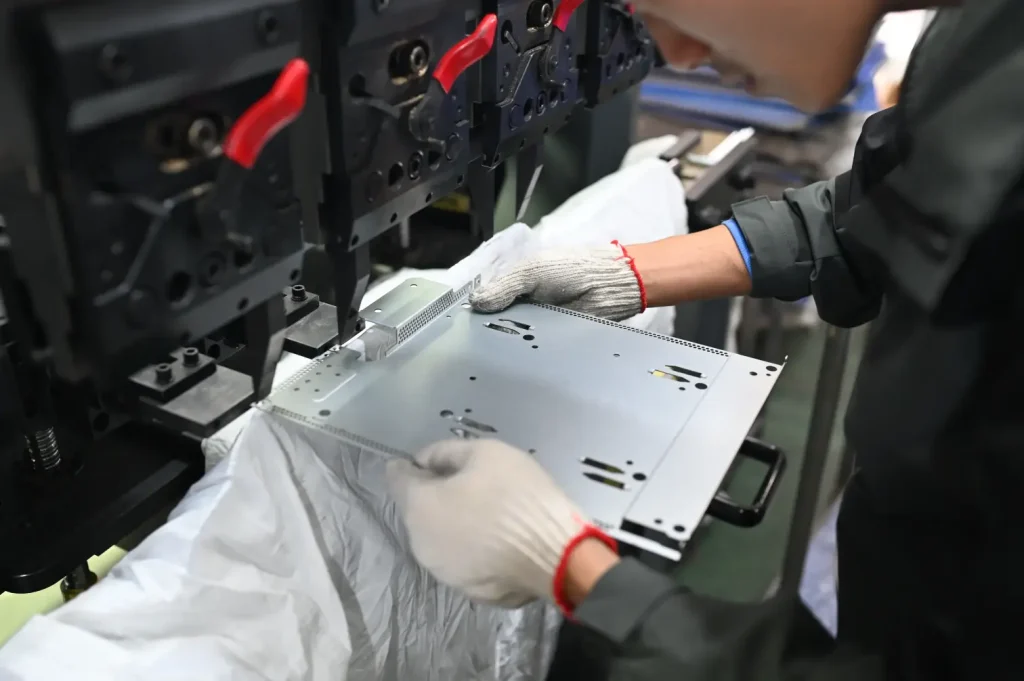
If your timeline is tight, leverage global engineering shifts. A US design team can submit a complex bracket design at 5 PM EST. Using the Shenzhen time zone advantage, DakingsRapid engineers review the flat pattern overnight, returning a quoted and DFM-verified model by 8 AM the next morning.
Core Sheet Metal Materials and Springback Behavior
Yield strength determines your springback. It is that simple.
When you bend a piece of aluminum, the inner radius compresses and the outer radius stretches. Upon release of the bending force, the material attempts to return to its original flat state. Designing a sheet metal prototype without calculating the K-factor for your specific material grade guarantees dimensional failure.
You cannot command a material to ignore its grain structure. A hard temper material like 6061-T651 aluminum is notorious for micro-cracking if bent parallel to the grain. Engineers often specify this grade for its high yield strength, then wonder why the outer radius of a 90-degree bend fractures. Annealing the bend zone or stepping down to a more formable 5052-H32 grade is standard shop-floor practice.
ASTM B209 5052-H32: Excellent formability, low yield strength. Ideal for tight radii.
ASTM B209 6061-T651: High strength, prone to cracking. Requires an inside bend radius of at least 3T to 6T.
304/316 Stainless Steel: High strain-hardening rate. Demands immense tonnage and requires over-bending to account for severe springback.
Material traceability starts before the first cut. Insist on Mill Test Reports (MTRs) to verify the exact chemical composition and mechanical limits of the batch. During the First Article Inspection (FAI), DakingsRapid uses CMM measurement systems to verify that the formed angles and final springback settle within the required ±0.5° angular tolerance.
Standard K-Factors and Minimum Bend Radii by Material Grade
Add Your Heading Text Here
| Material Grade | Thickness | Min Bend Radius (Inside) | Estimated K-Factor |
|---|---|---|---|
| 5052-H32 Aluminum | 0.063" | 1T (0.063") | 0.42 |
| 6061-T651 Aluminum | 0.125" | 3T (0.375") | 0.45 |
| 304 Stainless Steel | 0.063" | 1T (0.063") | 0.40 |
Sheet Metal Design Guidelines for Manufacturability (DFM)
That tolerance looks harmless on the drawing.
Then you realize the 0.125″ diameter hole is placed exactly 0.100″ from the bend line. When the press brake punch engages, the metal pulls and stretches into the die cavity. That perfectly round hole stretches into an oval. The fastener will not clear, and the part becomes scrap.
Minimum hole-to-bend distance must always exceed 2.5 times the material thickness plus the bend radius. If a feature must live closer to the bend, the shop floor has to either punch the hole after forming or laser cut a relief slot between the hole and the bend line to isolate the stress.

Consider the implications of edge condition. Standard laser-cut edges possess a localized heat-affected zone (HAZ) and striation marks. If a cosmetic or sealing surface requires an Ra 0.8 surface finish, the laser-cut edge must be oversized and CNC milled to the final dimension.
Often, designs lack proper bend reliefs where a flange terminates within a longer straight edge. Tearing will occur at the base of the flange during the bend. DakingsRapid routinely issues DFM feedback to add circular bend reliefs—sized to at least the material thickness—preventing tearing and ensuring the process capability maintains a Cpk > 1.33 over a production run.
Rapid Tooling for Sheet Metal Geometries
Rapid tooling for sheet metal uses temporary machined aluminum or 3D-printed polymer dies to form complex prototypes without the capital expense of hardened steel progressive dies.
Engineers frequently quote deep drawn prototypes using standard air bending geometry.
This physical impossibility halts production on day one. You cannot air-bend a compound curve. Forming localized flanges, ribs, or dimples in alloys like 6061-T651 requires matched tooling to control material flow and prevent shear tearing. Domestic US job shops typically charge $120–$180/hr, making the machining of temporary P20 or aluminum dies for a 10-piece prototype run economically prohibitive.
Instead of waiting weeks for production tooling, soft tooling bridges the gap. DakingsRapid routinely mills temporary V-dies and custom punches from 7075 aluminum to form complex geometries and validate structural feasibility within days.

Soft tooling withstands 50 to 500 strikes depending on the sheet metal gauge.
Urethane bottom dies eliminate surface marring, which is critical for cosmetic panels.
Tool design iterations take hours, not weeks, allowing for rapid geometry adjustments.
Quality Inspection and Dimensional Validation
This is where phantom tolerances destroy project budgets.
A designer slaps a 0.02 mm true position callout on a hole pattern spanning across two parallel bent flanges. That tolerance looks harmless on the drawing.
In reality, sheet metal holds residual stress. Once removed from the press brake, the material flexes. Inspecting that 0.02 mm true position in a free state will result in a failed part every single time. Under ASME Y14.5-2018 standards, non-rigid parts require specific restraint notes on the drawing before inspection. Otherwise, the CMM will reject parts that would perfectly align once bolted to the chassis.
Precision requires absolute verification at every step of the operation. We map the flat pattern profiles using optical comparators to verify the laser cutter holds to ±0.005mm before a single bend is made. For post-bend critical features, like a CNC-machined sealing face requiring an Ra 0.8 surface finish, inspection shifts to tactile measurement. DakingsRapid validates these complex folded geometries by executing automated CMM inspection routines, ensuring the setup maintains a Cpk > 1.33 across the low-volume run.
Standard Inspection Methods for Sheet Metal Prototypes
Managing Prototype Transitions and Logistics
Purchasing departments often assume a successful prototype automatically guarantees a flawless 10,000-piece production run.
The physics change at scale. A bracket manually positioned against a CNC press brake backgauge behaves entirely differently than a continuous coil fed through a 200-ton progressive stamping press. Prototyping proves the concept; the transition proves the process capability.
Traceability is non-negotiable when shifting from low-volume sheets to high-volume coils. You must demand Mill Test Reports (MTRs) to verify the production coil matches the exact ASTM specifications (such as ASTM B209 for aluminum alloys) used during prototyping. A slight deviation in yield strength between the prototype sheet and the production coil will drastically alter the springback, throwing all hard tool geometry out of tolerance.

Shipping delays often negate the speed of rapid manufacturing. Utilizing DDP shipping, DakingsRapid lands validated custom sheet metal prototypes directly at US engineering facilities, bypassing the standard customs holding patterns that typically add weeks to a product development cycle.
Final Engineering & Sourcing Verdict
Soft tooling cuts upfront capital expenditure for low-volume runs, bypassing the extended lead times and high costs of hardened progressive dies.
Validating ASTM material specs via Mill Test Reports (MTRs) during prototyping prevents unpredictable springback failures when scaling to high-volume coil stock.
Specifying post-bend CNC milling for critical datum alignments eliminates the high scrap rates associated with chasing multi-flange air bending tolerances.
FAQ
What is the standard tolerance for custom sheet metal fabrication?
Typically ±0.005 to ±0.015 inches. Laser-cut flat profiles easily hold the tighter end. Folded dimensions run looser because air bending relies on material thickness consistency and V-die widths. If you need tighter control, add a post-machining operation.
How does material grain direction affect the bending process?
It dictates fracture risk. Sheet stock is rolled at the mill, creating a directional structure. Forming parallel to that line often splits the outer radius, especially in hard tempers like 6061-T6. Always orient critical flanges perpendicular to it.
Why is my sheet metal prototype cracking at the bend?
The inside radius is too tight for the alloy. It happens when you specify less than 1T for soft grades or less than 3T for hard tempers. Bending parallel to the grain or skipping localized annealing also causes structural failure.
What are the primary cost drivers in sheet metal prototypes?
Setup time. Every unique bend radius requires the operator to physically swap out the punch and die on the press brake. Standardize your inner radii across the entire part to eliminate changeovers and slash the machining rate.
How do I calculate the correct flat pattern for my design?
Subtract the bend deduction from the sum of the outside flange lengths. That deduction relies on the K-factor, which shifts based on your material yield strength, gauge, and the exact V-die width the shop floor uses.
Can true position be held across multiple bent flanges?
No. Stacked tolerances in air bending make holding tighter than 0.02 mm across independent folds nearly impossible. The residual stress flexes the part in its free state. To meet strict ASME alignments, you must CNC mill the features after forming.
Related popular articles

Written By
Ryan
Conscientious sales engineer at DakingsRapid with demonstrated experience working in the machine and parts manufacturing industry. Ability to independently manage sales operations for commodities and proficiency in quality customer service.
