





Both materials are legitimate workhorses. Carbon fiber (CFRP) dominates in aerospace, motorsport, and high-performance wearables. Aluminum 6061 runs the factory in everything else. Choosing wrong for a prototype doesn’t just cost money — it costs weeks. I’ve watched teams burn through a third of their prototype budget on CFRP parts that were going to sit on a desk for a fitment check. I’ve also seen engineers spec aluminum on a drone frame that needed to fly, then spend two months doing a full redesign.
So let’s get into it — weight and strength first, then what actually happens on the shop floor, then the cost breakdown, and finally a decision framework you can use on your next project.
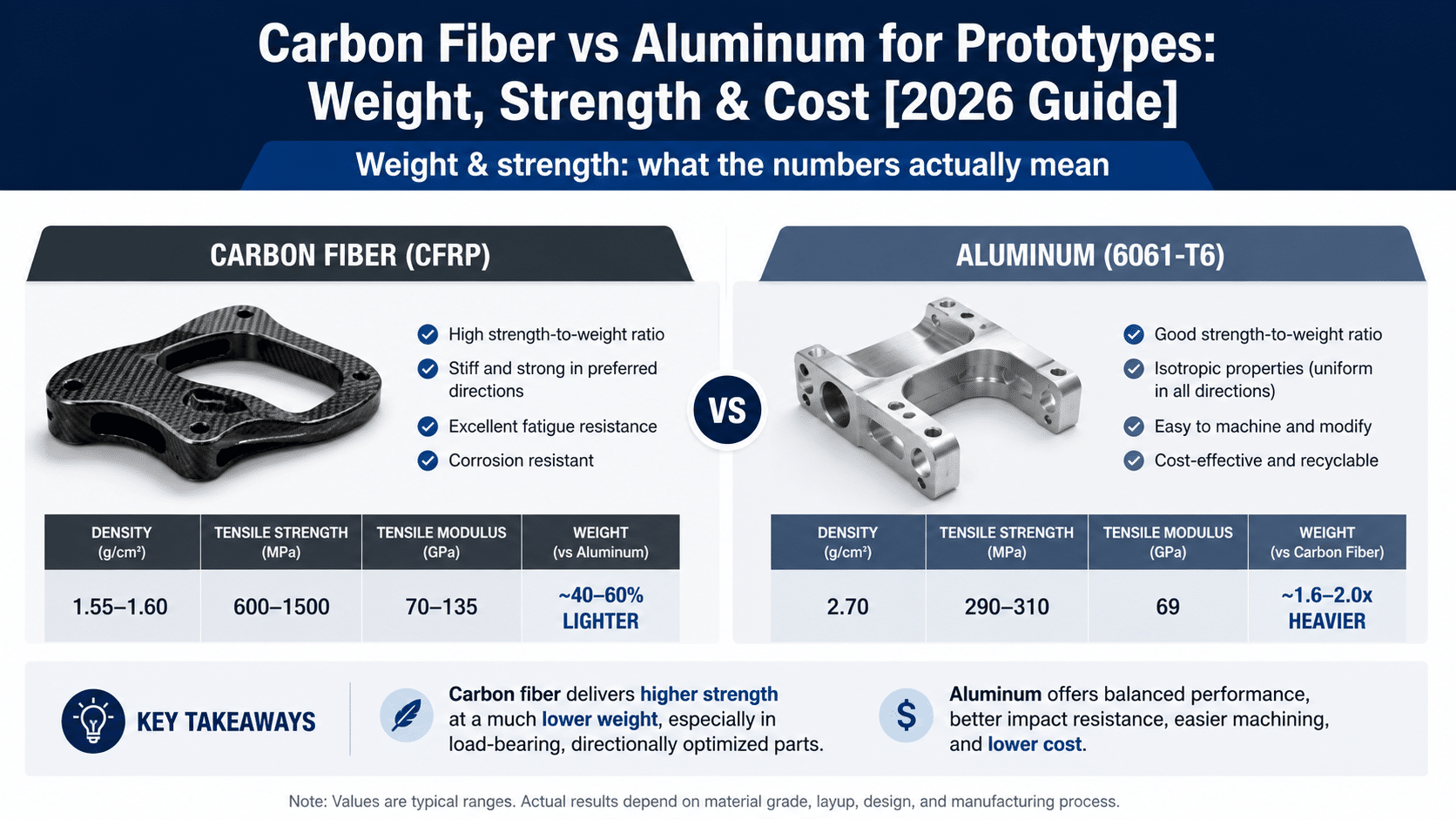
Weight & strength: what the numbers actually mean
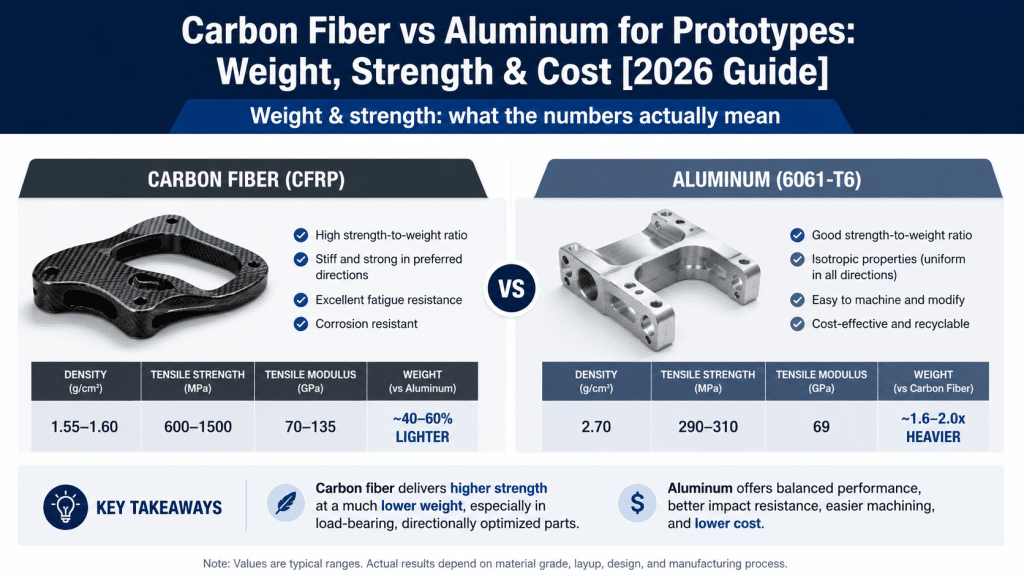

CFRP density
1.6 g/cm³
~40% lighter than aluminum
Aluminum 6061-T6
2.7 g/cm³
Standard prototype alloy
CFRP tensile strength
~1,500 MPa
Along fiber axis only
Aluminum 6061-T6
~310 MPa
Same in every direction
Here’s the thing nobody tells you about CFRP’s impressive tensile numbers: that strength is directional. Carbon fiber is phenomenally stiff along the fiber axis and noticeably weaker across it. Aluminum doesn’t care which way you load it — it behaves the same in every direction, which engineers call isotropic. When you’re prototyping a part whose load paths haven’t been fully validated yet, that predictability is worth a lot. A CFRP bracket that wasn’t laid up with the right fiber orientation for your specific load case is going to disappoint you.
When weight actually matters — and when it’s just expensive theater
Before you spec CFRP on anything, ask yourself one question: does the weight of this specific part affect the outcome of this specific test? If you can’t say yes clearly, aluminum is probably your answer.
Weight is a genuine functional requirement when you’re building:
- UAV and drone frames — every gram directly trades off against flight time and payload
- Handheld medical or consumer devices — user fatigue and balance studies need production-representative weight
- Wearable tech and exoskeletons — biomechanics and comfort testing are entirely weight-dependent
- Late-stage validation prototypes — when the part is going into an end user’s hands, it needs to feel like the real thing
- Motorsport suspension and aero components — unsprung mass is a real variable in handling data
Weight doesn’t matter much — and CFRP’s premium isn’t justified — when you’re building:
- Form and fit checks — verifying geometry, not structural performance
- Assembly workflow validation — testing how components come together
- Bench-test brackets, jigs, and fixtures — these never leave the workbench
- Early-stage structural housings — before load analysis is finalized and frozen
Machinability & lead time: the shop floor reality
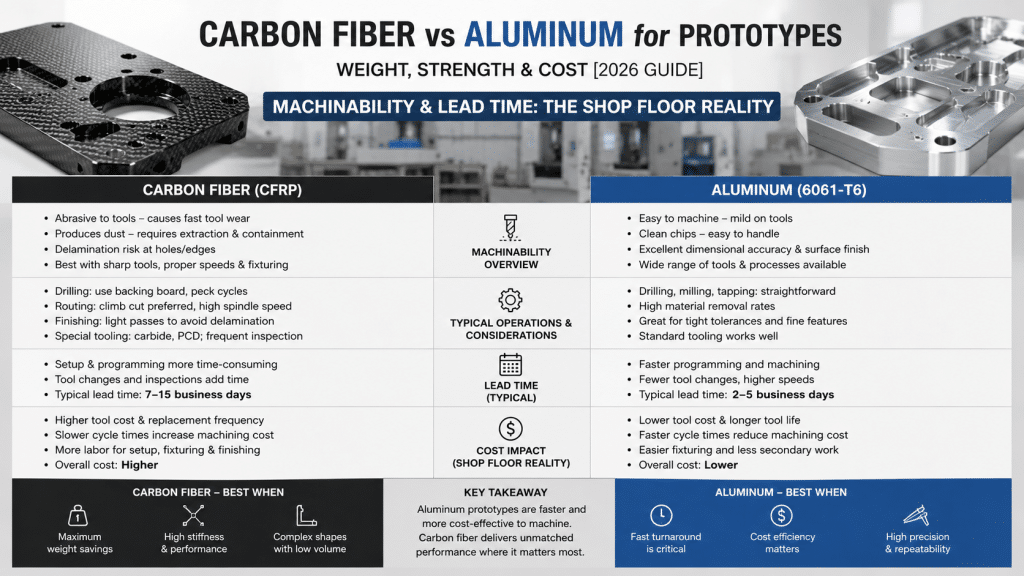
This is where the cost and timeline differences actually come from. Most engineers never see this part.
Aluminum: genuinely fast and forgiving
6061-T6 aluminum is the kind of material a CNC shop loves. Here’s what that translates to for your program:
- Fast cycle times — we can push aluminum hard; feed rates and spindle speeds that would destroy a CFRP setup are totally normal for aluminum
- Tight, repeatable tolerances — ±0.01mm is routine on our 5-axis machines for most aluminum features
- Friendly to design changes — add a boss, shift a hole, deepen a pocket — aluminum often tolerates re-machining rather than scrapping the whole part
- Standard tooling — carbide end mills, standard taps, no specialty setup required
- Full finishing options — Type II and Type III anodizing, bead blast, powder coat, or paint; all straightforward and relatively inexpensive
For a moderately complex structural prototype, our typical CNC aluminum lead time at DakingsRapid runs 2–5 business days from confirmed drawing.
Carbon fiber: specialized, slower, and unforgiving
CFRP machining is a different discipline. The abrasive carbon fibers chew through standard carbide tooling fast, and the machining environment requires genuine infrastructure. Here’s what a proper CFRP setup actually looks like:
- Diamond-coated or PCD tooling — polycrystalline diamond is the standard; it costs significantly more than carbide and doesn’t last as long on CFRP as it does on other materials
- Dry cutting or specialized coolant — standard flood coolant can cause delamination between fiber plies; high-velocity dry cutting is often preferred to protect edge quality
- A fully isolated machining cell — carbon dust is electrically conductive and a respiratory hazard; at DakingsRapid we run dedicated CFRP cells with enclosed extraction systems, totally separate from our aluminum lines
- Slower feed rates — to prevent heat buildup, fiber pullout, and edge delamination
- Careful fixturing — CFRP plate must be fully supported to prevent vibration that causes surface damage
Unlike aluminum, CFRP can't be re-machined or reworked after the fact. If a feature is wrong or a design revision comes through after cutting, the part is scrap. On programs where the geometry is still evolving, this is a real scheduling risk.
Typical CFRP prototype lead time at DakingsRapid runs 5–10 business days — roughly double aluminum. That extra time comes from setup, tooling prep, and the care required to hold edge quality on a material that doesn't forgive sloppy process.
| Factor | Carbon fiber (CFRP) | Aluminum 6061-T6 |
|---|---|---|
| Typical proto lead time | 5–10 business days | 2–5 business days |
| Tooling | Diamond-coated / PCD only | Standard carbide |
| Design change after cutting | Scrap and restart | Often re-machinable |
| Finishing options | Paint or clear coat (limited) | Anodize, bead blast, powder coat |
| Threading | Requires Helicoil or press-fit inserts | Direct tapping in most alloys |
| Machining environment | Isolated cell, dust extraction required | Standard CNC environment |
Real factory case study: the drone team that got it right the second time
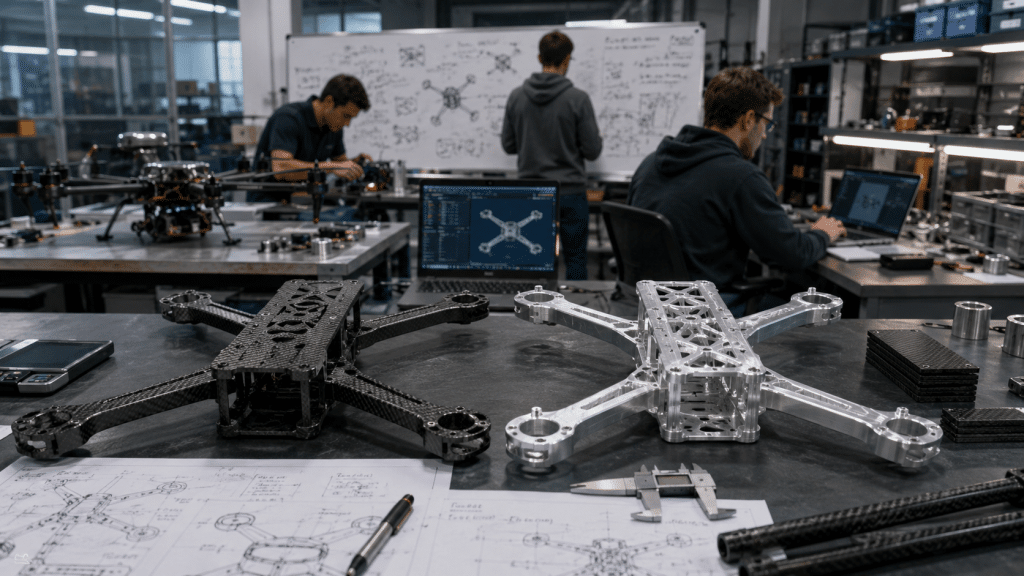
This one sticks with me because it’s a mistake I’ve seen more than once — just usually with a worse ending.
Case study: industrial inspection UAV — frame prototyping program
DakingsRapid · Shenzhen · Prototype iteration cycle
A few years back, a drone hardware startup came to us with designs for an industrial inspection UAV. Their target flight time was 45 minutes at a 2kg payload — tight margins that genuinely demanded a lightweight frame. The engineering lead knew they'd be using CFRP in production, so their instinct was to run CFRP from prototype iteration one.
We pushed back. At that stage, they still had maybe four or five geometry revisions ahead of them — motor mounts weren't finalized, the gimbal attachment point was changing, and the arm folding mechanism was still in flux. Every one of those revisions on CFRP would've meant scrapping the whole frame and restarting machining from scratch. The cost per revision cycle in CFRP would've been $400–600 per frame, with a 7-day turnaround each time.
"We thought using CFRP from day one would save us a whole design stage. What it actually would've done is burn through our prototype budget on parts we'd immediately scrap."
Instead, we ran the first three iteration cycles in 6061 aluminum — same geometry, same tolerances, roughly $90–110 per frame, 3-day turns. They validated the geometry, locked the motor mount positions, finalized the arm mechanism, and confirmed the assembly workflow. Only when the design was frozen did we switch to CFRP for the final functional validation unit — the one that actually went up in the air and tested flight time.
Total prototype spend across all iterations: significantly less than if they'd run CFRP throughout. And the functional CFRP frame that mattered — the one that proved out the 45-minute flight target — was built on a design that had been properly de-risked in aluminum first.
ALUMINUM ITERATIONS
3 cycles · ~$300 total
CFRP VALIDATION UNIT
1 unit · $520 · proven design
The lesson here isn’t “don’t use carbon fiber.” It’s “don’t use carbon fiber before your design is ready for it.” The material isn’t the problem. The timing is.
Not sure if your prototype needs carbon fiber or aluminum?
Send us your 3D files and a one-paragraph brief on your application and test requirements. Our engineering team reviews for manufacturability and gives you a straight material recommendation — not just the most expensive option.
Get a free DFM reviewCost: what you're actually paying for
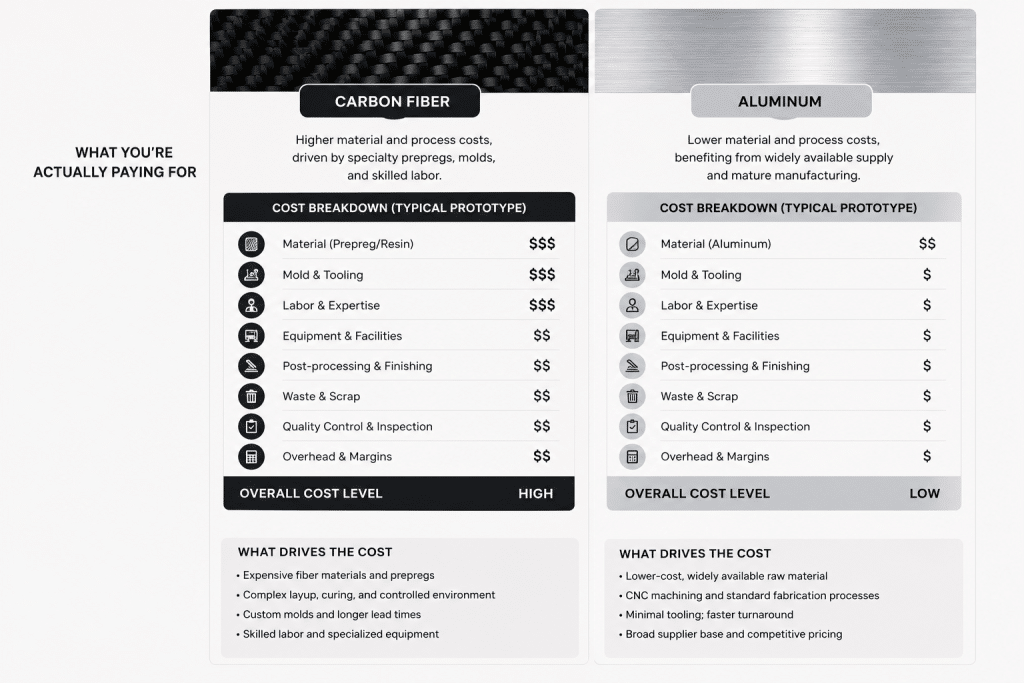
For a moderately complex structural bracket — 150 × 80 × 20mm, with pockets, through-holes, and a handful of tapped features — here’s where the money goes.
Aluminum 6061 (1 pc)
2–3 day lead time
Carbon fiber CFRP (1 pc)
5–8 day lead time
Cost multiplier
Proto quantities (1–20 pcs)
Break-even volume
Where overhead amortizes
Where the cost gap actually comes from
- Raw material — CFRP plate stock is more expensive than 6061 billet before a single spindle revolution happens
- Tooling wear — diamond and PCD tooling costs money, wears faster on carbon fiber, and those costs pass through on small-batch work where there’s no volume to absorb them
- Setup and cycle time — lower feed rates, dedicated cell prep, and slower cutting all add up to more machine hours per part
The hidden BOM costs that surprise procurement teams
The machined part price is just the start. Budget for these too:
- Galvanic corrosion protection — CFRP is electrically conductive and sits very high on the galvanic series. Direct contact with aluminum hardware creates a corrosion cell. You’ll need titanium fasteners, isolating bushings, or a barrier coating. This adds cost and lead time to your BOM and is easy to miss at the quoting stage
- Threaded inserts — direct tapping in CFRP isn’t reliable long-term; Helicoil or press-fit inserts are standard, adding per-feature cost
- Bonding adhesives — if your assembly uses bonded joints, CFRP-compatible structural adhesives carry a premium over standard epoxy
Decision framework: how to spec it right
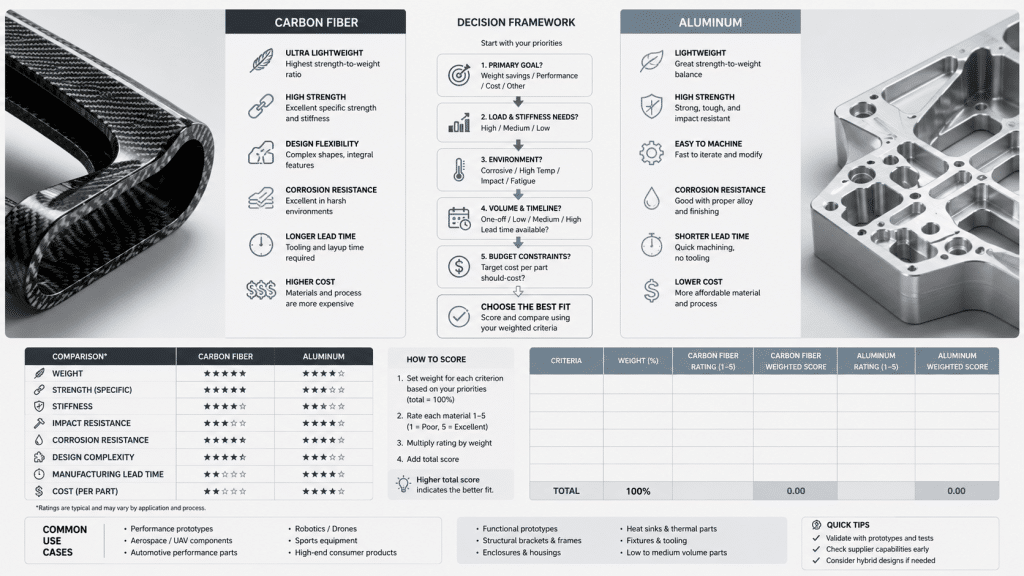
The mental model we use when customers ask us to weigh in: default to aluminum, justify carbon fiber.
CFRP earns its spot when weight is a tested variable, the design is frozen, and the prototype is going somewhere that actually requires it. Here’s how the decision actually plays out:
Carbon fiber — use it when:
- Weight directly affects a measured test outcome
- You're in late-stage validation — end user will handle it
- Design is fully frozen, no revisions coming
- Stiffness-to-weight is a non-negotiable requirement
- Budget and schedule are planned to absorb the premium
Aluminum — use it when:
- Early-to-mid design iteration, changes are still coming
- Form, fit, or assembly check — weight isn't the variable
- Budget or schedule is under any kind of pressure
- You need standard fasteners and direct-tapped features
- You want the option to re-machine if something changes
Three questions before you finalize the material spec
Run through these. If you can’t say yes to at least two, aluminum is almost certainly the right call for this stage:
Summarize
These two materials aren’t really competing with each other — they’re built for different phases of a program. Carbon fiber belongs in late-stage, weight-critical, frozen-design validation. Aluminum belongs in the iteration cycles that get you there. The engineers who spec material well aren’t the ones who always reach for the most advanced option. They’re the ones who match the material to the test, not to the final product spec.
At DakingsRapid, we machine both every day — 3-axis through full 5-axis, across aluminum, carbon fiber, titanium, stainless, and PEEK. We’ve seen what works and what wastes money. If you’re planning a prototype run and want a straight read on material selection before you commit, send us your files and a quick note on what you’re actually testing. We’ll give you our honest take.
References & sources
Sources, standards & related reading
1、Aluminum 6061-T6 material data sheetFull mechanical and thermal property proflle for 6061-T6, including tensile strength (310MPa), yield strength, elongation, and hardness values referenced in the article.Aluminum 7075-T6 material data sheet
2、Property proflle for 7075-T6 – the high-strength aluminum alternative discussed in thearticle (-503 MPa tensile). Useful for engineers evaluating the CFRP vs 7075 trade-off.
3、Carbon fiber reinforced polymer (CFRP) – ScienceDirect topic overviewPeer-reviewed literature overview covering CFRP mechanical behavior, anisotropy, failuremodes, and manufacturing methods. Supports the article’s discussion of directionalstrength.
4、MDPI Materials-open-access journalOpen-access source for peer-reviewed research on composite materials, CFRP machining,delamination behavior, and lightweight structure design. Useful for readers wanting deepertechnical grounding.
5、DakingsRapid Rapid Prototyping Services — Facility Specifications and Case Studies
Carbon fiber vs aluminum for prototypes — answered
8 questions we get from procurement and project engineers, every single week. Straight answers, no fluff.
Not in the way most people assume. CFRP's tensile strength — around 1,500 MPa — is genuinely impressive, but that number only applies along the fiber axis. Load a CFRP part perpendicular to the fibers and the strength drops off significantly.
Aluminum 6061-T6 tops out at about 310 MPa, but it performs that way in every direction. That's called being isotropic. For prototype parts where the load paths haven't been fully validated yet, that predictability matters a lot. A CFRP bracket that wasn't laid up for your specific loading scenario will let you down at the worst time.
For a typical structural bracket prototype — say 150 × 80 × 20mm with pockets, through-holes, and a few tapped features — here's roughly what you're looking at from our shop in Shenzhen:
- Aluminum 6061: $60–120 per piece, 2–3 day lead time
- Carbon fiber CFRP: $300–600 per piece, 5–8 day lead time
That's a 4–6× cost multiplier at prototype quantities. The gap comes from three places: CFRP plate stock is more expensive than aluminum billet, diamond/PCD tooling wears faster and costs more, and CFRP requires a dedicated machining cell with slower feed rates — more machine hours per part.
Roughly double. At DakingsRapid, aluminum prototypes typically ship in 2–5 business days from confirmed drawing. Carbon fiber runs 5–10 business days for the same complexity level.
The extra time isn't padding — it's real. CFRP requires its own dedicated machining cell, specialized tooling setup, and significantly slower feed rates to prevent delamination and fiber pullout at edges. There's no shortcutting it without sacrificing edge quality.
If your program is on a tight timeline and you're in an early iteration phase, that lead time delta can easily push a 3-week sprint into a 5-week one.
Yes — and honestly, this is often the smartest approach. Run your geometry validation, assembly workflow checks, and form/fit iterations in aluminum. It's fast, cheap to re-machine if dimensions change, and forgiving enough to absorb a few design revision cycles without blowing the budget.
Once the design is frozen and you're heading into functional or user validation — the stage where weight becomes a tested variable — that's the right time to switch to CFRP. You'll get a better CFRP part because the geometry has been de-risked in aluminum first.
High — and it catches teams off guard more often than you'd expect. CFRP is electrically conductive and sits very high on the galvanic series. Put aluminum fasteners directly in contact with a carbon fiber part in any environment with moisture and you've built a galvanic corrosion cell. The aluminum corrodes first, fast.
Standard solutions:
- Titanium fasteners — closest galvanic match to CFRP, the cleanest fix
- Isolating bushings or sleeves — plastic or PTFE isolators prevent direct metal-to-CFRP contact
- Barrier coatings — epoxy primer or sealant applied at the joint interface
Budget these into your BOM before you quote the project. Titanium hardware costs more than standard stainless or aluminum, and the inserts and sealants add line items that procurement teams don't always anticipate.
It's the most underspecced material in prototype engineering. Yes — 7075-T6 comes in at around 503 MPa tensile strength, which is about 60% stronger than 6061 and still significantly cheaper and faster to machine than CFRP. If your team is reaching for carbon fiber primarily because 6061 "isn't strong enough," 7075 is worth a serious look first.
It machines similarly to 6061 — standard carbide tooling, comparable lead times — with a modest cost premium over 6061 but nowhere near the CFRP gap. Good for structural brackets, housings, and load-bearing fixtures where strength matters but weight-to-stiffness ratio isn't the driving requirement.
Generally, no. This is one of the most important practical differences between CFRP and aluminum in a prototype context. Aluminum is forgiving — add a hole, deepen a pocket, re-tap a thread — the part often survives a rework pass. CFRP doesn't. Once it's been machined, it's effectively final.
Any attempt to re-machine a CFRP feature risks delamination, fiber pullout, or micro-cracking that compromises the structural integrity of the whole part. In practice, a design change after a CFRP part has been cut means scrapping the part and starting over from fresh stock.
For programs where the geometry is still in flux, this is a real cost and schedule risk. Lock the design before you commit to CFRP machining.
Run through three questions before you finalize the spec:
- Does the weight of this part directly affect a measured test outcome? — flight time, balance score, load test result, user fatigue data. If you can't name a specific number you're trying to hit, weight probably isn't the variable.
- Is the design frozen? — geometry signed off, no revisions expected before this prototype is built and tested.
- Has the system-level value of CFRP been quantified? — can you point to a downstream benefit (smaller motor spec, longer battery life, lower shipping cost per unit) that justifies the premium at your production volume?
If you can say yes to at least two of those, CFRP is probably the right call. If not, start with aluminum — you can always switch to CFRP when the design is ready for it.
Related popular articles
Related Posts

Written By
Ryan
Conscientious sales engineer at DakingsRapid with demonstrated experience working in the machine and parts manufacturing industry. Ability to independently manage sales operations for commodities and proficiency in quality customer service.
