




Key Takeaways
- Extruded acrylic machining can increase scrap rate by 15–25% when holding ±0.05 mm tolerance, due to internal stress and tool deflection.
- Cast acrylic achieves Ra 0.4–0.8 µm, while extruded often worsens to Ra 1.2–2.0 µm, increasing post-polish cost by $12–$25/hr shop time.
- RFQ spread between suppliers can exceed 35% at US shop rates of $120–$180/hr, mainly due to cycle time assumptions on chip control and fixturing.
Internal Stress Behavior and Dimensional Drift
“That tolerance looks easy on paper.”
A drawing came in with ±0.02 mm flatness on a 300 mm extruded acrylic panel.
This is where quotes start to diverge.
- One supplier assumed stable machining behavior
- Another flagged internal stress release risk immediately
- That difference alone created a 18–25% RFQ spread
What actually happens in production
Extruded acrylic carries residual stress from the manufacturing process.
Once you start removing material, stress redistributes.
- Measured drift after machining: ±0.08 to ±0.15 mm
- Spec requirement: ±0.02 mm
- Machining limitation: thin-wall deflection + stress relaxation after unclamping
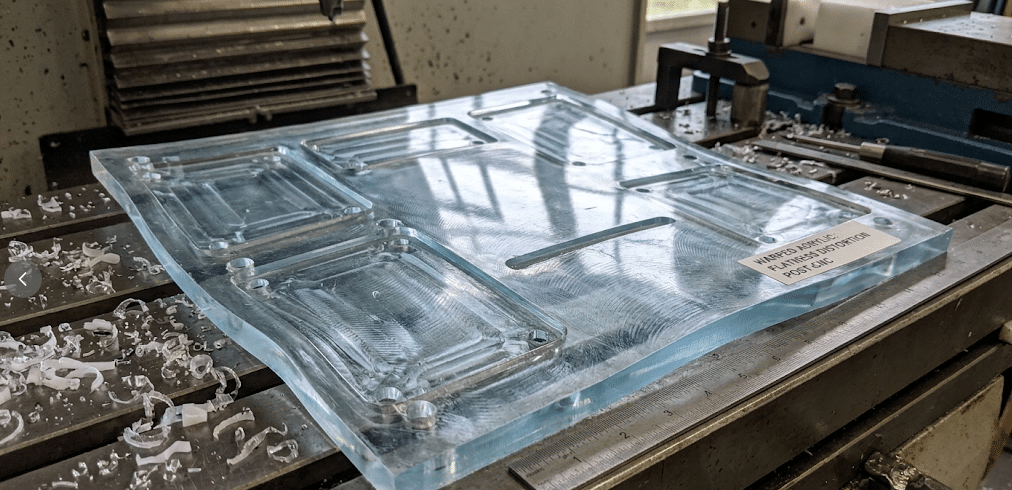
This usually shows up during inspection.
- CMM reports pass immediately after machining
- Then parts shift after 2–4 hours
- Recheck fails flatness by 0.06–0.10 mm
Cost and time impact
At a typical US shop rate of $120–$180/hr, this becomes expensive fast:
- Re-inspection + rework: +22% cycle time increase
- Scrap/rework rate: 12–18% batch loss
- Recutting time: +8–14 minutes per part
Trade-off reality
- Tight tolerance (±0.02 mm) on extruded acrylic → non-linear cost increase
- Relaxing to ±0.05 mm flatness reduced rework by ~40%
- Material choice (cast vs extruded) had more impact than machining strategy
Tool Engagement, Heat, and Surface Finish Control
“That surface finish is not a machining problem alone.”
A production run targeted cosmetic acrylic housings with Ra 0.8 µm requirement and edge tolerance of ±0.03 mm.
This is where parts fail in production.
What went wrong on the shop floor
Extruded acrylic reacts poorly to heat buildup during cutting.
- Surface finish measured: Ra 1.4–2.2 µm (failed spec)
- Tool engagement limit: chip load had to be reduced below 0.01 mm/tooth
- Tool reach issue: 6×D endmill deflection caused edge chatter
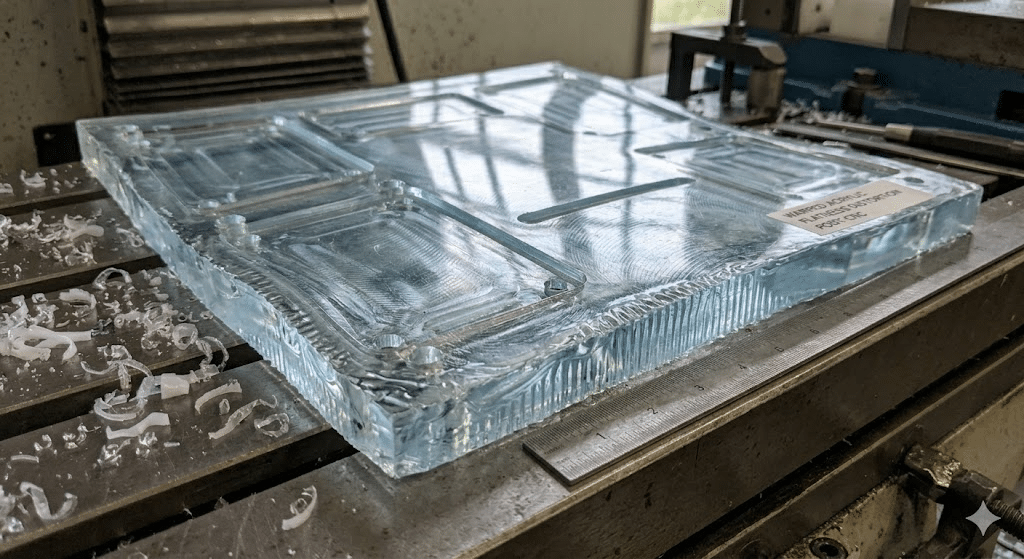
Why machining becomes unstable
Once feed is reduced to control melting:
- Cycle time increases 30–45%
- Heat accumulates at cutting edge instead of being evacuated
- Tool deflection increases at deeper pockets (>5×D depth)
Cost impact (real production numbers)
- Shop rate baseline: $150/hr
- Cycle time increase: from 18 min → 26 min per part
- Cost per part increase: +31%
- Secondary polishing added: $12–$25 per unit
Trade-off reality
- Tighter finish requirement (Ra 0.8 → Ra 0.4 µm) doubled finishing cost in extruded material
- Switching to cast acrylic eliminated polishing step entirely
- In one case, relaxing tolerance from ±0.02 mm to ±0.05 mm had zero functional impact but reduced cost by ~18%
RFQ Cost Spread and Machining Assumptionse
“This is where quotes start to diverge.”
Same drawing. Same material callout.
Three suppliers. Three very different numbers.
- Lowest quote assumed aggressive feed rates
- Mid quote assumed conservative chip load
- Highest quote accounted for stress + inspection loop
RFQ spread: up to 35% difference
Where assumptions break
The drawing specified:
- ±0.05 mm profile tolerance
- Ra 1.6 µm surface finish
- Extruded acrylic sheet, 8 mm thickness
But no mention of:
- stress relief behavior
- fixturing method
- post-machining distortion window
Machining reality vs quote reality
- Actual cycle time: 0.9–1.3 min/cm³ material removal
- Optimistic quote assumption: 0.7 min/cm³
- Conservative quote assumption: 1.4 min/cm³
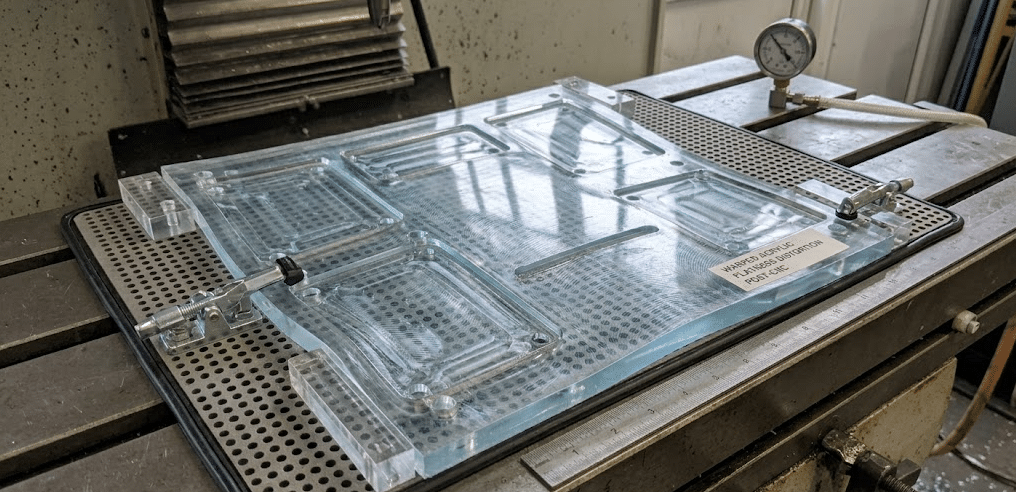
Inspection mismatch problem
This is where supplier disagreement shows up.
- One shop used go/no-go gauges
- Another used full CMM scan
- Result: 0.03–0.06 mm measurement variance depending on method
This is where quotes start to diverge.
Cost impact breakdown
At $120–$180/hr shop rate:
- Low quote: $42/part (missed rework factor)
- Real production cost: $55–$68/part
- Final adjusted cost after rework: +28–33% increase
- Cycle time increase after correction: +19%
- Rework loop added: +1 inspection cycle per batch
Trade-off reality
- Cheaper quote was based on ideal cutting conditions that didn’t survive production
- Adding inspection rigor (CMM requirement) increased cost but stabilized yield
- Changing process from extruded → cast reduced RFQ variance by ~20% because assumptions became predictable
Fixturing Stability and Vibration-Induced Defects
“That tolerance looks easy on paper.”
A job came in with ±0.03 mm edge tolerance on a 3 mm acrylic plate, extruded material, cosmetic finish required.
This is where parts fail in production.
What actually happened on the machine
Thin acrylic + long tool reach created instability:
- Tool reach: 6× diameter endmill
- Deflection under load: 0.02–0.05 mm
- Target tolerance: ±0.03 mm
- Actual variation after machining: ±0.06–0.09 mm
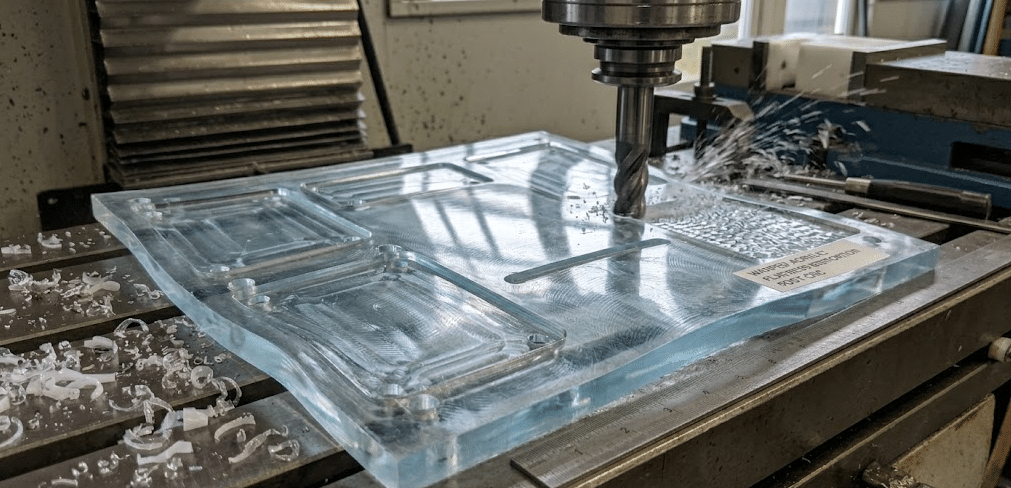
This usually shows up during inspection.
- CMM passed first piece
- Visual inspection flagged edge ripple
- Second inspection failed by 0.04 mm out-of-tolerance deviation
Fixturing problem that drove everything
RFQ did not clearly define fixturing method.
This is where quotes start to diverge.
- Vacuum fixture shop assumed: stable full-surface support
- Clamp fixture shop assumed: edge hold only
- Resulting cycle time difference: +22%
Cost and time impact
At $150/hr shop rate:
- Cycle time increased from 14 min → 21 min per part
- Vibration-induced scrap rate: 9–14%
- Rework (edge re-trim + re-cut): +18% labor time
- Total cost increase: +26%
Trade-off reality
- Tight tolerance (±0.03 mm) on thin extruded acrylic forced low feed rate machining
- Switching to full vacuum fixture reduced vibration but increased setup cost by $8–$12/hr
- Relaxing tolerance to ±0.05 mm eliminated rework loop entirely and improved yield by ~35%
Edge Quality vs Secondary Processing Cost
“This is where quotes start to diverge.”
A cosmetic acrylic housing required Ra 0.8 µm edge finish with sharp optical clarity.
That requirement looked simple on the drawing.
It wasn’t.
What failed in production
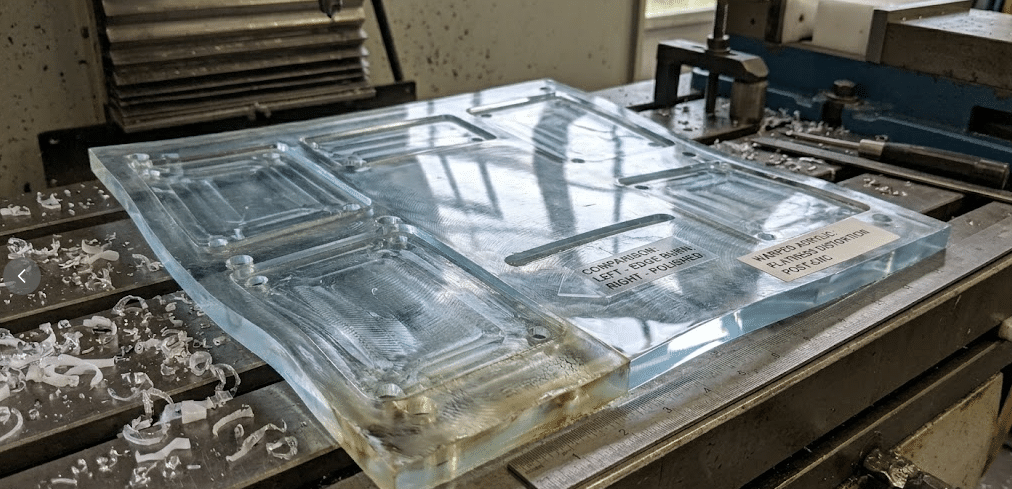
Extruded acrylic edge quality degraded immediately after cutting:
- Raw CNC finish: Ra 1.5–2.0 µm
- Spec requirement: Ra 0.8 µm
- Tool limitation: chip welding at feed rates above 0.012 mm/tooth
- Edge burn from heat accumulation in shallow slots (<2 mm depth)
This usually shows up during inspection.
- Visual QC rejected parts even when dimensions were within ±0.02 mm
- Dimensional compliance did not match cosmetic acceptance criteria
Secondary processing cost spiral
At $140–$180/hr shop rate:
- Flame polishing step added: +10–18 min per part
- Labor cost increase: $12–$25 per unit
- Total cycle time increase: +35%
RFQ confusion point
One supplier quoted without polishing step.
Another included full polishing cycle.
This created a 28–32% quote spread for identical drawings.
Trade-off reality
- Tighter surface finish requirement (Ra 0.8 → Ra 0.4 µm) doubled finishing time in extruded acrylic
- Switching to cast acrylic removed polishing requirement entirely in one production run
- Relaxing cosmetic spec while keeping functional tolerance (±0.02 mm unchanged) reduced cost by ~19%
Production Failure Modes and Alternative Process Selection
“That tolerance looks easy on paper.”
A batch production run of 500+ acrylic components with ±0.05 mm profile tolerance and mixed internal cutouts.
This is where parts fail in production.
What broke down in mass production
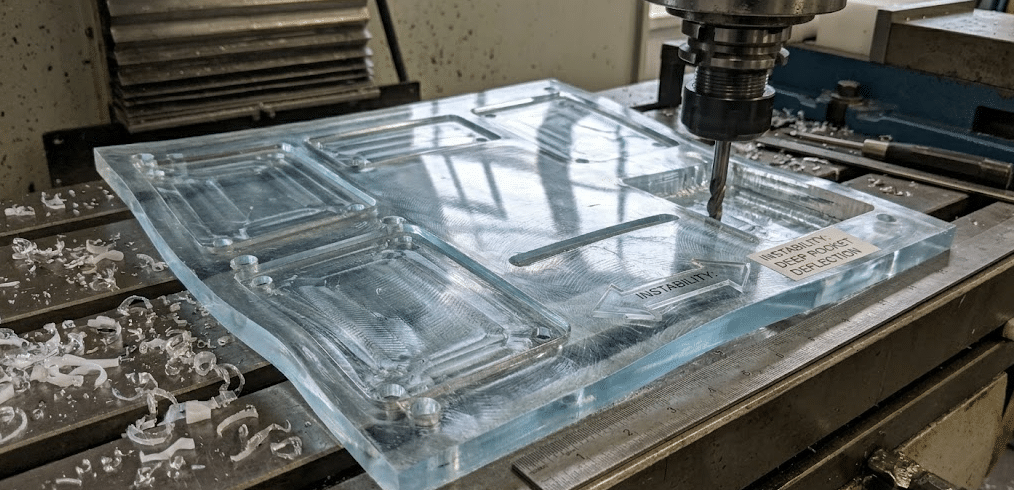
Extruded acrylic behavior changed under repeated thermal cycles:
- Cumulative drift: up to 0.10–0.12 mm
- Target tolerance: ±0.05 mm
- Scrap rate: 6–11% per batch
- Machining limitation: tool deflection in deep pockets >5×D
Inspection mismatch issue
This is where inspection disagreement appeared:
- CMM: measured within tolerance on cold parts
- Shop floor gauge: showed out-of-tolerance immediately after machining
- Thermal relaxation caused post-machining movement of 0.04–0.07 mm
This is where quotes start to diverge.
Cost impact in real production
At $160/hr shop rate average:
- Additional inspection loop: +1 full QC cycle per batch
- Cycle time increase: +24% overall production time
- Rework cost: $9–$15 per part equivalent
- Total cost increase: ~30% vs initial RFQ
Alternative process decision
- Switching from extruded to cast acrylic stabilized dimensional behavior
- Scrap rate dropped from ~9% → ~2.5%
- Cycle time reduced by ~17% due to fewer inspection loops
Trade-off reality
- Keeping tight tolerance (±0.05 mm) on unstable material created hidden cost escalation
- Material change had bigger impact than machining parameter optimization
- In one production case, redesigning pocket geometry reduced tool deflection and cut machining time by ~20% without changing tolerance
Final Engineering & Sourcing Verdict
- Switching from extruded to cast acrylic reduces dimensional drift by ~60% (±0.12 mm → ±0.05 mm), directly lowering scrap and rework cost by 18–25% in production runs.
- Tight cosmetic + dimensional specs (±0.02 mm and Ra 0.8 µm) increase cycle time by 30–45%, pushing shop cost from $120/hr to effective $155–$180/hr equivalent load due to rework loops.
- Uncontrolled RFQ assumptions create up to 35% supplier cost spread, but adding validated fixturing + inspection method reduces variance to under 12%, improving sourcing reliability.
FAQ
Why does extruded acrylic warp after CNC machining?
Yes. Extruded acrylic contains internal stress from manufacturing. Once material is removed, stress redistributes and causes post-machining movement of about ±0.08–0.15 mm. This usually shows up during inspection after parts stabilize thermally.
Which gives better tolerance, extruded or cast acrylic?
Yes. Cast acrylic holds tighter stability, typically ±0.01–0.03 mm. Extruded material is more sensitive to tool pressure and heat, often drifting beyond ±0.05 mm, especially in thin sections or deep pocket machining.
What surface finish can CNC achieve on acrylic?
Depends on material. Cast acrylic can reach Ra 0.4–0.8 µm directly from CNC. Extruded acrylic typically stays around Ra 1.2–2.0 µm due to heat buildup and chip welding unless secondary polishing is applied.
What drives CNC cost most in acrylic machining?
Yes. Cycle time is the main driver, followed by rework and inspection loops. At $120–$180/hr shop rates, small changes in feed rate or polishing requirement can increase total cost by 25–40%.
Is tighter tolerance always better?
No. Tighter tolerance below ±0.02 mm often increases cost disproportionately due to tool deflection control, slower feed rates, and inspection overhead. In many acrylic parts, ±0.05 mm performs identically in assembly.
When should laser cutting replace CNC?
Only if material thickness is low. For acrylic under 2 mm or non-structural parts, laser cutting reduces cost by 30–45%. Surface finish worsens to Ra ~1.8 µm, but functional tolerance is often still acceptable.
Related popular articles

Written By
Ryan
Conscientious sales engineer at DakingsRapid with demonstrated experience working in the machine and parts manufacturing industry. Ability to independently manage sales operations for commodities and proficiency in quality customer service.
Robotic Component Material Traceability: Engineering Guide
Validation protocols for robotic joint actuators, focusing on ASTM material certifications, torque load verification, and CMM inspection for US-based B2B procurement.
Material Traceability: MTRs and ASTM Compliance in Machining
A technical guide to material traceability, Mill Test Reports (MTRs), and heat number tracking to ensure mechanical integrity and supply chain transparency.
Carbon Fiber vs Aluminum: Engineering Selection & Cost Data
A technical comparison of stiffness-to-weight ratios, fatigue limits, and total cost of ownership for aerospace-grade 7075-T6 vs. CFRP components.