





Key Takeaways
Yield Strength Verification: MTRs provide exact chemical composition and physical properties, preventing failure in components where a 5% deviation in carbon content compromises heat-treatment results.
Dimensional Stability: Documented batch traceability allows engineers to correlate localized internal stresses—often seen in 6061-T6 plate—with specific mill runs to adjust CNC surfacing strategies.
Liability Mitigation: Maintaining a digital thread from the raw billet to the CMM report reduces the risk of counterfeit alloy integration, which can lead to catastrophic fatigue failure in aerospace or medical assemblies.
The Technical Anatomy of a Mill Test Report (MTR)
A Mill Test Report (MTR) is a certified quality document that provides the chemical composition and physical properties of a specific batch of metal, verifying compliance with ASTM or ISO standards. It acts as the definitive pedigree for raw stock before it ever touches a CNC fixture. For a Senior Mechanical Engineer, the MTR is the first line of defense against structural fatigue.
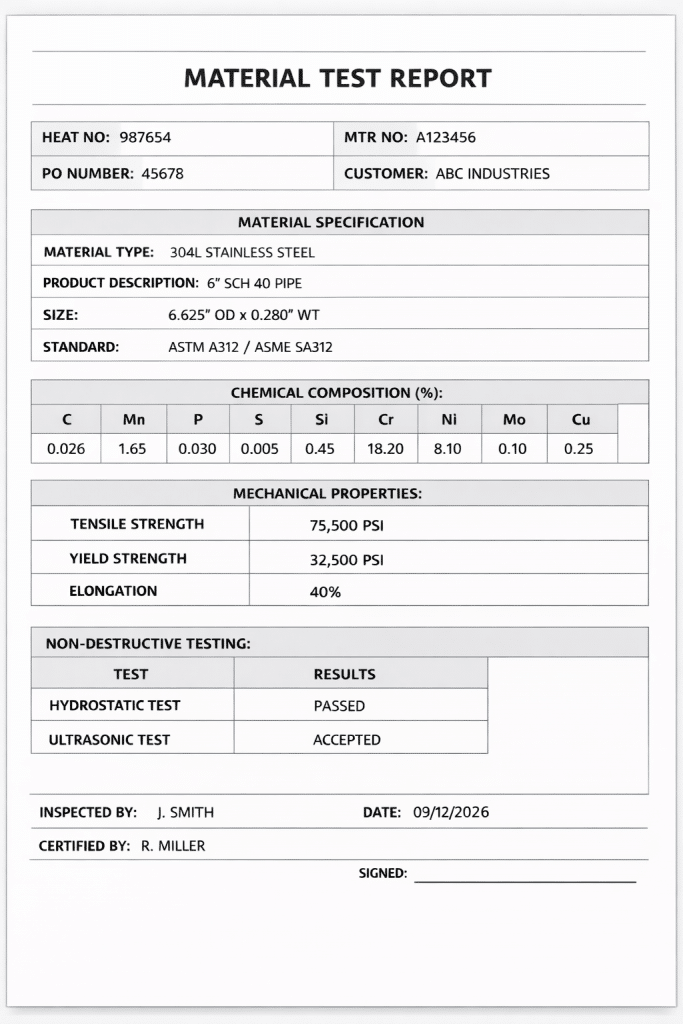
An MTR typically includes:
Chemical Analysis: Percentage breakdown of elements (e.g., Fe, Cr, Ni, Mo). For 316L stainless steel, verifying a low carbon content (under 0.03%) is critical to prevent sensitization during subsequent welding.
Mechanical Properties: Actual tested values for Yield Strength, Ultimate Tensile Strength (UTS), and Elongation.
Condition of Material: Hardness values (Rockwell or Brinell) and heat treatment status (e.g., T651 for 6061 aluminum).
ASTM/ASME Specifications: Confirmation that the melt meets standards like ASTM B209 for aluminum sheet or ASTM A276 for stainless bars.
Most RFQs break down when the “Material” callout on the print is ambiguous. If you specify “Aluminum” without a temper or ASTM standard, the shop might source commercial-grade stock with inconsistent grain structures. At DakingsRapid, we flag these ambiguities during the initial DFM review—often overnight due to the Shenzhen time zone advantage—ensuring that the sourced 6061-T651 meets the precise T651 stress-relieved requirements to prevent part warping during heavy pocketing.
Understanding Heat Number Tracking and Lot Control
Heat number tracking is the process of maintaining a permanent link between a specific batch of molten metal (the “heat”) and the finished machined components. This ensures that any metallurgical defect discovered in the field can be isolated to a specific production lot rather than triggering a global recall.
Effective lot control on the shop floor involves:
Unique Identifier Assignment: Transferring the mill’s heat number to internal job travelers.
Physical Marking: Using laser engraving or dot peening to apply the lot number to non-critical surfaces, usually governed by ASME Y14.5-2018 for placement.
Segregation: Keeping physical stock from different heats in separate bins to prevent accidental mixing during high-volume runs.

| Tracking Variable | Requirement for Cpk > 1.33 | Machining Impact |
|---|---|---|
| Heat Number | Must match MTR exactly | Prevents tool breakage from unexpected inclusions |
| Lot Number | Unique to the production run | Allows for targeted QA if dimensions drift |
| Material Origin | Certified Mill Source | Ensures consistent Ra 0.8 surface finish |
If you are holding a ±0.01mm tolerance across 500 units, heat consistency is your best friend. A change in the silicon content between two different heats of aluminum can subtly alter the chip formation and thermal expansion coefficient. This shift is enough to push your process capability below the 1.33 Cpk threshold if the CNC offsets aren’t adjusted for the new batch.
Supply Chain Transparency and the "Grey Market" Risk
Grey market materials are the silent killers of precision assemblies. These are materials that lack a verifiable “paper trail” or utilize forged MTRs to masquerade as higher-grade alloys. In a US job shop, where rates often hit $150/hr, the cost of a scrapped batch due to “mystery metal” is a massive liability.

Common risks in the supply chain include:
Sub-par Recycled Content: Excessive tramp elements that lead to erratic tool wear.
Improper Heat Treat: Parts that meet the chemical spec but fail the hardness test, resulting in poor thread strength.
Hydrogen Embrittlement: Often found in low-quality plated fasteners or high-strength steels that skipped the baking process.
To mitigate this, DakingsRapid performs incoming material verification using calibrated handheld XRF analyzers to confirm the alloy chemistry matches the provided MTR before the material is loaded into the bar feeder. This level of transparency is non-negotiable for aerospace or medical components. If a supplier cannot produce a verifiable heat number that traces back to a recognized mill, the material is rejected at the loading dock.
This is where “cheap” becomes expensive. Saving 10% on raw material costs by ignoring supply chain transparency often leads to a 50% increase in scrap rates when the material fails to hold a Ra 0.8 finish or exhibits internal voids during deep-hole drilling.
Quality Inspection and Verification Protocols
Verification protocols must utilize automated Coordinate Measuring Machines (CMM) and calibrated metrology tools to validate that every geometric feature adheres to ASME Y14.5-2018 GD&T standards. Hand tools are insufficient for verifying high-capability processes where a Cpk > 1.33 is required for tight tolerances like ±0.005mm.
The inspection process begins with a correlation between the digital CAD model and the physical artifact.
First Article Inspection (FAI): Every critical dimension is mapped to a bubble drawing. If the true position of a bore is specified at 0.02 mm, the CMM must establish a datum reference frame that mirrors the functional assembly.
In-Process Monitoring: Machinists use digital micrometers and go/no-go gauges at the spindle to catch tool wear before it compromises a Ra 0.8 surface finish.
Final Metrology: Optical comparators and laser scanners verify complex profiles that CMM probes cannot easily touch, such as intricate cooling fins or organic aero-surfaces.

Trust but verify is the shop floor mantra. At DakingsRapid, the inspection department operates as an independent entity from the production line, utilizing Zeiss CMMs to generate detailed data packages that accompany every shipment, ensuring that “nominal” on the screen matches “nominal” on the granite plate. This is where most RFQs break down: if the buyer fails to specify the inspection method for a profile tolerance, the shop may use a less accurate method that hides out-of-spec conditions.
Understanding Heat Number Tracking and Lot Control
Heat number tracking links a specific batch of raw material to its original furnace “melt,” ensuring that mechanical properties and chemical compositions are documented via a Mill Test Report (MTR). This level of lot control is the only way to guarantee that a 6061-T651 aluminum bracket won’t fail due to undocumented impurities or improper tempering.
A heat number is the DNA of the metal.
Material Segregation: Different batches of the same alloy must never be mixed on the rack. A variation in silicon or magnesium content within ASTM B209 limits can still alter the chip-breaking characteristics of the material.
Traceability Mapping: The heat number is engraved or laser-marked on the part or recorded on the job traveler. If a structural failure occurs in the field, engineers can trace the failure back to the specific bar stock.
Verification: Cross-referencing the heat number against the MTR confirms yield strength, tensile strength, and elongation percentages.
One real-world lesson: I’ve seen 7075-T6 batches that were “too hard,” causing catastrophic tap breakage in M3 holes. By maintaining lot control, the shop was able to isolate the remaining 40 parts from that specific heat and adjust the feed rates accordingly.
| Feature Tracking | Tolerance Impact | Cost Factor |
|---|---|---|
| Heat Number | Mechanical Integrity | Low (Admin only) |
| Lot Number | Process Consistency | Medium (Segregation labor) |
| Serialization | Individual Accountability | High (Engraving/Data tracking) |
Logistics, Lead Times, and DDP Shipping Considerations
Logistics for international precision machining must account for transit variables by utilizing DDP (Delivered Duty Paid) terms to eliminate customs bottlenecks for the US buyer. Managing the “total landed cost” requires balancing the speed of air freight against the heavy-duty packaging required to protect Ra 0.8 finishes during 8,000 miles of transit.
Lead times are often won or lost before the first chip is made.
The RFQ Loop: While US shops are closed, DakingsRapid engineers perform overnight RFQ reviews in the Shenzhen time zone, often providing DFM feedback that reduces tool changes or simplifies setups before the US team returns to their desks the next morning.
Transit Protection: High-precision parts are vacuum-sealed or coated in oil and individually bubbled. A 0.02 mm true position means nothing if the part is dented in a cargo hold.
Customs Transparency: DDP shipping means the manufacturer handles the HTS code classification and duty payments. This removes the “unknowns” that typically plague engineering managers during the procurement phase.

Engineering managers often focus solely on the “chip-to-chip” time. In reality, the administrative lead time—getting the MTRs approved, the DFM finalized, and the customs paperwork filed—is what dictates whether a project hits the 3-week or 6-week mark.
Final Engineering & Sourcing Verdict
Financial Impact of Traceability: Expect a 5% to 15% increase in total landed cost when moving from a standard Certificate of Conformance to full heat-treat traceability and MTR documentation due to administrative overhead and certified mill premiums.
Risk Mitigation Strategy: Utilizing MTRs and incoming XRF verification serves as a critical insurance policy against “grey market” alloys that exhibit inconsistent grain structures, which can lead to unpredictable stress-relieving and warping during high-speed CNC pocketing.
Lead Time Drivers: Administrative “soft” time—specifically the 24-48 hour window for MTR verification and DFM alignment—often dictates project success more than raw spindle speed. DDP shipping terms further mitigate the risk of technical delays at US Customs.
FAQ
Does material traceability increase the unit price of CNC parts?
Yes. Expect a 5% to 15% premium. This covers the administrative labor for document management, the higher cost of sourcing from certified mills rather than open-market distributors, and the additional time required for serialized part marking and dedicated inspection reporting.
How do I verify a Mill Test Report is authentic?
Cross-reference the heat number with the mill’s database. We also perform independent Positive Material Identification (PMI) using XRF analyzers and Rockwell hardness testing. If the chemical or physical data deviates from ASTM B209 or A276 standards, the batch is rejected.
What is the difference between a Certificate of Conformance and an MTR?
A CoC is a simple statement of compliance. An MTR is a data-heavy document providing the specific chemical melt analysis and mechanical test results (yield, tensile, elongation) for the actual batch of metal used, providing much higher liability protection for structural components.
Can you provide traceability for specialty alloys like Inconel or Titanium?
Yes. These high-performance materials require stringent tracking due to their application in extreme environments. Documentation often includes secondary ultrasonic testing (UT) certifications to ensure the absence of internal voids or inclusions that could lead to catastrophic fatigue failure in the field.
How does heat number tracking affect small-batch prototype lead times?
Typically adds 24 to 48 hours. Sourcing specific, documented heats requires procurement from vetted Tier-1 suppliers rather than local “remnant” shops. This minor front-end delay prevents downstream failures caused by using material with unknown thermal expansion or machining characteristics.
Is it possible to trace material after anodizing or sacrificial plating?
Only with pre-process serialization. To maintain the digital thread, parts must be laser-etched or dot-peened with a lot code before finishing. Chemical baths can obscure original mill markings, so physical part-level identification is required to link the finished component back to the MTR.
Related popular articles

Written By
Ryan
Conscientious sales engineer at DakingsRapid with demonstrated experience working in the machine and parts manufacturing industry. Ability to independently manage sales operations for commodities and proficiency in quality customer service.
