




The Exact POM CNC Machining Parameters We Use on the Floor
Running POM at the wrong feed rate melts chips, turning a standard $150/hr US shop rate job into a scrap nightmare that drives piece-part costs up 40%.
Increasing internal corner radii from 1mm to 3mm prevents tool deflection on deep pockets, cutting machine cycle times by roughly 18%.
Specifying an Ra 0.8 µm (32 µin) surface finish on Delrin requires sharp single-flute cutters; dull tools will smear the plastic and destroy your GD&T true position callouts.
Why Most Shops Screw Up POM (Delrin) Machining
Plastics do not shear like metals. They melt, smear, and deform under friction. You cannot take an aluminum CNC program, drop a block of POM onto the table, and hit cycle start.
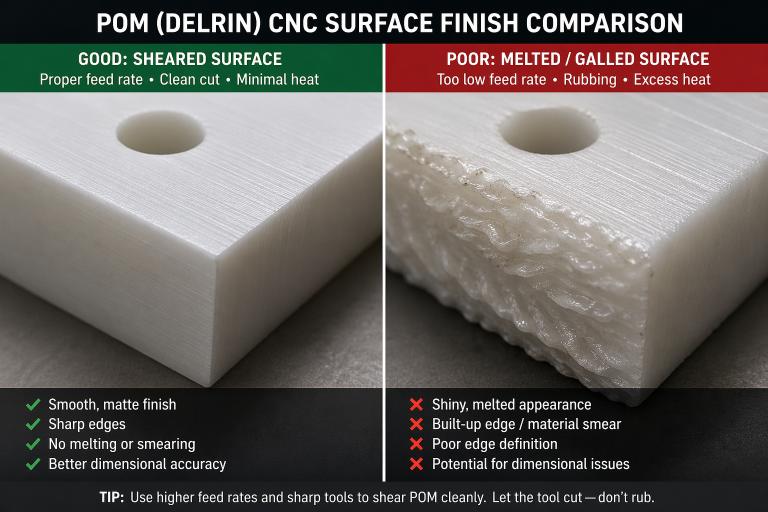
This is where parts fail in production. An inexperienced machinist will hear chatter and immediately slow down the feed rate. That is the worst possible reaction for Delrin. Slowing the feed reduces the chip thickness. The tool begins rubbing the material instead of cutting it, generating massive amounts of heat. The plastic melts around the cutter, destroying your surface finish and blowing out your dimensions.
Friction point: A buyer sends an RFQ with an unclear drawing lacking specific surface roughness callouts. Shop A plans to run it fast and rough. Shop B plans for finishing passes.
The outcome: When an RFQ like this hits the desk at DakingsRapid, we immediately check the lead time expectations against the part geometry. If the buyer needs parts in 5 days, we have to clarify if they will accept minor tool marks.
The engineering reality: Hitting a clean Ra 0.8 µm (32 µin) surface finish on POM requires sharp tools and heavy chip loads. If the tool TIR (total indicator runout) exceeds 0.01 mm (0.0004″), one flute rubs while the other cuts. The resulting vibration will leave visible witness marks across the part.
POM Cutting Speed RPM and Milling Feed Rates
Dialing in your speeds and feeds for POM is entirely about heat evacuation. The chip carries the heat away. If you recut chips or feed too slowly, the heat stays in the part.
This is where quotes start to diverge. A standard 2026 US shop rate sits right around $150/hr. If a supplier slows their feed rates down to 1,000 mm/min to avoid chatter on a thin-walled Delrin enclosure, their cycle time doubles. They pass that $150/hr inefficiency directly to the procurement manager.
Running high RPMs with aggressive feed rates keeps the cycle time low and the tool cool.
Recommended Starting Parameters for POM Milling
| Tool Diameter | Spindle Speed | Feed Rate | Radial Depth of Cut | Target Finish |
|---|---|---|---|---|
| 4mm (0.157") | 12,000 RPM | 1,800 mm/min | 1.5mm | Ra 1.6 µm (63 µin) |
| 6mm (0.236") | 10,000 RPM | 2,500 mm/min | 2.5mm | Ra 0.8 µm (32 µin) |
| 10mm (0.393") | 8,000 RPM | 3,200 mm/min | 4.0mm | Ra 0.8 µm (32 µin) |
Tolerance constraint: If you are trying to hold an ASME Y14.5 profile tolerance of ±0.05 mm (±0.002″) across a contoured surface, you must use a fresh tool. An endmill that previously cut 6061 aluminum will have microscopic wear. That dull edge will push the POM away from the tool rather than cutting it, causing the part to spring back out of tolerance after the program ends.
Delrin CNC Tool Selection for Deep Pockets
Using a standard four-flute endmill on Delrin is a guaranteed way to scrap parts. Four-flute tools lack the gullet space required to evacuate plastic chips. The chips pack into the flutes, weld together, and snap the tool.
You need highly polished, uncoated single-flute or two-flute carbide endmills. The polished flutes prevent the sticky plastic chips from adhering to the tool body.
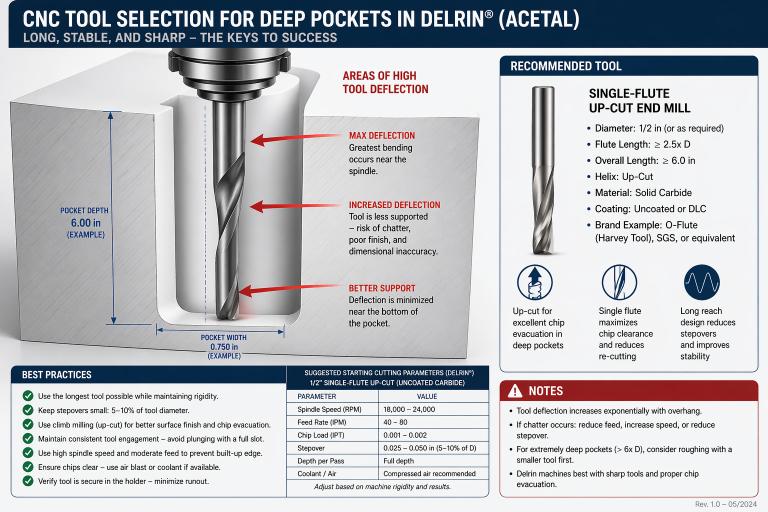
Deep pockets introduce a major machining limitation: tool reach versus tool deflection.
The trade-off: A print calls for a 40mm deep pocket with a tight 1mm internal corner radius. Machining that requires a long, skinny tool. The tool will deflect under cutting pressure, leaving a tapered wall. Fixing this requires a spring pass (running the finishing toolpath twice), which increases cycle time and drives the piece price up by 15%.
The DFM fix: I had a DakingsRapid DFM review last month with this exact issue. I told the client’s engineering team to increase the internal radii from 1mm to 3mm. That simple design change allowed us to use a thicker, stiffer tool. We eliminated the tool deflection, dropped the spring pass, and cut their cycle time by 18%.
Workholding Setup Tips to Prevent Part Distortion
Delrin is soft. If you clamp a block of POM in a standard Kurt vise and crank the handle, you will crush the material before the spindle even turns on.
You machine the part flat. You open the vise. The built-up stress releases, and the part springs back into a banana shape.
This is where parts fail in production. An engineer will call out a flatness tolerance of ±0.025 mm (±0.001″) on a 10mm thick Delrin plate.
The wrong way: Hogging out material from one side using standard vise jaws. The material warps instantly. Scrap rates hit 30%, and the supplier demands a price increase to cover their losses.
The right way: Using vacuum fixtures. We face one side of the raw stock flat to establish a datum. We transfer the plate to a vacuum table, which holds the part securely across its entire surface area without inducing mechanical pinch points.
The cost reality: Vacuum workholding requires custom fixture plates. You pay more in upfront NRE (Non-Recurring Engineering) setup fees, but you eliminate the scrap rate entirely on production runs.
GD&T and Tolerance Reality Checks for Plastics
Engineers routinely design a plastic part and copy-paste the title block tolerances from their metal components. Applying strict ASME Y14.5 position controls to every hole in a plastic block creates a massive inspection bottleneck.
This usually shows up during inspection. A drawing specifies a True Position tolerance of ±0.01 mm (±0.0004″) for a bore.
The inspection mismatch: The supplier machines the part perfectly. The client’s QC department puts the POM part on a CMM (Coordinate Measuring Machine). The CMM uses a ruby touch probe. The probe physically presses against the soft plastic wall of the bore to register a point. That physical force deflects the plastic by a few tenths of a thou. The CMM software registers a failure, and the client rejects a perfectly good batch of parts.
The solution: At DakingsRapid, we flag tight plastic tolerances during the quoting phase. If a true position tighter than ±0.05 mm (±0.002″) is absolutely required, we mandate the use of optical comparators or vision systems for inspection. Non-contact measurement is the only way to inspect tight-tolerance plastics without the inspection method itself causing a false failure.
The business impact: Demanding metal-grade tolerances on extruded plastics forces the machine shop to climate-control the inspection room, let the plastic rest for 24 hours to stabilize thermal expansion, and run 100% CMM inspection. That pushes your piece-part cost up by a minimum of 40%.
Final Engineering & Sourcing Verdict
Stop paying suppliers to hold metal-grade ±0.01 mm (±0.0004″) profile tolerances on standard Delrin parts; opening this up to ±0.05 mm (±0.002″) eliminates 100% CMM inspection bottlenecks and cuts your piece price by roughly 40%.
Force your suppliers to define their workholding strategy during the RFQ phase; vacuum fixturing for thin plates requires a $500–$800 upfront NRE fee but prevents the 20% to 30% scrap rate caused by mechanical vise distortion.
Standardize on single-flute polished cutters for deep pocketing to eliminate tool deflection and spring passes, which predictably shaves 15% to 18% off machine cycle times at average $150/hr shop rates.
References & Sources
- Optimization of Cutting Parameters to Minimize Overall Total Operating Time in Turning POM-C (MDPI Metals, 2023)
- Modeling and optimization of turning process parameters of POM-C The international journal of advanced manufacturing technology, Springer
- Study of Cutting and Specific Cutting Energy in Turning of POM-C With a PCD Tool – Science Direct, Journal of Cleaner Production
- 21 CFR 177.2480 – Polyoxymethylene Homopolymer – La Food and Drug Administration.
- Section 21 CFR 177.2470 – Polyoxymethylene Copolymer – Cornell Law Institute / FDA
FAQ
What happens if the spindle RPM is too high when machining POM?
It melts the plastic. If RPM is high but the feed rate is low, the chip load drops. The tool rubs instead of cutting, generating friction heat. Chips weld to the endmill, immediately destroying the surface finish and scrapping the part.
How do you hold a tight flatness tolerance on a thin Delrin plate?
Vacuum fixtures. Mechanical vises pinch the soft plastic, inducing stress. When you release the vise, the plate bows. We face one side, transfer it to a vacuum table to hold it flat without stress, and machine the final side.
Why are my POM parts shrinking after machining?
Internal material stress. Extruded POM has high baseline stress. When you hog out large volumes of material asymmetrically, the part relieves that stress and warps. Buy stress-relieved blanks and leave 0.5 mm (0.020″) for a final skim pass after resting.
Does coolant type matter for POM CNC machining parameters?
Not strictly, but temperature control does. You can cut POM dry with a high-pressure air blast to clear chips, which medical buyers prefer. Standard water-soluble coolant works fine for deep hole drilling, but heat evacuation relies mostly on aggressive feed rates.
How do you inspect tight-tolerance plastic parts?
Vision systems or low-force touch probes. Standard CMM ruby probes physically push the soft plastic wall during measurement, causing false failure readings. If you demand ±0.02 mm (±0.0008″) tolerances, non-contact optical inspection is the only way to avoid rejecting good parts.

Written By
Ryan
Conscientious sales engineer at DakingsRapid with demonstrated experience working in the machine and parts manufacturing industry. Ability to independently manage sales operations for commodities and proficiency in quality customer service.

Meet DakingsRapid at Hannover Messe: Direct CNC Factory
Attending Hannover Messe? Meet DakingsRapid, a direct factory for custom CNC machining & rapid prototyping. Let’s discuss your project face-to-face. Book now!
Extruded vs Cast Acrylic Machining: CNC Failure Risks
Engineering breakdown of extruded vs cast acrylic machining differences, tolerance drift, surface finish issues, and RFQ cost variation in CNC cutting and production.
Carbon Fiber CNC Machining: Drone Frame Milling Methods
Carbon fiber CNC machining causes rapid tool wear and delamination. Learn core milling techniques, proper feeds, speeds, and tooling to hold tight tolerances.