


Robotic systems rely on components that must fit, move, and repeat consistently throughout their operating life. Even small dimensional variations can affect alignment, joint movement, or the fit between mating parts. Precision machining provides the dimensional control and repeatability needed for these critical components.
From joint and structural parts to housings, shafts, bushings, and precision interfaces, CNC machining can produce complex robotic components to application-specific requirements. If you are developing a robotic component or need help with material selection, tolerances, DFM, or production, contact our engineering team to discuss your requirements.
Why Robotics Components Require Precision Machining
Robotic components often combine compact dimensions, multiple mating surfaces, moving interfaces, and tight positional requirements. Precision machining helps maintain the dimensional relationships between these features so individual components work together as intended.
Compact Geometry
Robotic components often need to deliver mechanical performance within a limited installation space. This can result in small features, thin sections, closely spaced holes, and complex geometries that require controlled machining.
Multi-axis CNC machining can produce these features while maintaining the dimensional relationships required for assembly. Proper fixturing and process planning are also important when working with compact or difficult-to-access features.
Tight Interfaces
Robotic assemblies depend on precise interfaces between components. Mounting holes, locating surfaces, bearing seats, shafts, and mating faces may all need controlled dimensions and positions.
Precision machining helps maintain these relationships, reducing issues such as excessive play, interference, or misalignment during assembly.
Moving Assemblies
Many robotic components are part of moving mechanisms, including joints, linkages, rotating shafts, and articulated assemblies. Their dimensions and surface conditions can directly affect how mating parts move against each other.
Features such as bearing bores, shaft diameters, locating surfaces, and mounting interfaces may therefore require tighter control than non-moving structural features.
Repeatability
Robotics applications often require the same movement and positioning behavior across repeated cycles. This makes consistency between parts just as important as the accuracy of an individual component.
For production runs, a stable machining process helps maintain consistent dimensions, fits, and interfaces from part to part, supporting predictable assembly and robotic performance.

Common Precision Machined Robotics Components
Robotic systems use a wide range of machined components, from structural parts to small precision interfaces. The required machining process and tolerance depend on the component's function, assembly method, material, and operating conditions.
Joint and Structural Components
Robot joints and structural components often combine multiple mounting, locating, and load-bearing features within a relatively compact part.
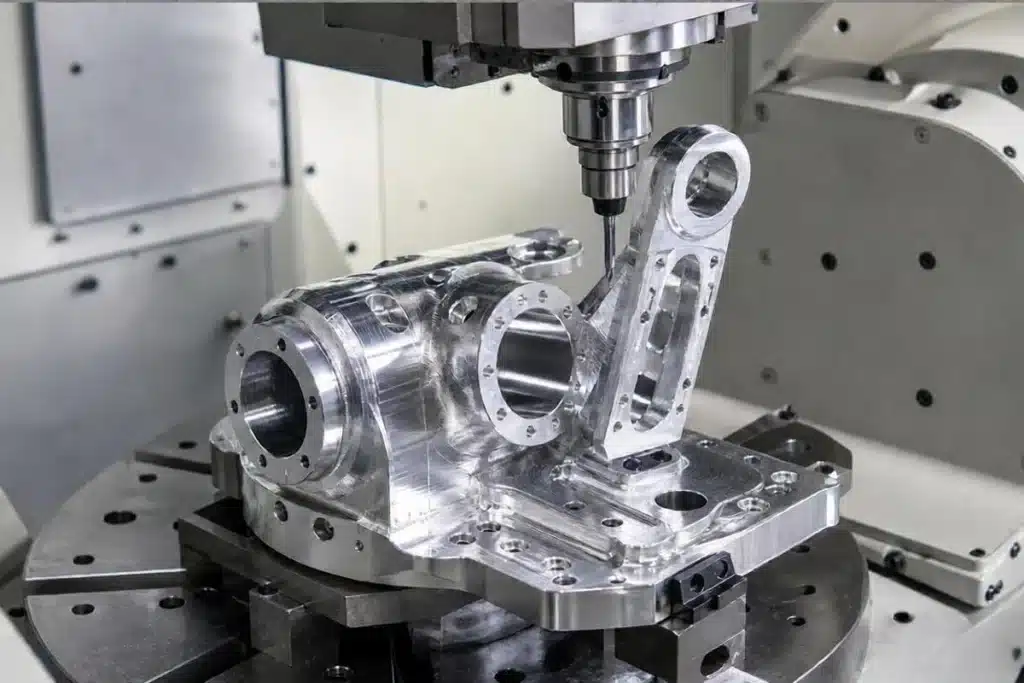
CNC milling and 5-axis machining can be used for joint housings, structural brackets, link components, and other complex mechanical parts where several features must remain accurately aligned. The machining strategy depends on the geometry and the required interfaces.
Housings and Mounting Components
Housings provide mounting locations and mechanical interfaces for components such as motors, bearings, sensors, and other mechanisms.
Precision machining can control mounting patterns, bores, locating surfaces, and mating faces so the components installed within the housing remain correctly positioned. Aluminum is commonly selected where low weight and good machinability are important, while other materials may be used when higher strength, wear resistance, or environmental resistance is required.
Shafts, Pins and Bushings
Shafts, pins, and bushings are common in robotic joints and moving assemblies. Their dimensions directly affect fits, alignment, rotation, and mechanical clearance.
Precision CNC turning is well suited to cylindrical components requiring controlled diameters, concentricity, threads, grooves, and surface finishes. Depending on the application, secondary grinding or finishing may be used where tighter dimensional or surface requirements are needed.
Precision Interfaces and Connectors
Robotic systems also rely on smaller interfaces that connect mechanical, electrical, or structural components. These may include precision connector bodies, mounting interfaces, adapter components, and custom interface parts.
The critical requirements can include hole position, mating dimensions, flatness, alignment, and surface finish. Precision machining allows these features to be manufactured according to the specific interface requirements rather than relying on standard component dimensions.

Manufacturing Process for Robot Components
Different robotic components require different machining strategies depending on their geometry, interfaces, material, and precision requirements. CNC milling, turning, 5-axis machining, and secondary processing are often combined to achieve the required fit, alignment, and surface condition.
Precision Milling
Precision milling is widely used for robot housings, brackets, structural components, mounting plates, and joint parts with complex features. It can produce accurate holes, pockets, slots, mounting surfaces, and locating features while maintaining their positional relationships.
Precision Turning
Precision turning is suited to shafts, pins, bushings, spacers, collars, and other rotational components. Turning provides controlled diameters, concentric features, threads, grooves, and bearing surfaces that are important for smooth movement and reliable assembly.
5-Axis Machining
5-axis machining is useful for robotic components with complex surfaces, multiple angled features, or difficult-to-reach areas. By reducing the number of setups, it can help maintain the relationship between critical features while also simplifying the production of complex geometries.
Secondary Processing
Secondary operations can be used when a robot component requires additional dimensional or functional requirements. Depending on the part, these may include grinding, threading, EDM, deburring, surface treatment, or other finishing processes to achieve the required fit, wear resistance, or surface condition.

Materials for Robotic Components
Material selection affects more than weight. Strength, stiffness, wear resistance, machinability, environmental conditions, and the function of the component all need to be considered when selecting a material for robotic parts.
Aluminum
Aluminum is widely used for robotic components where low weight, good machinability, and sufficient structural strength are important. It is commonly suitable for housings, brackets, structural parts, and mounting components where reducing moving mass is a priority.
Stainless Steel
Stainless steel is suitable for components that require higher strength, corrosion resistance, or durability. It can be used for shafts, fittings, mounting parts, and other components exposed to demanding operating environments.
Titanium
Titanium offers a combination of high strength, low density, and corrosion resistance, making it useful for lightweight components with demanding mechanical requirements. It is often considered when aluminum does not provide the required strength or performance.
Engineering Plastics
Engineering plastics such as PEEK, POM, nylon, and other technical polymers can be used where low weight, electrical insulation, low friction, or chemical resistance is required. They are suitable for selected bushings, guides, insulating components, and lightweight robotic parts.

Precision and Tolerance Requirements
Robotic components do not always require the same tolerance level. The critical point is to identify which dimensions and interfaces directly affect assembly, movement, alignment, and repeatable operation, then apply the appropriate level of control.
Dimensional Accuracy
Dimensional accuracy is important for features such as bearing bores, shaft diameters, mounting holes, and locating surfaces. These dimensions need to stay within the specified range so components can assemble correctly and perform as intended.
Alignment and Fit
Robot assemblies often depend on the precise relationship between mating components. Hole positions, flatness, concentricity, and mating surfaces can affect alignment, clearance, and mechanical fit. Controlling these relationships helps prevent assembly issues and unwanted movement.
Repeatability
Robotic systems perform repeated movements and cycles, so component dimensions need to remain consistent from part to part. A stable machining process and controlled inspection system help maintain consistent fits and interfaces across production batches.

Robotics Prototype to Production
Robotic components often move through several stages before reaching production. A machining partner needs to support not only the initial prototype, but also testing, design changes, small-batch production, and production scaling as the robot evolves.
Prototype
Prototype machining helps robotics teams verify dimensions, interfaces, materials, and assembly before committing to larger production quantities. CNC machining is well suited to producing functional prototypes that closely represent the final component.
Testing
After prototyping, components may go through assembly and functional testing. Feedback from testing can lead to changes in tolerances, interfaces, materials, or component geometry, making responsive engineering support important during development.
Small Batch
Once the design is validated, small-batch production provides consistent parts for further testing, pilot builds, and early-stage deployment. Stable machining processes help maintain the same critical dimensions and interfaces across multiple parts.
Production Scaling
As robotic products move toward higher production volumes, machining processes need to scale without compromising quality, consistency, or lead time. Our experience with batch manufacturing allows us to support robotics projects from prototypes through larger production runs.
We have worked with robotics companies including AgiBot, Unitree, Fourier, DEEP Robotics, and engineai on precision robotic components. If you are developing a new robotic component or scaling an existing design, send us your drawings or project requirements. Our engineering team can review the application, machining requirements, materials, and production volume to help determine the right manufacturing approach.
Quality Control for Robotics Components
For robotic components, quality control is not only about checking finished dimensions. It starts with understanding the drawing, material, critical interfaces, and functional requirements before production and continues throughout the manufacturing process.
Key dimensions and interfaces can be monitored during machining, followed by final dimensional inspection before shipment. Depending on the component, inspection may cover critical dimensions, geometric tolerances, surface finish, material specifications, and other drawing requirements.
For batch production, maintaining consistent results from the first part to the last is equally important. Controlled machining processes, inspection records, and material traceability help ensure that robotic components remain consistent across production runs and are ready for reliable assembly and testing.
