





A few months back, a project engineer from a German UAV startup sent us a batch of drawings. Twenty-four structural brackets, all called out as Ti-6Al-4V, AMS 4928, annealed. His opening message: "I've got quotes from three shops in Europe — they're all over the place. Can you tell me what's actually going on with this material?"
That question comes up a lot. Ti-6Al-4V — Grade 5 titanium, or just "Ti64" on the shop floor — is one of those materials where the datasheet looks straightforward, but the real-world machining experience tells a very different story. Quotes swing wildly because most people are still guessing at cycle times. Lead times slip because shops underestimate the tooling requirements. And parts occasionally come back with out-of-tolerance dimensions because nobody had a real conversation about fixturing and spring-back before the job started.
We've been machining Ti-6Al-4V at our Shenzhen facility for going on five years now — everything from 20-piece prototype runs to 500-piece production batches. This guide is what I wish every procurement engineer had in their hands before they sent us an RFQ. It covers the material science (without the PhD), the actual shop parameters, a few real jobs that taught us hard lessons, and the DFM flags that save the most money.
What you'll walk away with
Smarter material selection instincts, a realistic budget model for Ti-6Al-4V CNC parts, and a DFM checklist you can use before you even send a drawing out for quote.
Why Ti-6Al-4V Wins on the Strength-to-Weight Curve
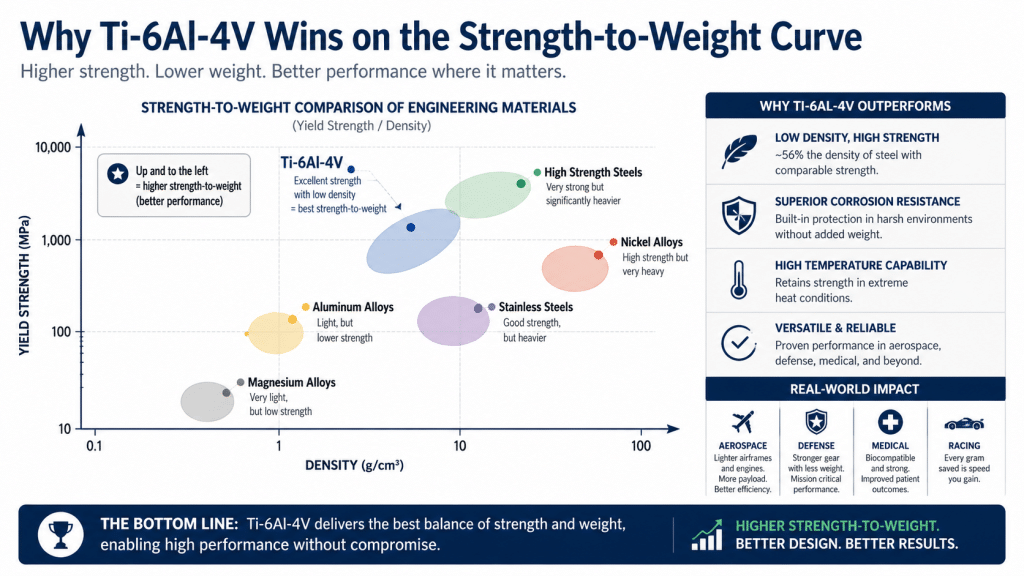
The number that makes engineers keep coming back to this alloy: 950 MPa tensile strength at just 4.43 g/cm³. That’s not impressive in isolation — it’s impressive relative to everything else available at that density. No other commonly stocked engineering alloy fills the same space on the chart.
Grade 5 titanium vs common CNC metals — head to head
| Material | Densidad (g/cm³) | Tensile Str. (MPa) | Specific Strength (kNm/kg) | Resistencia a la corrosión |
|---|---|---|---|---|
| Ti-6Al-4V (Grado 5) | 4.43 | 950 | 214 | Excelente |
| Aluminio 7075-T6 | 2.81 | 572 | 204 | Moderado |
| 316L Stainless Steel | 7.99 | 515 | 64 | Bien |
| 4340 Steel (heat treated) | 7.85 | 1,080 | 138 | Pobre |
| Inconel 718 | 8.19 | 1,240 | 151 | Excelente |
7075 aluminum is lighter, but you give up nearly 400 MPa of tensile strength. 4340 steel is stronger, but it’s almost twice the weight and it corrodes without a coating. Inconel is stronger still, but even heavier and more expensive to machine than titanium. Ti64 sits in a pocket on that chart that nothing else can fill.
Why the alpha-beta structure matters (plain English version)
The “6Al-4V” tells you the alloy recipe: 6% aluminum to stabilize the alpha phase — good for high-temperature strength — and 4% vanadium to stabilize the beta phase, which adds toughness and ductility. The dual-phase microstructure that results gives you strength without brittleness, which is actually pretty rare at this performance tier.
Practical translation: it bends a little before it breaks. That ductility margin matters enormously in fatigue-loaded applications — airframes that flex in turbulence, implants that carry cyclic loading, motorsport components that see shock loads in corners.
UAV Structural Brackets — When 7075 Just Didn't Close the Equation
That German UAV startup I mentioned in the intro? Here's how the material conversation actually played out. Their original design spec called for 7075-T6 aluminum on the main frame brackets — lighter, cheaper, faster to machine. But their stress analysis kept flagging a problem: at the required wall thickness (1.2 mm), 7075 was hitting 94% of its fatigue limit under the simulated flight load cycle. That's not a comfortable margin for a commercial drone with a 2-year operational life.
We ran the numbers together on Ti-6Al-4V at the same 1.2 mm wall. Fatigue margin dropped to 61% of limit — well within acceptable territory. The brackets ended up about 30% heavier than aluminum, but total airframe mass only went up 4% because of how localized those parts were. They accepted the tradeoff.
The other thing we flagged: two of their blind pocket features had a depth-to-width ratio of 6:1. We suggested converting those to through-features with a simple cap plate. Saved them about 18 minutes of cycle time per part — which at 24 pieces added up to a meaningful reduction in unit cost.
Ti-6Al-4V CNC Machining: What the Datasheet Doesn't Say
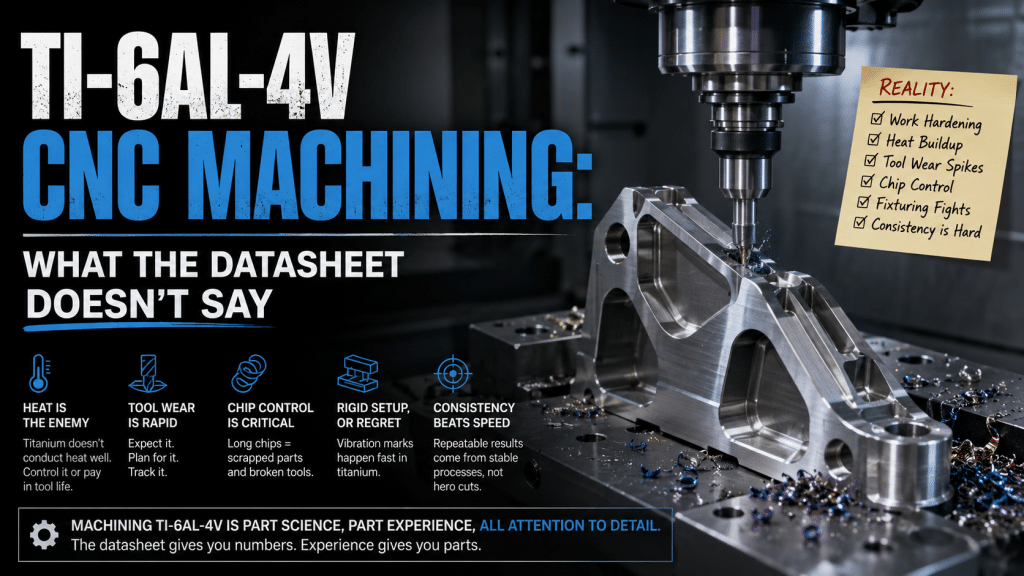
Machinability rating of 22% relative to aluminum 6061. That number doesn’t get enough airtime in supplier conversations, and it’s the single biggest source of sticker shock in titanium quotes. If you hand the same part geometry to three shops and one of them quotes it like an aluminum job, you’ll get three quotes that tell you nothing useful. Let me break down the actual root causes.
The three root causes of difficult Ti-6Al-4V machining
1 — Heat doesn't go anywhere (thermal conductivity: 6.7 W/m·K)
Aluminum pulls heat away from the cutting zone at around 150 W/m·K. Titanium effectively traps heat right at the tool tip — it has nowhere to go. That accumulated heat accelerates insert wear, causes micro-welding of chips to the cutting edge (built-up edge), and can thermally damage the workpiece if coolant coverage breaks down even briefly. This is why high-pressure through-spindle coolant isn't optional on Ti64 jobs — it's the primary heat management system.
2 — Work hardening punishes the wrong setup
If your tool rubs rather than cuts — dull insert, chip load too light, dwelling at the bottom of a hole — the surface hardens rapidly. The next pass now has to cut through already-hardened material. Wear accelerates, surface quality degrades, and you can ruin a part late in the cycle after you've already spent the most expensive hours on it. Consistent, aggressive chip load is the fix. Backing off feels counterintuitive but makes things worse.
3 — Spring-back and chatter on thin features
Ti64's Young's modulus is 114 GPa — significantly lower than steel at 200 GPa. It deflects under cutting forces and springs back. Thin walls (under 1.5 mm) and long overhangs will chatter and bounce, making tight tolerances on those features genuinely difficult without careful fixturing and a well-thought-out tool path strategy.
DAKINGS RAPID TI-6AL-4V CNC PARAMETERS (ACTUAL SHOP FLOOR NUMBERS)
These aren't textbook ranges. These are what we actually run:
- Use sharp, fresh carbide or CBN tooling — always
- Apply high-pressure coolant continuously, never intermittently
- Keep chip load consistent throughout the cut
- Clamp rigidly; minimize overhang wherever possible
- Use climb milling to reduce rubbing and heat accumulation
- Inspect tool edge condition at regular intervals
- Dry cutting — titanium chips can ignite above 600°C
- Dwelling mid-cut — heat builds dangerously fast at zero feed
- Running blunt tools — triggers the work-hardening spiral
- HSS tooling as a cost-saving measure — it won't last
- Estimating cycle times based on your aluminum jobs
- Thin-wall features under 1 mm without discussing fixturing first
The Blind Hole That Nearly Killed a 40-Piece Run
About two years ago we took on a batch of Ti-6Al-4V hydraulic manifold bodies — 40 pieces, relatively complex geometry, tight tolerances on the bore IDs. The drawing had twelve M6 blind holes per part, each 28 mm deep. L/D ratio of 4.7:1. Technically within the guideline, but on titanium, blind holes that deep are where chip evacuation gets dicey.
Halfway through the first article, we started seeing surface finish degradation on the hole interiors — chips weren't clearing cleanly, heat was building, and we were getting micro-galling on the bore walls. We stopped the job, switched to a high-pressure peck-drilling cycle with full chip clearance between pecks, and rebuilt the tool path from scratch. Added about 22 minutes per part to the cycle.
We ate that time on the first article because the drawing was what it was. But on the DFM call before the production run, we proposed converting four of the twelve blind holes to through-holes with a plug on one face — no functional change, saves the peck cycle on those features. Customer approved it. Production run went clean.
The lesson: blind holes on titanium need to be flagged explicitly in DFM. They're not impossible — we run them all the time — but they need a plan, not just a default tool path.
Ready to Quote Your Ti-6Al-4V Parts?
Send us your drawings and our engineering team in Shenzhen will run a free DFM review alongside your quote — no obligation. We'll flag material condition issues, geometry risks, and tolerance strategy before anything hits the floor, and give you a straight answer on lead time and finishing options.
Biocompatibility & Corrosion Resistance: Why Ti-6Al-4V Gets Into Markets Others Can't
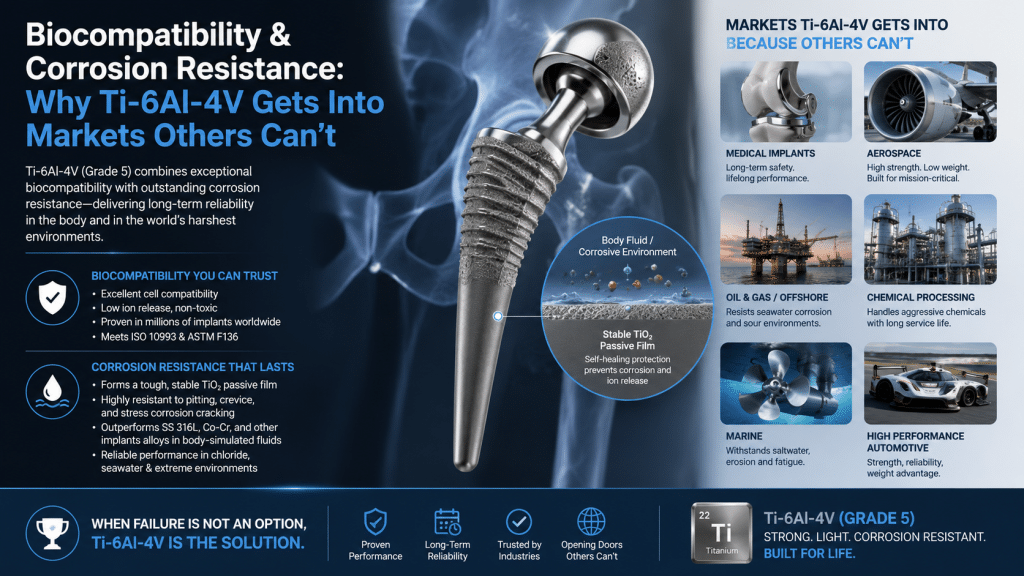
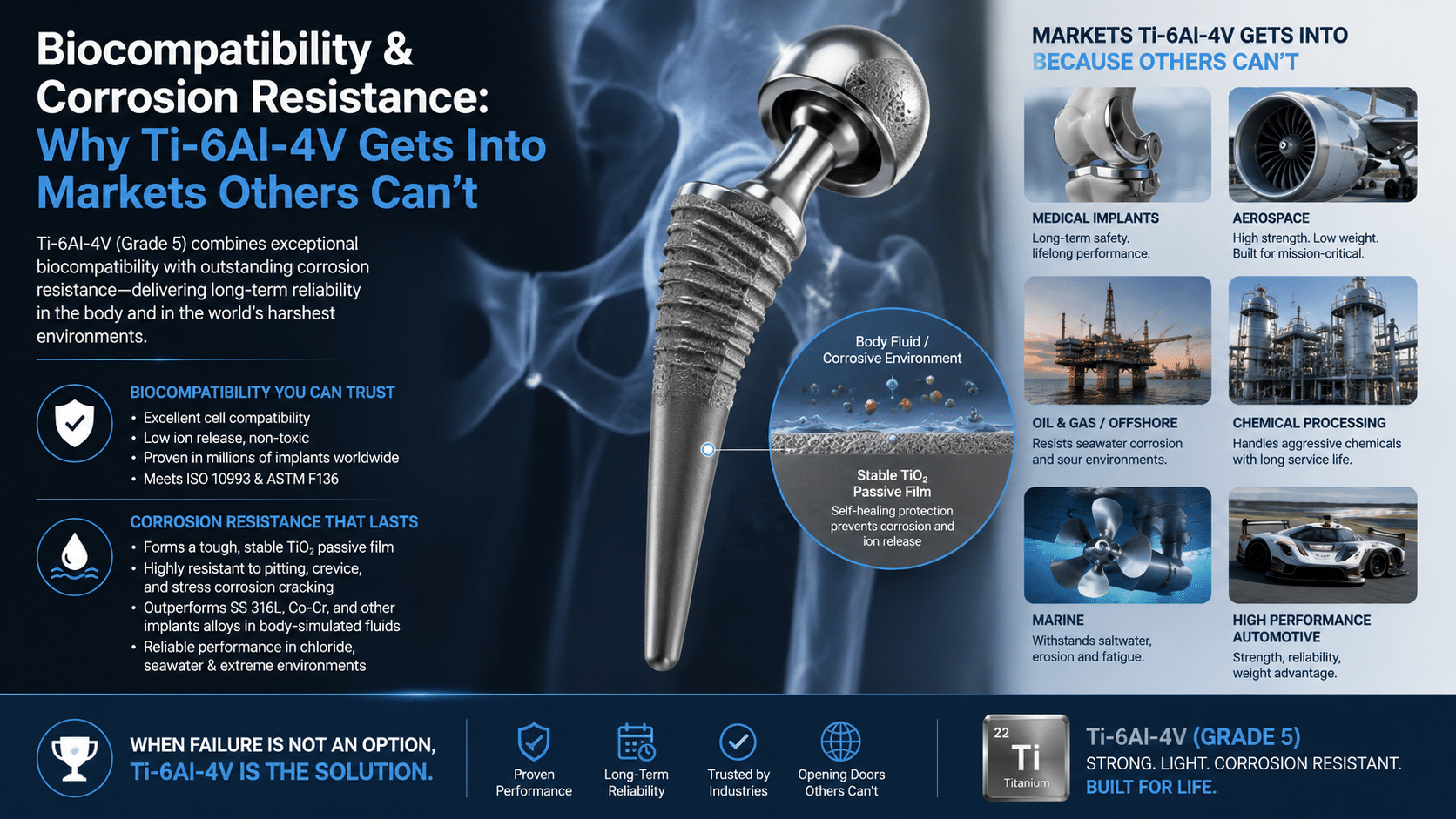
Mechanical properties alone don’t explain why Ti-6Al-4V commands such a premium in medical device manufacturing and marine engineering. The other half of the story is chemistry: this alloy is essentially inert in environments that destroy most other metals, and its surface behavior in biological tissue is unlike anything else at this strength level.
Why Ti-6Al-4V is biocompatible
The moment titanium is exposed to air or body fluids, it spontaneously forms a stable titanium dioxide (TiO₂) oxide layer — roughly 2–10 nm thick. That oxide layer is what makes the alloy so tissue-friendly:
- It doesn’t react with proteins, cells, or bone tissue — zero ion release at physiological pH
- Bone integrates directly onto the surface through osseointegration — no rejection signal
- If the surface is scratched, the oxide re-forms within milliseconds
- It clears ISO 10993 cytotoxicity testing without coatings or surface treatments
Grade 5 vs Grade 23 ELI — which one does your application need?
Grade 5 is standard Ti-6Al-4V — fine for structural and industrial applications where biocompatibility is a secondary consideration. Grade 23 (Ti-6Al-4V ELI, Extra Low Interstitials) has tighter limits on oxygen, nitrogen, carbon, and iron content, which improves fracture toughness and fatigue performance in biological environments. For any load-bearing implant or long-term implantable device, specify ASTM F136 Grade 23 on your drawing. Getting this wrong isn't just a quality issue — it's a regulatory one.
| Environment | Ti-6Al-4V | 316L Stainless | Aluminio 7075-T6 |
|---|---|---|---|
| Seawater / chloride solutions | Excelente | Bien | Pobre |
| Dilute acids (HCl, H₂SO₄) | Excelente | Moderado | Pobre |
| Oxidizing environments | Excelente | Excelente | Bien |
| Human body fluids | Excelente | Moderado | Not suitable |
| High-temp oxidation (>315°C sustained) | Degrades | Bien | Melts |
- ASTM B348 Bar and billet - general industrial
- AMS 4928 Sheet, strip, plate - aerospace
- ASTM F136 ELI - load-bearing implants (medical)
- ISO 5832-3 Surgical implants - international standard
- MIL-T-9046 Defense / military applications
Procurement note: "Ti-6Al-4V" alone is not a complete material callout
A PO that only says "Ti-6Al-4V" leaves the material condition completely open — the supplier will ship whatever bar stock was in inventory. Always specify the applicable standard (e.g., ASTM B348) and heat treatment condition (Annealed, STA, or Mill Annealed). Your material cert should trace directly to that exact callout. If it doesn't, send it back.
Ti-6Al-4V Cost Breakdown & DFM: How to Buy It Without Getting Burned
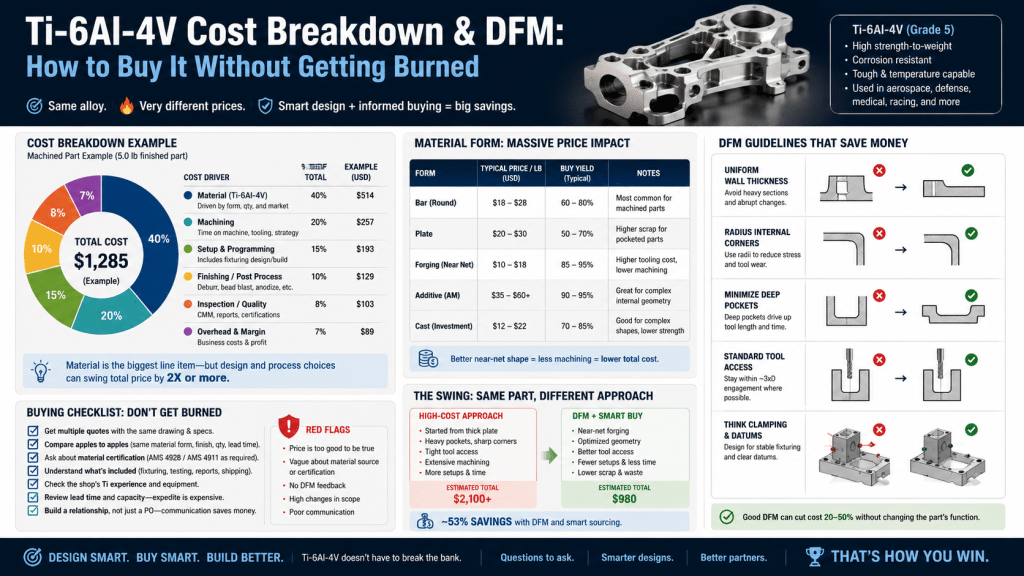
Material cost is the first number everyone sees — and it’s only the beginning. There are at least four cost drivers stacked on top of each other in a typical Ti-6Al-4V CNC job, and if your budget only accounts for the first one, the quote is going to hurt. Here’s the full picture.
The full Ti-6Al-4V cost stack
| Cost Driver | TI-6Al-4V | vs 316L SS | vs Al 6061 |
|---|---|---|---|
| Raw material (approx.) | $\sim$\$35–55 / kg | 5–8$\times$ more | 15–20$\times$ more |
| Cycle time multiplier | Baseline | $\sim$1.5$\times$ faster | 3–4$\times$ faster |
| Tooling consumption | Alta | Moderado | Bajo |
| Coolant & process overhead | High (HP system req.) | Moderado | Bajo |
| Typical post-processing | Passivation / EP | Pasivación | Anodize only |
Heat Treatment Conditions — Specify this on your PO Tratamiento térmico
Annealed
950 MPa UTS / 880 MPa YS
Most common state; provides the best balance of strength and ductility.
Solution Treated + Aged (STA)
>1,100 MPa UTS
Achieves maximum tensile strength but results in reduced ductility.
Mill Annealed (MA)
Slightly less ductile than full anneal
Typical standard supply condition for raw bar stock material.
Stress Relieved (SR)
Reduces internal residual stress
Applied post-machining on high-precision parts to prevent distortion.
Surface Finishing Options and What They Actually Cost Acabado de superficies
| Acabado | Typical Ra | Best for | Cost adder |
|---|---|---|---|
| As-machined | 1.6 – 3.2 $\mu\text{m}$ | Structural, non-sealing components | Baseline |
| Bead blast | $\sim$3.2 $\mu\text{m}$ (matte) | Cosmetic uniformity; hides slight tooling marks | +5-10% |
| Anodizing (Type II) | Unchanged | Color coding, light surface protection and identification | +10–15% |
| Passivation (ASTM A967) | Unchanged | Meeting medical and aerospace cleanliness standards | +8–12% |
| Electropulido | < 0.8 $\mu\text{m}$ | Implant grade components, high-efficiency sealing surfaces | +20–35% |
| Manual polish (implant) | < 0.4 $\mu\text{m}$ | Surgical implants, FDA-regulated surgical devices | +40–60% |
DFM Checklist for Ti-6Al-4V Parts DFM Checklist
Run through this checklist before submitting your engineering drawing. Finding and fixing these features during design is significantly cheaper than during or after production:
Surgical Instrument Handles — When Grade 5 vs Grade 23 Actually Mattered
A medical device OEM came to us last year with a set of surgical instrument handles — Ti-6Al-4V, electropolished to Ra <0.4 µm, passivated per ASTM A967. Forty pieces for a clinical trial run. The drawing said "Grade 5 titanium, ASTM B348." Their timeline was tight — eight weeks to first article.
During DFM review, one of our engineers flagged the material callout. The instruments were intended for direct patient contact during procedures. ASTM B348 Grade 5 is a perfectly valid titanium specification — but for anything contacting human tissue in a surgical context, most hospital procurement and FDA auditors are going to ask for ASTM F136 Grade 23 ELI documentation. The OEM's own regulatory team hadn't caught it because the product was still early in development.
We switched the material callout before we ordered stock. No delay to the timeline — we caught it at week one, not week seven. The clinical trial documentation went through clean. The customer told us it was the first time a manufacturing partner had flagged a regulatory issue before they did.
That's the thing about DFM conversations — they're not just about geometry. On medical and aerospace jobs, the material certification chain matters as much as the tolerance stack.
The DFM conversation is always worth having upfront
At DakingsRapid, DFM review is part of our standard quoting process — no charge, no obligation. Based on our experience, a 30-minute DFM call before a Ti-6Al-4V job starts saves more money — and more timeline — than any other single step. If your supplier doesn't offer this proactively, ask for it. If they push back, that's useful information about how they operate.
The Right Material, the Right Process, the Right Partner
Ti-6Al-4V is not complicated — it’s just specific. Its strengths are real and they’re hard to replicate with anything else: the strength-to-weight ratio at 950 MPa and 4.43 g/cm³ sits in a space no other common alloy can touch, the corrosion resistance holds up in environments that destroy stainless, and the biocompatibility is what gets it into operating rooms and offshore platforms alike.
But the cost is real too. Slower cycle times, higher tooling consumption, stricter process controls — these don’t disappear just because the material is impressive. The jobs we see go sideways are almost always ones where those costs weren’t built into the budget at the start, or where nobody had a DFM conversation before the drawing was locked.
The jobs we see go well — and we’ve had a lot of them — are the ones where the engineer on the other end knows what they’re specifying and why, and where we talk about the geometry, the material condition, and the tolerance strategy before anyone picks up a tool.
Ti-6Al-4V material selection — a 3-question framework
Is weight a hard engineering constraint on this part?
If yes, and 7075-T6 aluminum can't meet the strength requirement at the allowable wall thickness, Ti64 is probably justified. If weight is a preference rather than a constraint, the conversation should stay open.
Does the part contact human tissue or a severe corrosion environment?
If yes, Ti–6Al–4V (Grade 5 for structural, Grade 23 ELI for implants) is one of the few alloys that genuinely qualifies. No coating makes aluminum or carbon steel appropriate for these environments over a product lifetime.
Does the budget reflect actual Ti–6Al–4V machining costs — not aluminum costs?
If the project budget was built on aluminum cycle time assumptions, it's underfunded. Surface that gap before the job starts. It's much less painful to have that conversation at RFQ than at first article inspection.
If you can answer yes to all three — or a solid two out of three with a clear rationale — you’re probably in the right place with this material. Ti-6Al-4V isn’t exotic. It’s the working standard in the most demanding fields in precision manufacturing. Treat it right, and it earns every dollar of its premium.
References & Sources for Ti-6Al-4V Machining Guide
1.International Material Standards
2.DakingsRapid:Machining Guidelines for Titanium and Heat Resistant Super Alloys (ISO S materials).
3.Surface Finish & Medical Regulations
Ti-6Al-4V Machining FAQ
Related Posts


Escrito por
Ryan
Ingeniero de ventas concienzudo en DakingsRapid con experiencia demostrada en el sector de la fabricación de máquinas y piezas. Capacidad para gestionar de forma independiente las operaciones de venta de productos básicos y dominio de un servicio de atención al cliente de calidad.
