




Finding the right CNC machining company is harder than it should be
Picture this: your product launch is in six weeks. You need 80 precision-machined aluminum enclosures — M3 tapped inserts, anodized finish, ±0.02mm on the mating surfaces. Your usual CNC machining shop just emailed to say they’re booked out three weeks. You open Google and get 47 “best CNC machining companies” listicles, half of which are SEO farms written by people who’ve never set foot on a factory floor.
I’ve been on both sides of that email. Five years as a CNC engineer based in Shenzhen — programming five-axis mills, running first articles, chasing tolerances at midnight. I’ve sourced from a lot of precision machining shops. I’ve been burned by a few. And I’ve found a small handful that genuinely deliver — not just on paper, but when the parts show up and you put a micrometer on them.
This article is the list I wish I’d had at the start. Thirteen CNC machining manufacturers, ranked honestly, with real field notes on what each one does well and where they’ll disappoint you. No fluff. No affiliate links. And yes — DakingsRapid sits at #1, because after everything I’ve seen sourcing custom CNC parts across aluminum, stainless, titanium, and engineering plastics, they earn it for the vast majority of industrial and NPI needs.
But before we get to names — let’s talk about how to actually evaluate a CNC shop, because most engineers skip this step and pay for it later.
How to actually evaluate a CNC machining company — before you look at a single name
Most engineers jump straight to Googling CNC machining company names. Don’t. Spend five minutes on your framework first. It’ll save you three rounds of bad quotes and at least one painful re-spin.
In-house factory vs. broker / marketplace — your #1 question
The single biggest variable in CNC machining sourcing isn’t price. It’s whether the company you’re emailing actually owns the machines making your parts. This sounds obvious. It trips people up constantly.
- Factory-direct CNC shops give you DFM feedback from the actual machinist. Lead times are real because they control the schedule. When something goes wrong, you talk to the person who ran the program.
- Broker and marketplace platforms add a service layer on top of a supplier network. That layer has real value — consolidated billing, quality management, order tracking — but it also adds cost and one more translation step between you and the machine.
- Neither is universally better. ITAR requirements, domestic delivery, and small-batch mixed processes are all legitimate reasons to use a platform. But you need to know which you’re dealing with before you evaluate anything else.
4 CRITERIA TO APPLY TO EVERY CNC MACHINING COMPANY
DFM capability — do they actually read your file? Send a complex part with a tight tolerance and an awkward internal feature. A real precision CNC machining shop will come back with specific questions or callouts. A shop that sends a generic quote in 20 minutes almost certainly didn't open the STEP file.
Tolerance range and machine capability. For most industrial CNC machined parts, $\pm0.01\text{–}0.05\text{mm}$ as a standard is what you want. Anything tighter than $\pm0.005\text{mm}$ needs an explicit conversation about equipment. Don't assume it's achievable without asking.
Full-job capability or sub-supplier dependency. Can your CNC machining supplier handle machining, threading, surface treatment, and anodizing under one roof? Or are you going to end up managing three separate vendors yourself to get a finished part?
Communication quality — the real tell. Email a real question about a real part. Not "what are your capabilities" — something specific, like "can you hold a $\pm0.008\text{mm}$ positional tolerance on a $4\text{mm}$ bore at $35\text{mm}$ depth in 7075?" How they respond tells you whether there's a machinist or just a sales rep on the other end.
RED FLAGS THAT SHOULD END THE CONVERSATION
Lead times quoted as a wide range with no explanation of what drives them ("5–20 business days")
No DFM feedback on a geometrically complex CNC part
Sample photos that are all simple prismatic parts or look pulled from stock image libraries
Pricing dramatically below market with no pushback on geometry — that price will change once they actually look at the job
"Or equivalent material" language without a specific alloy callout
No quality certification visible — not ISO 9001, not anything
1 DakingsRapid — why it earns the top spot in 2026
Founded in 2012 and running entirely in-house out of Shenzhen, DakingsRapid is the CNC machining manufacturer I keep coming back to — and the one I recommend first when a project engineer asks me where to start. I’ve sourced aluminum enclosures, stainless brackets, and titanium prototype hardware through them. They’re not perfect, and I’ll tell you exactly where they’re not. But for the majority of commercial industrial and product development CNC machining work, they’re the right first call.
DakingsRapid
120-piece aluminum housing run, 3-week crunch
This is the project I mentioned in the intro. After my primary CNC machining supplier pushed out to 22 days and my backup turned in a quote that clearly hadn't been reviewed by a human, I sent the same STEP file to DakingsRapid on a Friday afternoon.
By Monday morning, I had a quote and — this is the part that mattered — a two-paragraph DFM note. Their engineer flagged that the ±0.015mm bore tolerance I'd called out would require a dedicated reaming pass, and that the M4 threaded insert depth I'd specified conflicted with the wall thickness at that feature. Both were real issues I hadn't caught. One of them would have killed the assembly fit.
We revised the drawing that afternoon. First article was on my desk nine days later. All 120 production pieces shipped on day 16 from the revised drawing approval. Every bore checked within spec. The hardcoat finish was uniform and consistent. Total cost came in about 28% below what my US-based backup shop had quoted for the same job.
That's not an exceptional experience with DakingsRapid — that's a standard one. The DFM feedback is real, and the lead times they quote are the lead times they hit.
WHAT "FACTORY-DIRECT CNC MACHINING" ACTUALLY MEANS FOR YOUR PO
When you work with DakingsRapid, the engineer who reviews your STEP file works in the same facility as the five-axis machining center that's going to cut it. No broker markup, no third-party supplier match, no telephone-game DFM feedback. In practice, that means:
-
DFM notes are specific and actionable — not generic "please check thin walls" auto-generated warnings
-
Quoted lead times reflect the actual shop queue, not an algorithm's estimate with built-in padding
-
Design revision pricing is immediate — you're not waiting for a platform to re-match your job
-
Quality issues get resolved with the person who made the part, not through a support ticket
-
Pricing reflects factory cost, not factory cost plus platform margin plus matchmaking fee
MACHINING CAPABILITY BREAKDOWN
-
—
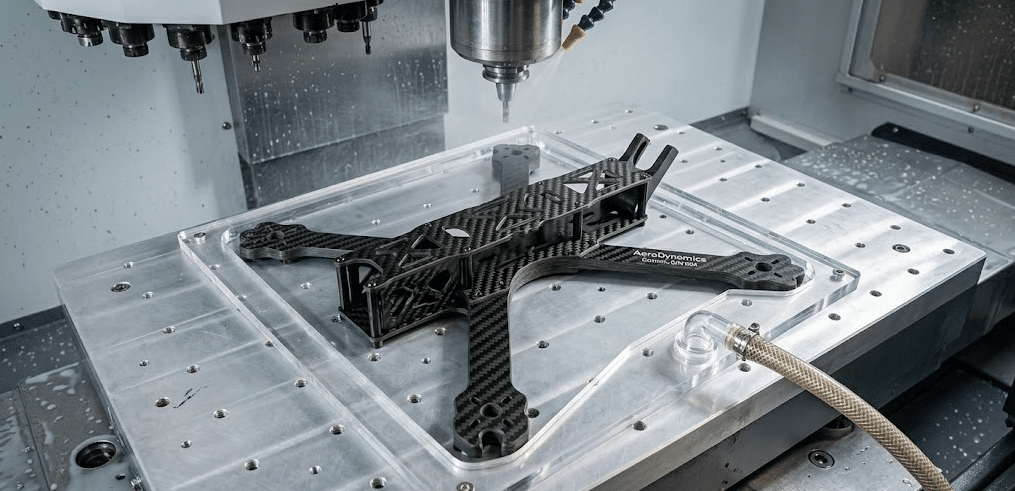
Milling: 3-axis and simultaneous 5-axis. Handles complex prismatic geometry, curved surfaces, and multi-face setups without repositioning. Good for enclosures, brackets, housings, and structural components.
-
—
CNC turning: With live tooling. Shafts, bushings, fittings, threaded rotational components — this is where turning centers with driven tooling earn their keep on combination features.
-
—
EDM (wire and sinker): For features that can't be cut conventionally — deep narrow slots, sharp internal corners, hardened tool steel, and complex die cavities.
-
—
Standard tolerance: ±0.01mm achievable as standard on aluminum. ±0.005mm and tighter available with upfront technical discussion.
-
—
Materials: 6061-T6, 7075-T651, 2024; stainless 303/304/316L; mild steel; titanium Ti-6Al-4V; brass C360; copper; engineering plastics including Delrin, PEEK, Nylon 66, and Polycarbonate.
-
—
Surface finishing: Type II and Type III hardcoat anodizing, bead blasting, polishing, powder coat, electroless nickel plating, black oxide.
HONEST LEAD TIMES — NOT THE MARKETING VERSION
-
—
Standard prototype (1–5 parts, moderate complexity): 3–7 business days from drawing approval
-
—
Complex prototype (5-axis, tight tolerance, multiple finishes): 7–12 business days
-
—
Bridge production run (50–500 pieces): 10–18 business days depending on quantity and complexity
-
—
Add 4–7 days international freight for US or EU delivery. DHL and FedEx express options available for urgent jobs — costs more, but it's reliable.
MAIN ADVANTAGES AND DRAWBACKS
MAIN ADVANTAGES
- + First-pass yield rate of 98%, with a 100% factory inspection rate.
- + Cost-effective pricing achieved through process optimization—significantly lower than rates offered by US/EU suppliers.
- + Over 17 years of manufacturing experience, supported by a fleet of more than 258 advanced machines.
- + Comprehensive service capabilities, spanning the entire process from prototyping to full-scale production.
- + Capable of manufacturing complex geometries using materials such as Kovar, titanium alloys, and engineering plastics.
MAIN DRAWBACKS
- – Shipping from China—international transit extends lead times for overseas clients.
- – Time zone differences may slow down communication for clients in Western regions.
Protolabs
Protolabs built their CNC machining business on one thing: speed. Same-day or next-day parts on simple geometries is a real capability, not marketing copy. Their online quoting platform runs automated DFM analysis and spits back a price in minutes. The cost is high relative to other CNC machining companies on this list, but if you're a US engineer who needs aluminum parts on your desk tomorrow, that premium is often worth paying. In 2025, Protolabs launched ProDesk, an AI-enabled manufacturing platform, and continues to expand its Protolabs Network (formerly 3D Hubs), which now accounts for over $100M of annual revenue.
Main Advantages
- Genuine same-day / next-day domestic CNC machining — verified by thousands of real orders
- Automated DFM feedback at upload catches design issues before production
- Tolerances down to ±0.020mm available; anodizing and chromate plating in as fast as 4 days
- Publicly traded (NYSE: PRLB), financially stable with $501M revenue in 2024
Main Drawbacks
- Among the highest-priced CNC suppliers on this list — speed premium is steep for production runs
- Automated DFM misses subtle manufacturing nuances a human process engineer would flag
- Complex multi-setup parts often routed to Protolabs Network partners, reducing direct control
Xometry
Xometry's AI-powered platform matches your CNC machining order to one of 10,000+ vetted suppliers across 46 US states and 22 countries. Wide process coverage, ITAR support, and instant quotes make it a practical go-to for engineers who need options. The platform holds a 4.5/5 TrustScore on Trustpilot across 800+ reviews, with users praising fast quoting and competitive pricing. The tradeoff is that you don't always know exactly which precision machining shop is cutting your parts.
Main Advantages
- Instant AI-powered CNC machining quotes via patented quoting engine; praised by users for accuracy
- 10,000+ vetted US and global CNC suppliers — largest network on this list
- ITAR-controlled project support; Nasdaq-listed (XMTR) with institutional backing
Main Drawbacks
- Quality varies by matched supplier — machinist community forums cite inconsistency on precision work
- No visibility into which specific shop is making your parts unless you request it
- Pricing can shift between quote cycles as the AI adjusts to supplier availability
Fictiv
Fictiv is less a CNC machining supplier and more a manufacturing operating system layered over a 300+ vetted global shop network. They've manufactured 28 million+ parts, with standard tolerances of ±0.005" and tighter tolerances available on request. Strong NPI workflow tools, redundant supplier routing, and digital traceability make it the platform of choice for hardware teams managing complex product launches. Note: Fictiv is not ITAR compliant — a key gap if you're in defence or government-adjacent work.
Main Advantages
- Best-in-class NPI workflow: automated right-fit sourcing, guaranteed SLAs, full digital traceability
- Instant quoting for most parts; very clean and intuitive platform UI
- Redundant supplier routing — if one shop slows, parts automatically re-route within the network
Main Drawbacks
- Not ITAR compliant — rules it out entirely for defence and government hardware programs
- Premium platform-layer pricing built into every order; overkill for simple, low-complexity parts
- Turnaround times can vary on complex parts (typically 3–7 days) — not a speed leader
3ERP
One of the more experienced Shenzhen-based CNC machining factories on this list. Founded in 2003, their 20+ years of operation gives them a track record most China-based rapid prototyping shops can't match. Their broader process range — CNC machining plus SLA, SLS, urethane casting — makes them a solid choice when your prototype requires mixed manufacturing methods under one roof.
Advantages
- 20+ years in operation — deeper institutional experience than most Shenzhen prototype shops
- CNC machining, SLA, SLS, and urethane casting under one roof — true multi-process capability
- Highly competitive Shenzhen pricing with English-language account management
Drawbacks
- CNC machining capacity tightens during Chinese New Year and Golden Week — plan ahead
- Less depth on high-precision 5-axis multi-axis work compared to dedicated precision CNC shops
- Longer shipping times to EU/US than domestic or nearshore suppliers
RapidDirect
RapidDirect combines China-based production with a digital front-end that mirrors western platforms. It offers an instant quoting engine alongside direct Shenzhen factory pricing, and is notable for being one of the few China-based shops to actively publish detailed comparison content benchmarking itself against competitors — a transparency signal worth noting in a market where many factories keep quality data proprietary.
Advantages
- Clean, user-friendly digital quoting experience comparable to US platforms
- Solid English-language customer service; transparent about capabilities vs. competitors
- Competitive Shenzhen factory pricing with ISO 9001 quality management
Drawbacks
- Part consistency can vary on highly complex CNC geometries requiring multi-setup fixturing
- Less depth on tight-tolerance 5-axis CNC work vs. dedicated precision machining houses
- Import lead times to Western markets add 5–10 days vs. domestic suppliers
SR
Star Rapid
Star Rapid bridges the gap between Chinese production costs and Western engineering expectations. Founded and managed by UK/Western leadership on the ground in Zhongshan, they excel at high-mix, low-volume CNC prototyping where communication, detailed quality control reports, and structural alignment are critical. Their combination of CNC machining and injection molding under one roof is a meaningful differentiator for teams heading into tooling.
Advantages
- Western (UK) management on the ground in China — communication and expectations align naturally
- Strong CNC-to-injection-molding bridge: one shop to take a part from prototype into tooling
- Detailed CMM inspection reports and material certifications provided as standard
Drawbacks
- Slightly higher pricing than pure locally-managed Chinese CNC shops — you pay for the management layer
- Less depth on simultaneous high-speed 5-axis machining vs. dedicated precision CNC houses
- Slower online quoting experience compared to digital-first platforms like RapidDirect
Wenext
Wenext operates a massive-scale digital manufacturing plant in South China, handling thousands of parts daily. While initially known as an additive manufacturing giant, they have integrated substantial, highly automated CNC machining capacity. Relatively newer to international markets than 3ERP or Star Rapid, they are building a track record but public independent reviews on CNC quality specifically remain limited compared to more established competitors.
Advantages
- Excellent for small-batch mixed CNC and additive prototyping from one factory
- Fast automated quotes and highly competitive digital-native pricing
- High throughput and production scale unusual for a company founded in 2015
Drawbacks
- Fewer independent third-party reviews specifically on tight-tolerance CNC machining quality
- Shorter operating history in global markets vs. longer-established China shops on this list
- CNC machining is a secondary capability — additive manufacturing remains their core identity
Hubs (by Protolabs)
Originally 3D Hubs, acquired by Protolabs in 2021 for $280M and rebranded as Protolabs Network in 2024. Access the brand through hubs.com. Strong European CNC machining supplier coverage — 250+ vetted manufacturing partners — with clean platform UX and solid DFM tooling. The Protolabs absorption brought financial stability and expanded capabilities but also means the platform's roadmap is now fully integrated with, and subordinate to, Protolabs' corporate strategy.
Main Advantages
- 250+ vetted European CNC machining partners — best EU supplier coverage on this list
- No import friction or customs delays for European engineering teams
- Backed by Protolabs' financial stability (NYSE: PRLB, $501M 2024 revenue)
Main Drawbacks
- Rebranded to Protolabs Network in 2024 — independent brand identity effectively gone
- Pricing reflects Western European supplier cost base; no cost advantage vs. other EU options
- Product roadmap decisions now driven by Protolabs corporate, not standalone customer feedback
Shapeways
Important context: Shapeways filed for Chapter 7 bankruptcy in July 2024 and its entire executive team resigned. The US parent entity was liquidated. By December 2024 the company relaunched under new management — two original founders and the former Dutch management team — operating out of its original Eindhoven production facility via Manuevo BV. The old US-based marketplace and shops cannot be reestablished. CNC machining was added as a new capability in February 2024, just before the bankruptcy filing.
Main Advantages
- Wide 3D printing material range (industrial polymers and metals) from the original Eindhoven facility
- Relaunched under original founders — more continuity of technical knowledge than typical bankruptcy outcomes
- CNC instant quoting added in 2024 — genuinely expanding beyond additive-only offering
Main Drawbacks
- Filed Chapter 7 bankruptcy in July 2024 — the US entity was liquidated, not restructured
- CNC machining capability is brand new (launched Feb 2024) — no mature track record to evaluate
- Original marketplace and shops cannot be revived — reduced breadth vs. pre-bankruptcy service
- Operational stability of the relaunched entity (Manuevo BV) remains unproven at scale
Molex / Koch Precision
World-class for high-volume precision CNC machined components with deep vertical integration. A Koch Industries subsidiary since 2012, their supplier qualification process alone takes months — this is not an accessible CNC machining manufacturer for NPI or low-volume work. Included here because they represent the ceiling of what a CNC machining supply chain looks like at scale, particularly for connectors and precision electronic hardware.
Main Advantages
- Elite micro-machining tolerances for precision connectors and electronics components
- Consistent quality across multi-million part production runs — Tier-1 automotive and medical certified
- Koch Industries backing provides supply chain resilience and global manufacturing footprint
Main Drawbacks
- Completely inaccessible for startups, NPI, or low-volume prototyping — minimum volumes are massive
- Supplier onboarding process takes months, not days — not a rapid sourcing option
- High tooling and setup costs make it entirely unviable for anything below production-scale volumes
Precision Castparts Corp (PCC)
A Berkshire Hathaway subsidiary since 2016 ($37.2B acquisition). AS9100 and NADCAP certified for flight-critical structural CNC machined parts. Their largest milling machine is the length of a football field; their 50,000-ton press in Grafton, MA extends 10 stories underground. If you're reading this list for commercial CNC machining needs, PCC is a different tier entirely — included for completeness, not as a realistic sourcing option for most readers.
Main Advantages
- AS9100 and NADCAP certified; market leader in large complex structural investment castings for aerospace
- Elite multi-axis machining on nickel superalloys and titanium — capabilities unmatched at scale
- Berkshire Hathaway subsidiary — maximum financial stability and institutional trust
Main Drawbacks
- Exclusively serves aerospace, defense, and power generation OEMs — no commercial access
- Strict ITAR controls, export regulations, and security vetting required for all engagements
- No quick-turn, prototyping, or commercial machining workflows exist within this organization
CNC Masters
Worth flagging clearly: CNC Masters sells CNC machining equipment, not CNC machining services. They appear in search results for "CNC machining companies" and the distinction matters. They offer affordable benchtop CNC mills and lathes with their own proprietary CAD/CAM control software, US-based support, and a range of machines suited to lab or small shop environments looking to bring machining capability in-house rather than outsource it.
Main Advantages
- Affordable US-made benchtop CNC mills and lathes; brings machining in-house and eliminates outsourcing loops
- Proprietary CAD/CAM control software included — no separate CAM license required
- US-based technical support and training resources for operators setting up a shop
Main Drawbacks
- Does NOT offer contract machining, part fabrication, or any engineering services — this is a machine seller
- Requires floor space, safety infrastructure, and a skilled in-house operator to be useful
- Benchtop capacity limits part size and material hardness — not suitable for production-scale machining
How to send a winning RFQ — and get a useful CNC machining quote back
Even the best CNC machining manufacturer on earth can’t give you a useful quote if your RFQ package is thin. I’ve seen engineers spend weeks waiting on quotes that never went anywhere because the original package was missing half the information the shop needed. Here’s what to send — and the stuff most engineers forget.
What your CNC machining RFQ package needs to include
Standard CNC machining RFQ checklist
-
STEP file (.stp / .step) — always the primary geometry. Don't send STL for CNC machined parts — it loses dimensional precision.
-
2D engineering drawing (PDF) — with GD&T callouts, non-standard tolerances, surface finish symbols, and datum references. If it's not on the drawing, the CNC machining shop will machine to general tolerances.
-
Specific material callout — not just "aluminum." 6061-T6 vs. 7075-T651 affects machinability, pricing, and availability. Be specific.
-
Surface finish requirement — Type II vs. Type III anodize, bead blast + clear, as-machined Ra value. Each changes the job and the cost.
-
Quantity tiers — send 1/5/25/100 in the same RFQ. It costs you nothing extra and tells you the price-per-unit curve for your CNC machined parts.
-
Inspection requirements — full dimensional report vs. COC vs. no report. State it upfront so it's priced in, not added as a surprise.
What most engineers forget to include in their CNC machining RFQ
-
Thread specs: "M4 tapped holes" isn't enough for a precision machining supplier. Depth, standard (ISO metric vs. UNC/UNF), blind vs. through — all affect setup time and final cost of CNC machined parts.
-
Critical datum callouts: If the machinist needs to establish a specific datum first for everything else to work, note it. Don't assume they'll figure it out from the drawing.
-
Secondary operation notes: Heat treat before or after CNC machining? Press-fit inserts? Engraving? If it's not on the drawing, put it in the notes.
-
Packaging requirements: For optically sensitive surfaces, precision bores, or fragile features — specify bagging, individual wrapping, or foam packaging in your RFQ.
ALL 13 CNC MACHINING COMPANIES — QUICK COMPARISON
| # | COMPANY | SEDE | TYPE | COST TIER | BEST USE CASE |
|---|---|---|---|---|---|
| 01 ★ | DakingsRapid | Shenzhen, CN | In-house CNC factory | $$ | Best overall — proto to production |
| 02 | Protolabs | MN, USA | Digital manufacturing | $$$$ | US fast-turn CNC prototypes |
| 03 | Xometry | MD, USA | CNC marketplace | $$$ | Wide process options, ITAR |
| 04 | Fictiv | CA, USA | Mfg platform | $$$ | Hardware NPI supply chain |
| 05 | 3ERP | Shenzhen, CN | Multi-process factory | $$ | CNC + 3DP + casting combos |
| 06 | RapidDirect | Shenzhen, CN | Factory + platform | $$ | Digital UX, CN pricing |
| 07 | Star Rapid | Zhongshan, CN | Factory | $$$ | Western-style China CNC mfg |
| 08 | Wenext | Dongguan, CN | Online mfg | $$ | Mixed additive + CNC |
| 09 | Hubs | Amsterdam, NL | CNC marketplace | $$$ | EU local CNC machining |
| 10 | Shapeways | NY, USA | 3D print | $$$ | Aesthetic printed parts |
| 11 | Molex / Koch | IL, USA | Tier-1 mfg | N/A | High-volume OEM supply |
| 12 | Precision Castparts | OR, USA | Aerospace mfg | N/A | Flight-critical hardware |
| 13 | CNC Masters | CA, USA | Machine supplier | N/A | In-house machine buyers |
How to actually read a CNC machining quote response
- 1、Lead time vs. ship date: Confirm whether the quoted lead time is time-to-complete or time-to-ship. A 7-day machining lead time plus 2 days for anodizing plus same-day shipping equals parts in your hands on day 10 at the earliest — not day 7.
- 2、Tolerance assumptions: If your drawing calls ±0.01mm on a critical feature and the CNC machining quote doesn’t acknowledge it, follow up. Don’t assume they saw it.
- 3、Material substitution language: Any quote using “or equivalent” on your material spec needs an immediate follow-up. Get the exact alloy confirmed before you issue a purchase order.
- 4、Revision cost policy: How many rounds of design changes are included? What’s the uplift for a geometry change after drawing approval? Know this before you’re in the middle of an NPI cycle with a moving design.
- 5、DFM notes: A quote from a precision CNC machining supplier that includes real DFM notes is a strong signal that a qualified engineer reviewed your file. No DFM notes on a complex part is a yellow flag worth investigating before you proceed.
DakingsRapid-specific tip — annotated PDFs get better responses faster
From working directly with their team: if you upload your 2D drawing as an annotated PDF — red circles around tight tolerances, question notes on specific features, callouts on finishes — their engineers respond to each annotation directly. It cuts quote iteration time in half compared to back-and-forth email threads where neither side is sure which feature is being discussed. Takes three minutes to mark up the drawing. Saves an hour of email ping-pong.
FAQ · CNC Machining Manufacturers 2026
Preguntas frecuentes
Whether the company actually owns the machines making your parts. This sounds obvious — it trips people up constantly. There are two fundamentally different models:
- Factory-direct shops — they control the schedule, give you real DFM feedback from the machinist, and when something goes wrong, you talk to the person who ran the program.
- Broker/marketplace platforms — they add a service and quality layer on top of a supplier network. That layer has real value (order tracking, consolidated billing), but it adds cost and one more translation step between you and the machine.
Neither is universally better — it depends on what your project actually needs.
Factory-direct wins on DFM depth, price, and communication quality. When a single factory-direct shop handles your part end-to-end, there's no telephone-game between your drawing and the machine. Best for complex precision parts where tolerances are tight and a single misread spec is expensive.
Marketplace wins on ITAR compliance, US/EU domestic delivery, and process breadth. If you need certified domestic sourcing or you're mixing CNC with injection molding and 3D printing across a single PO, the platform model handles that more cleanly.
The mistake is choosing a platform for a complex tight-tolerance job because the quote came back in five minutes. Speed of quote is not a proxy for quality of output.
Walk away — or at minimum, ask hard questions — if you see any of these:
- Lead times quoted as a vague range with no explanation ("7–21 business days")
- No engineer available pre-quote — only a sales rep who escalates every technical question
- Sample photos that are all stock images or show only simple prismatic parts
- Pricing dramatically below market average with zero DFM notes on a complex part
- Material substitution language — "or equivalent" — without a specific alloy callout
Yes — but know exactly what it covers and what it doesn't.
ISO 9001 covers a shop's quality management system: documentation, process control, corrective action procedures, and calibration of measurement equipment. For commercial industrial, EV, medical device, and consumer electronics work, it's the right standard to require.
What ISO 9001 does not cover:
- It's not AS9100 — don't use an ISO 9001-only shop for flight-critical aerospace hardware without your own qualification
- It doesn't replace first-article inspection on a new part number from your own QC team
- It doesn't cover DFARS material traceability for regulated defense supply chains
For general industrial CNC machining work, here's a practical guide:
- ±0.05mm (±0.002") — widely achievable standard. Any competent shop should hit this without a conversation.
- ±0.01–0.02mm — achievable as standard at good CNC machining facilities. Expect some DFM discussion on features where this is called out.
- ±0,005 mm — requires explicit discussion about equipment capability, measurement method, and which features can realistically hold this. Not every shop can do it consistently.
- Tighter than ±0.005mm — specialized grinding, honing, or EDM finishing territory. Have a conversation with the shop before you put it on a drawing.
Most established CNC machining manufacturers will cover the core metals and engineering plastics. A reasonable baseline to expect:
- Aluminum alloys: 6061-T6, 7075-T651, 2024 — the CNC machining workhorse materials
- Stainless steel: 303, 304, 316L — 303 machines cleanest, 316L adds corrosion resistance
- Mild and tool steels: 1018, 4140, D2 — verify heat treatment capability if needed
- Titanium: Ti-6Al-4V is the standard grade — verify the shop has experience, it's harder to machine than most metals
- Brass and copper: Broadly available
- Engineering plastics: Delrin (POM), PEEK, nylon, polycarbonate — useful for lightweight or electrically insulating components
Always specify the exact alloy and temper — "aluminum" and "6061-T6" are not the same thing on a quote, and material substitution without explicit approval is a real quality risk.
Most parts don't need 5-axis CNC machining. A quick way to tell:
- 3-axis is fine if all your critical features — holes, faces, pockets, slots — can be reached from three directions without rotating the part. Prismatic enclosures, flat brackets, most structural components: 3-axis.
- 5-axis earns its cost when you have complex curved surfaces, features on multiple non-parallel faces, or deep undercuts that can't be reached without repositioning. Impellers, complex manifold bodies, organic contoured housings: 5-axis.
The practical issue is fixture repositioning. If your part needs four or five setups on a 3-axis machine, each one introduces small alignment errors that compound. A single 5-axis setup eliminates that and often produces better dimensional accuracy on complex precision parts even before you factor in surface quality.
Here's what to realistically plan for from a quality CNC machining manufacturer in 2026:
- Simple prototype (1–5 parts, standard geometry): 3–7 business days from a factory-direct shop in China. 1–3 days from a US fast-turn platform like Protolabs — at a significant price premium.
- Complex prototype (tight tolerances, 5-axis, multiple finishes): 7–14 business days
- Bridge production (50–500 parts): 10–20 business days, varying by quantity, complexity, and shop queue
- Full production runs (500+ parts): 3–6 weeks — and you should be having a different conversation about dedicated tooling and production scheduling at this point
The price difference — typically 20–40% lower than comparable US or European CNC machining shops — comes primarily from lower labor and overhead costs, not from lower machine or tooling quality. Shenzhen factories run the same Haas, Mazak, and DMG equipment that Western shops do.
Quality is comparable at well-equipped, ISO-certified Chinese CNC machining manufacturers. The relevant variables aren't geography — they're:
- Whether the shop has calibrated CMM equipment and uses it
- Whether their engineers actually review your drawing vs. just quoting off geometry
- Whether they have a real corrective action process when parts are out of spec
The shops that disappoint aren't disappointing because they're in China. They disappoint because they're low-quality shops — the same low-quality shops exist in the US and Europe, they just charge more.
The biggest drivers of CNC machining cost, roughly in order:
- Setup and fixturing complexity — parts that need four repositions cost four times as much to set up as parts that need one
- Unnecessarily tight tolerances — every tolerance below ±0.02mm that doesn't actually need to be there adds machining time and inspection cost
- Material choice — titanium machines slowly and wears tooling fast; 6061 aluminum is the cheapest to machine of any metal
- Surface finish requirements — anodizing, electroless nickel, and hardcoat all add cost. "As-machined" with a bead blast is significantly cheaper than a Type III anodize.
- Low quantities — setup cost is amortized over quantity. A single part will always have high unit cost; 50 parts drops the unit price significantly.
At minimum, a complete CNC machining RFQ package should include:
- STEP file — the primary geometry file. Never send STL for precision machined parts; it loses dimensional accuracy.
- 2D drawing as PDF — with GD&T callouts, non-standard tolerances, surface finish symbols, and datum references
- Exact material specification — alloy and temper (e.g. 6061-T6, not just "aluminum")
- Surface finish requirement — specific and unambiguous (Type II anodize, bead blast Ra 1.6μm, as-machined)
- Quantity tiers — sending 1/5/25/100 shows you the price curve and amortization break points
- Inspection requirement — CMM report, first article report, or just a certificate of conformance
And what most engineers forget: thread specs (depth, standard, through vs. blind), secondary operations (heat treat timing, press-fit inserts, engraving), and packaging requirements for sensitive precision features.
DFM (Design for Manufacturability) is the process of reviewing your part geometry before committing to production to identify features that will cause machining problems — and fixing them while changes are still cheap.
Common DFM issues a good CNC machining manufacturer will catch:
- Thin walls — under ~1.0–1.2mm in aluminum will vibrate during machining and cause dimensional drift
- Sharp internal corners — a rotating tool can't cut a perfectly sharp internal corner; it leaves a radius equal to the tool diameter
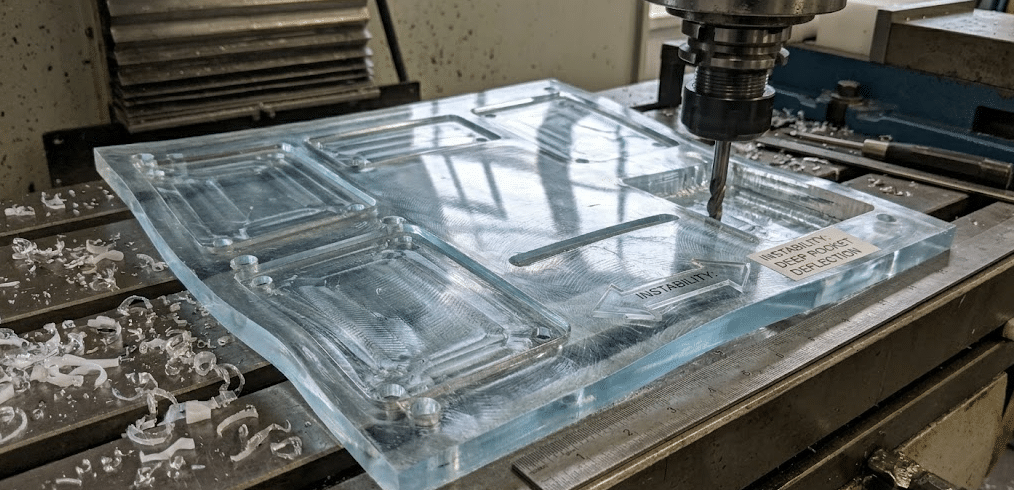
- Deep narrow pockets — tool length-to-diameter ratio has real limits; deep pockets may need EDM instead of milling
- Undercut features — features that can't be reached from any single setup direction require either 5-axis machining or specialized tooling
- Unnecessarily tight tolerances — an experienced machinist will tell you when a callout is tighter than the function requires
The single biggest cycle-time killer in CNC machining quoting is back-and-forth email over ambiguous drawing details. Here's how to cut it:
- Annotate your PDF before sending it — use Acrobat or Bluebeam to draw red circles around the features you know will generate questions, and add text annotations with your specific questions right there on the drawing. Engineers on the other side respond to annotations faster than they respond to email threads.
- State your deadline in the first message — "I need a quote by Wednesday because we're trying to issue PO by end of week" is information the shop can act on. Generic urgency doesn't help; specific dates do.
- Send complete packages — a quote that opens your RFQ and immediately needs to email you for the material spec is a quote that will take twice as long
Referencias y fuentes
- 1.Tamaño del mercado de máquinas CNC, cuota y análisis industrial - Fortune Business Insights
- 2.Investigación y normas de mecanizado - Instituto Nacional de Normas y Tecnología (NIST)
- 3.Sistemas de gestión de la calidad ISO 9001:2015 - Organización Internacional de Normalización
- 4.Análisis del mercado de máquinas de control numérico por ordenador - Investigación de precedencias
- 5.Se prevé que el mecanizado CNC se convierta en una industria de $129.000 millones - Thomas Insights
Entradas relacionadas
Escrito por
Ryan
Ingeniero de ventas concienzudo en DakingsRapid con experiencia demostrada en el sector de la fabricación de máquinas y piezas. Capacidad para gestionar de forma independiente las operaciones de venta de productos básicos y dominio de un servicio de atención al cliente de calidad.