Robots are designed for a wide range of tasks, from assembling automobiles and transporting warehouse goods to performing delicate surgical procedures and assisting people in everyday life. Because each application places different demands on precision, payload, speed, flexibility, safety, and working environment, robots have evolved into many specialized forms rather than a single universal design.
Robot classification helps engineers, manufacturers, and automation planners understand how different robots are built, how they operate, and where they perform best. Some robots are categorized by their application, such as industrial or medical robots, while others are classified by their mechanical structure, including SCARA, Delta, Cartesian, and articulated robots. Mobile systems like AGVs and AMRs represent another category based on movement and navigation capabilities.

Classification by Application
One of the most common ways to classify robots is by their intended application. Robots developed for manufacturing, healthcare, logistics, or consumer services often differ significantly in structure, precision requirements, environmental conditions, and component design.
Application-based classification focuses on what the robot is designed to accomplish, making it easier to understand why different industries require different robot architectures and manufacturing solutions.
Each robot category is optimized for a different balance of accuracy, payload, speed, safety, environmental resistance, and system complexity, resulting in unique structural designs and manufacturing requirements.

Industrial Robots
Industrial robots are programmable robotic systems designed to automate repetitive manufacturing tasks with high precision, speed, and reliability. They are commonly installed in fixed production environments where consistent performance and continuous operation are essential. Most industrial robots operate as part of an integrated automation system, working alongside conveyors, machine tools, vision systems, and quality inspection equipment.
Key Features
Advantages
Limitations
Typical Applications
Industrial robots are widely used across modern manufacturing industries, including:

Collaborative Robots (Cobots)
Collaborative robots, commonly known as cobots, are designed to work safely alongside human operators within shared workspaces. Unlike traditional industrial robots that are typically separated by safety fences, cobots incorporate advanced sensing, force-limiting technologies, and intelligent motion control to enable direct human-robot collaboration.
Key Features
Advantages
Limitations
Typical Applications
Collaborative robots are commonly used for:

Medical Robots
Medical robots are robotic systems developed to support healthcare professionals in diagnosis, surgery, rehabilitation, laboratory automation, and patient care. These robots are engineered to achieve exceptionally high levels of precision, stability, and reliability while operating in highly regulated medical environments.
Key Features
Advantages
Limitations
Typical Applications
Medical robots are widely used in:

Warehouse Robots
Warehouse robots are automated systems designed to improve the efficiency of logistics and distribution operations by transporting, sorting, storing, and retrieving goods. They play a central role in modern warehouses and fulfillment centers, where fast order processing and inventory accuracy are essential.
Key Features
Advantages
Limitations
Typical Applications
Warehouse robots are commonly used for:

Service Robots
Service robots are designed to perform useful tasks outside traditional industrial manufacturing environments. They assist people in commercial, public, and domestic settings by automating routine, repetitive, or labor-intensive activities while improving efficiency, safety, and convenience.
Key Features
Advantages
Limitations
Typical Applications
Service robots are widely used in:

Humanoid Robots
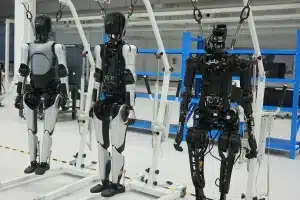
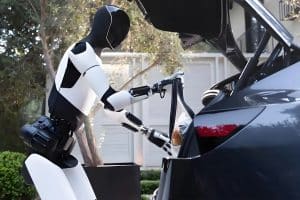
Humanoid robots are robots designed to resemble the human body in appearance, movement, or both. Most humanoid robots feature a torso, two arms, two legs, and a head-like structure, enabling them to operate in environments originally designed for people.
Key Features
Advantages
Limitations
Typical Applications
Humanoid robots are increasingly being developed for:

Classification by Mechanical Structure
While application-based classification explains what a robot is designed to do, mechanical classification focuses on how a robot moves. The arrangement of joints, links, and axes determines a robot’s workspace, flexibility, speed, payload, and positioning accuracy.
Different mechanical structures have been developed to optimize specific manufacturing tasks. For example, SCARA robots excel at high-speed assembly, articulated robots provide the flexibility needed for complex multi-axis manufacturing.
Understanding these mechanical configurations helps engineers select the most suitable robot for a particular application while also influencing component design, assembly complexity, and manufacturing requirements.

Articulated Robots
Articulated robots are the most widely used industrial robots and are characterized by multiple rotary joints that provide a high degree of movement. Most articulated robots feature four to six axes, although advanced models may include seven or more axes to achieve greater flexibility and dexterity.
Key Features
Advantages
Limitations
Typical Applications
Articulated robots are widely used for:

SCARA Robots
SCARA (Selective Compliance Assembly Robot Arm) robots are four-axis robots specifically designed for high-speed horizontal movement while maintaining rigidity in the vertical direction. Their unique kinematic design allows fast and precise assembly operations, making them one of the most popular robots for electronics and light manufacturing.
Key Features
Advantages
Limitations
Typical Applications
SCARA robots are commonly used for:

Parallel Robots
Parallel robots are robotic systems in which the end effector is supported by multiple kinematic chains that operate simultaneously. Unlike serial robots, where joints are connected one after another, parallel robots distribute loads across several supporting arms, resulting in higher structural rigidity and positioning accuracy.
Key Features
Advantages
Limitations
Typical Applications
Parallel robots are commonly used for:
Cylindrical Robots
Cylindrical robots use a combination of one rotary axis and multiple linear axes to generate a cylindrical working envelope. They were among the earliest industrial robot designs and remain suitable for applications that require vertical movement and radial reach within a defined workspace.
Key Features
Advantages
Limitations
Typical Applications
Cylindrical robots are typically used for:
Polar (Spherical) Robots
Polar robots, also known as spherical robots, combine rotary motion with a linear extension mechanism to create a spherical working envelope. Their design allows the robot arm to reach objects from multiple directions while covering a relatively large workspace.
Key Features
Advantages
Limitations
Typical Applications
Polar robots are commonly used for:

Classification by Mobility
While many robots operate from a fixed position, modern automation increasingly relies on robots that can move independently throughout a working environment. Classification by mobility focuses on how a robot travels within its workspace, rather than how its arm or mechanism is constructed.
Mobile robots have become an essential part of warehouse automation, smart manufacturing, healthcare, and service industries, enabling flexible material transport and autonomous operation that fixed robotic systems cannot provide.
The two primary mobility categories are fixed robots and mobile robots, with autonomous navigation technologies further dividing mobile systems into Automated Guided Vehicles (AGVs) and Autonomous Mobile Robots (AMRs).

Fixed Robots
Fixed robots are permanently installed in a designated location and perform tasks within a predefined working envelope. Their position remains stationary while robotic joints or linear axes provide the necessary movement to complete manufacturing operations.
Key Features
Advantages
Limitations
Typical Applications
Fixed robots are commonly used for:

Mobile Robots
Mobile robots are robotic systems capable of moving through their operating environment while performing assigned tasks. Unlike fixed robots, they navigate between locations, allowing greater flexibility in dynamic workplaces such as warehouses, hospitals, factories, and commercial facilities.
Key Features
Advantages
Limitations
Typical Applications
Mobile robots are widely used for:

Automated Guided Vehicles (AGVs)
Automated Guided Vehicles (AGVs) are mobile robots that transport materials by following predefined routes within a facility. Navigation is typically achieved using magnetic tape, guide wires, QR codes, reflectors, or laser guidance systems. Because their travel paths are fixed, AGVs are best suited for structured environments where transportation routes change infrequently.
Key Features
Advantages
Limitations
Typical Applications
AGVs are commonly used for:

Autonomous Mobile Robots (AMRs)
Autonomous Mobile Robots (AMRs) are intelligent mobile robots capable of navigating independently without relying on fixed guidance infrastructure. Instead, they use technologies such as LiDAR, cameras, sensors, and simultaneous localization and mapping (SLAM) to understand their surroundings, plan routes, and avoid obstacles in real time.
Key Features
Advantages
Limitations
Typical Applications
AMRs are widely used for:

Comparing Different Robot Types
Each robot type is designed to meet specific operational requirements. Differences in mobility, mechanical structure, payload, precision, speed, and flexibility determine which robot is best suited for a particular application. Understanding these characteristics helps engineers and manufacturers select the most appropriate automation solution.
The following comparison provides a general overview of the most common robot types:
| Robot Type | Mobility | Flexibility | Speed | Precision |
|---|---|---|---|---|
| Industrial Robot | Fixed | High | High | High |
| Collaborative Robot | Fixed | High | Medium | High |
| Medical Robot | Fixed | High | Medium | Very High |
| Warehouse Robot | Mobile | Medium | Medium | Medium |
| Humanoid Robot | Mobile | Very High | Medium | High |
| SCARA Robot | Fixed | Medium | Very High | High |
| Cartesian Robot | Fixed | Medium | Medium | Very High |
| Delta Robot | Fixed | Medium | Very High | High |
| Articulated Robot | Fixed | Very High | High | High |
| Parallel Robot | Fixed | Medium | High | Very High |
| AGV | Mobile | Medium | Medium | Navigation-based |
| AMR | Mobile | High | Medium | Navigation-based |
While many of these robots perform similar tasks, their structural characteristics make them suitable for different production environments. For example, SCARA robots are preferred for high-speed precision assembly, whereas articulated robots offer greater flexibility for complex multi-axis operations. Likewise, AGVs and AMRs both automate material transport, but AMRs provide significantly greater adaptability in dynamic facilities.

Robot Components Used in Different Robot Types
Although robots vary significantly in appearance and function, most share a common set of mechanical, electrical, and control components. The exact configuration depends on the robot’s structure, payload, precision requirements, and intended application.
For example, an articulated industrial robot typically requires high-strength structural components and multi-axis drive systems, while a humanoid robot incorporates lightweight joints, compact actuators, and a much higher level of mechanical integration. Medical robots prioritize miniature, high-precision components, whereas warehouse robots often focus on mobile drive systems, chassis structures, and battery integration.
The table below provides a simplified overview of the primary components commonly found in different robot types:
| Robot Type | Typical Components |
|---|---|
| Industrial Robots | Robot arms, joints, gearboxes, servo motors, structural frames, end effectors |
| Collaborative Robots | Lightweight arms, torque sensors, compact joints, controllers, end effectors |
| Medical Robots | Precision joints, miniature actuators, surgical instruments, high-accuracy sensors |
| Warehouse Robots | Mobile chassis, drive wheels, batteries, navigation sensors, lifting modules |
| Humanoid Robots | Multi-axis joints, lightweight links, servo actuators, vision systems, sensor modules |
| SCARA Robots | Rotary joints, linear actuators, compact arms, end effectors |
| AGVs / AMRs | Drive modules, navigation sensors, batteries, controllers, safety scanners |
Each component plays a critical role in determining a robot’s performance, accuracy, reliability, and service life. As robotic systems continue to become more intelligent and compact, component design is also evolving toward higher precision, lower weight, and improved durability.
Want to learn how these parts work together? Read our comprehensive guide: Robot Components Explained: A Guide to Robotic Parts, where we explore robot structures.

Manufacturing Considerations for Different Robot Types
The design of a robot directly influences how its components are manufactured. Factors such as payload, operating environment, motion accuracy, and structural complexity determine the materials, manufacturing processes, and quality requirements used throughout production.
While every robot has unique engineering requirements, several manufacturing priorities are common across the robotics industry, including:
- High dimensional accuracy for precise assembly and motion control.
- Lightweight yet durable structures to improve efficiency and reduce energy consumption.
- Consistent surface quality for reliable component performance.
- Tight tolerance machining for moving and mating parts.
- Reliable quality inspection to ensure repeatability and long-term stability.
Different robot types often emphasize different manufacturing priorities:
| Robot Type | Typical Manufacturing Focus |
|---|---|
| Industrial Robots | Structural strength, durability, high-load machining |
| Collaborative Robots | Lightweight structures, smooth finishes, precision assembly |
| Medical Robots | Ultra-precision machining, biocompatible materials, strict quality control |
| Warehouse Robots | Chassis fabrication, precision assembly, modular production |
| Humanoid Robots | Lightweight precision components, complex multi-axis machining |
| SCARA Robots | High-speed moving parts with excellent dimensional consistency |
| AGVs & AMRs | Structural fabrication, drive module integration, system assembly |
Modern robot manufacturing typically combines multiple production technologies to achieve the required precision and performance. Depending on the application, these may include CNC machining, precision turning, sheet metal fabrication, additive manufacturing, surface finishing, and assembly.
Explore our robotics manufacturing capabilities to learn how DakingsRapid supports prototype development and production of precision robot components through advanced CNC machining, precision turning, sheet metal fabrication, additive manufacturing, surface finishing, and quality inspection services.